threshold cover

Decision Fatigue or Threshold Blindness? Identifying Your Internal Gaps

imagesReading Time: 8 mins #

disclosure line icon vector This post may contain affiliate links.

I almost didn’t take the call.


The call hit my screen. It interrupted a project that felt urgent but was actually a distraction. I looked at the name, calculated the cost of the disruption, and hesitated. Two rings. That delay wasn’t a choice; it was a glitch in my system, a failure to recognize the moment for what it was. If I had let it ring a third time, the window would have slammed shut, and three years of growth would have stayed in the “what-if“ pile. The threshold wasn’t the call itself. It was the moment I realized I was letting it pass.

The echoes of those two rings stayed with me.


I don’t look back at that call with gratitude. I look at it with the cold unease of someone who knows how thin the margin really was. One more ring. That is all it would have taken to send it to voicemail and lose the next three years to a different trajectory. That pivot point didn’t look like an opportunity. It looked like a nuisance.


That is the trap. These junctions do not show up with a neon sign or a drumroll. They arrive as noise. They present as the very thing you are trying to ignore so you can get back to your “urgent“ work.

What is a “Threshold”

The word carries specific weight and appears in three places that actually matter.


In neuroscience, it’s the spark. The minimum hit required to make a nerve fire. Below that line, you get nothing. Above it, you get the signal. It’s not a slow slide—it’s binary.


In business, it’s where the math breaks. You’re a startup until your revenue reaches a certain threshold, and then your company’s entire operating system has to change. The number itself is just a marker—the structural shift that follows is the only thing that’s real.

In the rest of your life, a threshold is just the edge. A career move you’ve been putting off. A conversation that would change the trajectory of a relationship but requires a kind of honesty you aren’t ready to pay yet. It’s the moment before the moment.


The pattern here is absolute. A hard line, a binary outcome, and a window that closes whether you’re ready for it or not. If you spend that window running the math on the decision, you’ve already missed the closing. The decision is secondary. Recognizing the window is the only part that matters.

The Inventory of Closed Doors

Relationship breaking points are ghosts. You do not see them closing until you are already standing on the wrong side of the door.


I had a friendship back in 2019 that had been running on fumes for years. We were operating on pure inertia, not connection. I knew what needed to be said to save the thing or kill it, but I was afraid of the friction. So I deferred. I kept the surface smooth. I told myself I was being diplomatic, but I was buying time I did not actually have.


The friendship died anyway. It did not end with a clean cut; it just withered into nothing, producing the exact outcome I had spent two years trying to avoid. Honesty would have provided a repair option or a clean ending. My deferral provided neither; it left me with a permanent absence and no evidence to explain why the void existed.

threshold: The Unclaimed Sea
[The Unclaimed Seat | moneycatzzz.com]

Daniel Kahneman identified the trap. In Thinking, Fast and Slow, he maps the most expensive mistake you will ever make: we systematically overvalue the pain of doing the hard thing and ignore the cost of doing nothing. The difficult conversation feels like a tax you cannot afford in the moment, but the years of “what-if“ you carry afterward are the real debt. Failure is cheap because it provides the evidence you can actually use.


Hesitation is the most expensive thing you can buy because it leaves a hole in your history that can’t be filled.

The Career Calculation That Doesn’t Work

Career thresholds are almost always buried in risk assessments, and that’s exactly why we miss them. You treat the moment like a math problem, but you’re using the wrong equation.


The 2017 Recollection

Back in 2017, I received an offer that was a total outlier: a new market with a new team, and a sector I only knew from the periphery. I spent three weeks building a decision matrix, stress-tested the financials, and ran every simulation I could think of. I ultimately passed because the risk profile did not fit the box I had drawn for myself. The company went on to dominate that sector for the next four years.


The loss wasn’t about bad data. My internal blueprint was a closed system. It demanded reasons to stay inside the lines, and I was an expert at manufacturing them. That was the cost of the illusion of control. I traded four years of market dominance for the temporary safety of a decision matrix.

The only lens that holds up here is Taleb’s, Black Swan. High-impact events aren’t supposed to fit into your risk matrix. They are supposed to shatter it. The real junction isn’t the opportunity that looks correct on paper; it is the one that triggers visceral hesitation because the outcome defies quantification. Analysis is just a stall tactic. That window stays open on its own schedule, and if you are still running the math when it closes, you have already made your choice.

Recognizing the Moment Before It Closes

Recognizing a window before it slams shut isn’t something you learn from a book. It’s a callous you earn by missing the moment enough times to know exactly what the silence feels like after it’s gone.


I’ve learned to track the “phenomenology“ of a threshold by the way it disrupts my internal signal. It doesn’t feel like excitement. It feels like a sudden, sharp clarity; a high-frequency signal cutting through the static of your day. The surrounding noise drops away, and you’re left with a choice that feels objectively different from the usual “to-do“ list items.


The tell is the deferral pull. When the urge to wait becomes louder than the situation warrants, you aren’t being careful. You are standing at a junction. You are trying to negotiate with a reality that has already shifted.

The hesitation you feel is not a lack of data; it is a signal of the stakes. Your mind senses the existential weight before your risk-assessment models even boot up. The analysis is just a defense; a story you weave to stay comfortable while the opportunity expires.


I have stopped treating hesitation as a reason to wait. It is a diagnostic. When the pull hits, I ask one question: “What is the missing piece of information?“ If it is actionable, I hunt it down. If the answer is “certainty,“ I move. Certainty is a hallucination. It never appears, and the window closes regardless of whether you have captured it.

threshold: Obsidian Surface
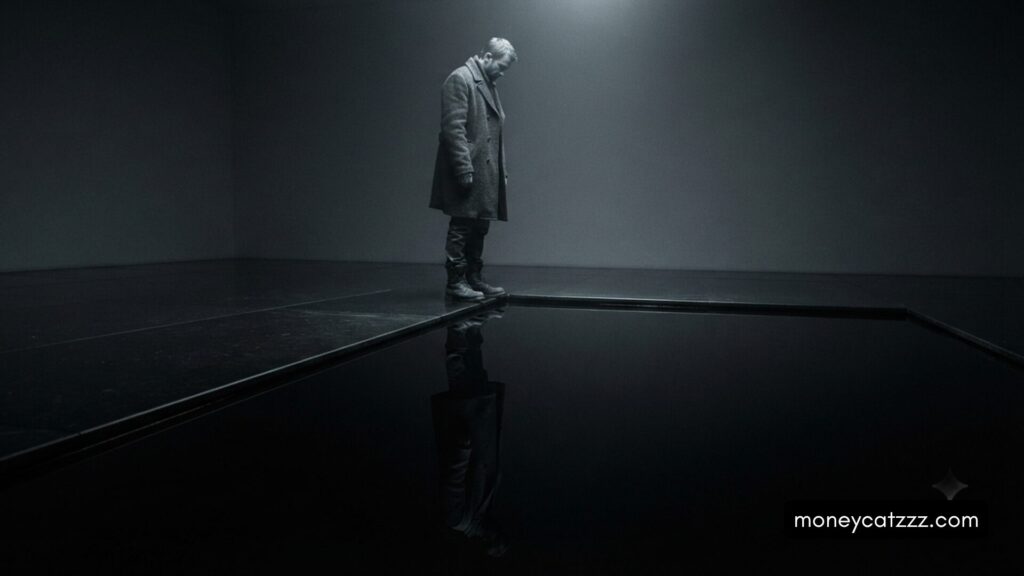
[The Reflection in the Obsidian Surface | moneycatzzz.com]

The Permanent Silence

The research on regret is consistent, even if people despise the admission. We do not regret the swings that missed; we regret the ones we were too paralyzed to take. A failed attempt is just data; a pivot, a calibration for the next move. It is recoverable. The junction you refuse to cross is not a miscalculation. It is a permanent silence.


The grief isn’t for the outcome. You never reached for it. The grief is for the insight; the missing information that stayed locked in the void because you didn’t act. You’ve carved a gap into your own history that no amount of rationalization can backfill. The window has shut; the insight was lost with it.


I am not advocating for recklessness. Analysis has its place. But you must be honest about the trade. When you defer, you are not waiting for a “better“ set of facts. You are trading the cost of an active decision for the cost of a permanent gap. Sometimes that trade is necessary, but ensure you are the one choosing it, not your fear.

That call? I nearly missed it by two rings. I thought I was being careful; I was merely waiting for a comfort that was never coming. The window was not days wide; it was seconds wide.


A fanfare will not announce the next one. It will likely look like a nuisance. It will most probably feel like an interruption. The deferral pull will arrive exactly on time, whispering that you need more time, more data, more safety.


That pull is your signal.


Move.

____________________________________________

Reading Suggestion: Deciphering the Patterns of Human Stagnation

61NFGAAbwlL. AC UY218


The Black Swans

by Nassim Nicholas Taleb

Amazon Button

71Zp0t4sG0L. AC UY218


Learned Optimism

by Martin Seligman

Amazon Button

61fdrEuPJwL. AC UY218 1


Thinking, Fast and Slow

by Daniel Kahneman

Amazon Button

Disclosure: This post may contain affiliate links. We only recommend products we believe in, and we may receive a commission at no cost to you! Thank you for your support!

Acknowledgment: Cover Image by moneycatzzz.com

Disclaimer: The information is provided for general information only – moneycatzzz.com makes no representations or warranties in relation to the information, including but not limited to any representation or warranty as to the fitness for any particular purpose of the information to the fullest extent permitted by law. While every effort has been made to ensure that the information provided in this article is accurate, reliable, and complete as of the time of writing, the information provided in this article should not be relied upon to make any financial, investment, real estate or legal decisions. Additionally, the information should not substitute advice from a trained professional who can take into account your personal facts and circumstances, and we accept no liability if you use the information to form decisions.

Signup to our Newsletter for regular updates: