
 Reading Time: 8 mins #
 This post may contain affiliate links.
The book had been on my nightstand for three weeks.
I was reading it, but I couldn’t stop annotating it. Every paragraph had a note in the margin. Every page raised a new question. I had filled two yellow sticky notes with cross-references to things I’d read six months back, drawn arrows between loosely connected ideas, and built a dense secondary text running parallel to the actual page.
At some point, I looked up and realized I had no idea what the book was actually about anymore. I possessed the commentary. I had lost the story.
I do this with my life, too.
A coincidence arrives: a chance meeting, an unexpected phone call, or a name appearing twice in twenty-four hours, and my brain boots up immediately. And yes, that car registration number everywhere. What does it mean? Why now? What is the pattern? I have been treating my existence like a complex text that requires constant interpretation. The annotations have become so dense that I can no longer see the page underneath them.
The signs themselves don’t cause the strain of looking for signs. It’s driven by the compulsive, continuous labor of decoding everything they might mean.

The Celestine Phenomenon: Rise of a Cultural Engine
To understand how modern culture became obsessed with reading signs into everything, you have to look at 1993.
Before it was a global publishing giant, The Celestine Prophecy was a self-published manuscript written by James Redfield, a former adolescent therapist. Traditional publishers rejected it. Redfield printed 3,000 copies himself, drove around in his car, and sold them directly out of his trunk to independent bookstores across the American South.
Fueled entirely by word-of-mouth momentum among readers hungry for purpose, he moved 100,000 copies in under a year. Warner Books jumped at the phenomenon, dropping a massive advance for the rights before the title went on to anchor the New York Times bestseller list for 165 weeks and sell more than 20 million copies worldwide. The book has since become a collector’s item.
The premise driving the book was deceptively simple: coincidences aren’t random; they’re signposts. In Redfield’s Peruvian parable, the First Insight begins when you start noticing these moments and realize the universe is dropping subtle hints to direct your life.
Redfield didn’t just write a bestselling adventure novel; he commercialized a universal cognitive glitch.
I picked up the book in my late twenties, right when my career hit an uncertain patch. Meaning felt urgent. I needed the world to be structured rather than indifferent. The idea that some higher intelligence was quietly orchestrating every chance encounter landed as relief, not pressure.
Then the interpretation became a full-time job.

[The High Cost of the Apophenia Engine | moneycatzzz.com]
Jung vs. Redfield: The Danger of Stripping the Buffer
Carl Jung’s original framework for synchronicity was much more careful than Redfield’s popularization.
When Jung coined the term, he was not arguing that every coincidence carries a personal message. He argued that some acausal connections carry deep psychological meaning and that the human psyche is occasionally capable of recognizing those mirrors.
The distinction matters. Jung left room for randomness. He left room for an event to be an event.
As Redfield’s framework filtered into popular self-help culture, it gradually removed that space. Every coincidence became evidence. Every chance encounter became a divine directive.
When you strip away the category of “pure chance,“ you turn daily reality into a paranoid puzzle. The result, for people wired like me, is a life lived primarily in the margins.
The Interpretation Machine
Here is what over-interpretation looks like from the inside: it doesn’t feel like a problem while you’re running it.
It feels like heightened awareness. It feels like attentiveness; the specific satisfaction of someone paying close enough attention to catch what others miss. You tell yourself you aren’t superstitious, that you’re awake. You aren’t manufacturing meaning; in fact, you’re receiving it.
Except the machine never turns off.
Every coincidence enters the processing queue. Every random encounter gets evaluated for significance. Names, numbers, and unexpected connections run straight through the decoder. The system stays on, scanning continuously with the same query: What does this mean?
The cost of reading meaning into everything isn’t spiritual; it’s cognitive.
You are running a continuous background process that consumes the mental bandwidth needed for actual living. The interpretation machine doesn’t pause while you’re pitching a client, making a decision, or trying to stay present in a room. It runs underneath everything, quietly extracting processing power from whatever else you’re trying to do.
I tracked this for one week last year. Every time I caught myself decoding a coincidence, I made a note in my phone. By the fourth afternoon, I had thirty-one entries.
Some were substantial: a meaningful connection or a genuine pattern worth examining. Most were pure noise that I had dressed up as signal because the machine needed something to process.
Thirty-one interruptions in four days. That isn’t enlightenment, it’s a notification management problem.
The Over-Annotated Margin
There is a version of reading that absorbs the text, and another that engages with it.
The second version produces very impressive margins: underlines, brackets, arrows, and connections to other texts, past conversations, or your own life history. The page looks like evidence of deep intellectual engagement. In reality, it proves you’ve become more interested in your own response to the text than in the text itself.
Learning how to stop over-interpreting coincidences starts with recognizing this dynamic in yourself. You aren’t decoding the universe. You’re producing an endless commentary on the universe, and at some point, the commentary replaced the experience. The annotations aren’t the book—they are what you did instead of reading it.
I had a coincidence last spring that I would have previously processed for weeks. I was sitting at a corner table in a coffee shop when a stranger sat down at the adjacent table, opened a book I’d been thinking about buying, and ordered the same drink I had just finished.
Three identical data points.
The old system would have spun up instantly: What’s the connection? What’s the message? What am I supposed to do with this information?
Instead, I watched him read for a few minutes, finished my glass of water, and left.
Nothing happened, and more importantly, I was present for twenty minutes without feigning trust in a universe I was actually trying to micro-manage.

[The Liberating Quiet of an Indifferent Universe | moneycatzzz.com]
When to Let a Coincidence Be Random
Trusting the universe vs. manufacturing trust is a distinction the self-help movement has largely erased. Manufactured trust is a packaged product; actual trust is just a posture you inhabit quietly.
Mimicking actual trust looks like treating every coincidence as divine confirmation, keeping the interpretive apparatus at full capacity, and producing a narrative that proves you’re aligned with something larger. It’s wearisome and primarily serves as a social signal to others.
Actual trust looks like being willing to let a coincidence be random without that randomness threatening your sense that the world is navigable. It requires a tolerance for ambiguity that the interpretation machine was specifically built to eliminate. The machine runs because ambiguity feels uncomfortable. Every decoded coincidence provides a temporary reduction in that discomfort. The relief is real, but the cost is the continuous operation of a system you can’t turn off.
Knowing when to let a coincidence be random isn’t a formula. It’s the practice of asking one honest question before the decoding starts: Am I analyzing this because it’s genuinely significant, or because the ambiguity of not knowing is uncomfortable?
Most of the time, the answer is the latter.

Putting Down the Pen
I still notice coincidences. I’m not arguing for willful blindness or for flattening experience into a pure, cold mechanism. Some coincidences carry genuine weight. Some patterns are real. The psyche does sometimes recognize connections before the analytical mind catches up.
I have stopped treating every coincidence as a mandatory decoding event. I’ve stopped running the interpretation engine on everything that moves.
As Jung philosophized, I have started letting random things be random. That turns out to require more courage than decoding them. The decoded coincidence produces a comfortable story, while the random event sits there, asking nothing of you and offering nothing back.
That quiet stillness is where I’ve started to find the exact clarity I was looking for across all the annotations.
James Redfield was pointing at something real: the quality of attention that notices the texture of your own life. What he didn’t warn about, and what Jung understood far better, is that the attention itself can become its own obstacle. The instrument becomes the subject. The margin eats the page.
Release is just the decision to read the book.
Close the notebook. Let the coincidence sit there. The story is already moving forward; you don’t need to annotate your way into it.
The margin is not the experience. The moment is.
__________________________________________________
About James Redfield:
James Redfield is an American author and former adolescent therapist who self-published The Celestine Prophecy in 1993, famously selling copies out of his car trunk. By blending New Age spiritualism, Jungian concepts, and fast-paced parable storytelling, he transformed niche metaphysical ideas into a global mainstream phenomenon.

Pic by Amazon
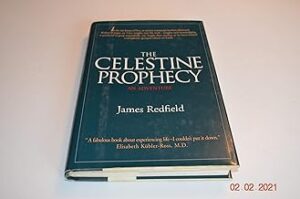
The Celestine Prophecy




Disclosure: This post may contain affiliate links. We only recommend products we believe in, and we may receive a commission at no cost to you! Thank you for your support!
Acknowledgment: Cover Image by moneycatzzz.com
Disclaimer: The information is provided for general information only – moneycatzzz.com makes no representations or warranties in relation to the information, including but not limited to any representation or warranty as to the fitness for any particular purpose of the information to the fullest extent permitted by law. While every effort has been made to ensure that the information provided in this article is accurate, reliable, and complete as of the time of writing, the information provided in this article should not be relied upon to make any financial, investment, real estate or legal decisions. Additionally, the information should not substitute advice from a trained professional who can take into account your personal facts and circumstances, and we accept no liability if you use the information to form decisions.