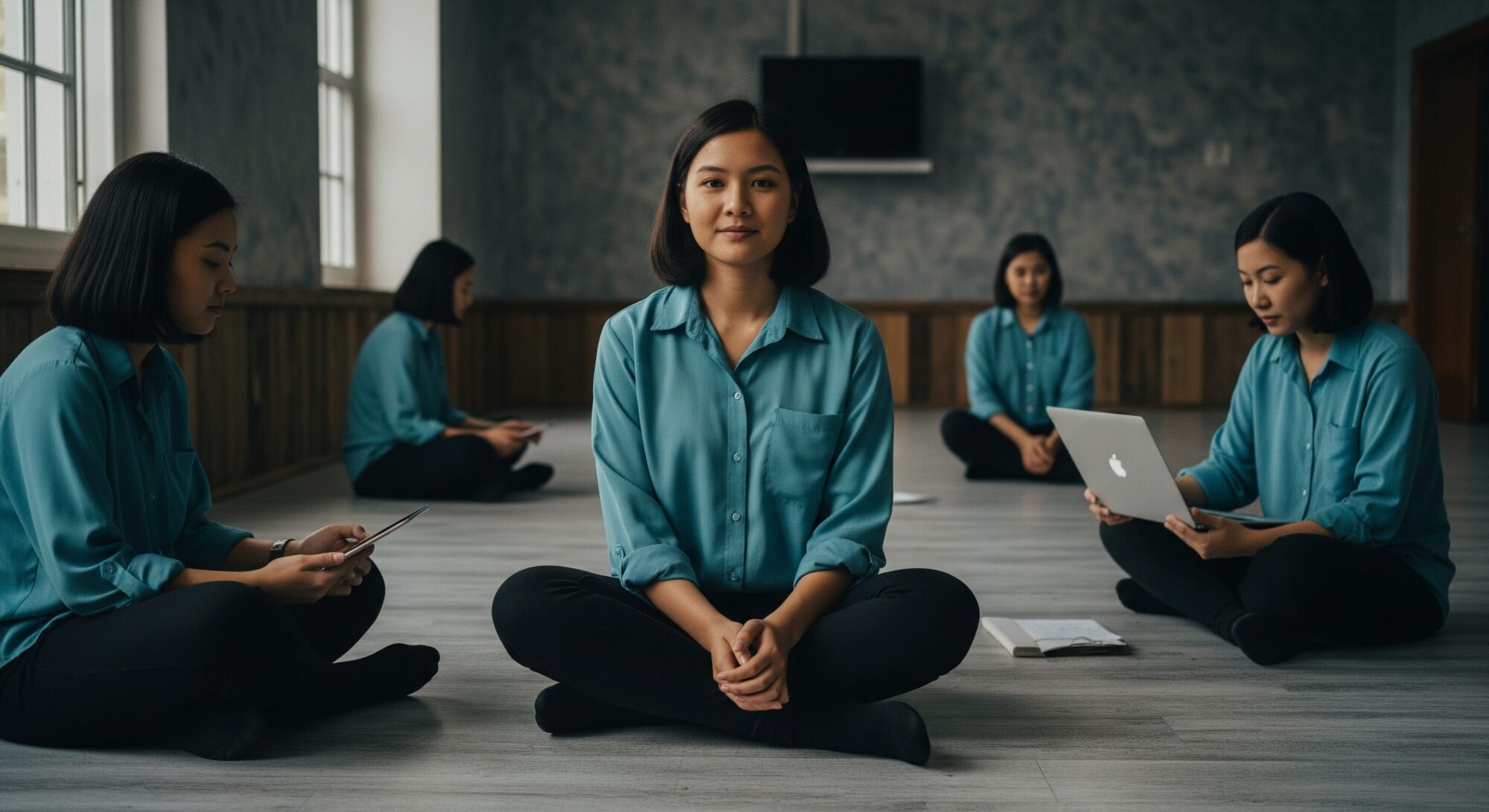
 Reading Time: 8 mins #
 This post may contain affiliate links.
Tuesday morning, 9:47 a.m. Seventeen browser tabs open. Three half-written emails. A meditation app reminding me to be mindful while I scrolled Instagram during a Zoom call I was supposedly attending. I was everywhere and nowhere, and the exhaustion felt bone-deep.
“I need to manage my time better,” I told my therapist that afternoon, pulling out my color-coded planner. She gently closed it. “What if time isn’t the problem? What if you’re never actually WHERE you are? There’s this Japanese concept called Ichigo Zammai that teaches total presence through single-pointed focus. Not managing ten things adequately, but doing one thing completely.”
She explained it wasn’t about productivity or even mindfulness as I understood it. It was about becoming so absorbed in washing a dish that you ARE the washing: no observer, no judgment, just total presence.
That conversation sent me down a path that would completely transform how I work, rest, and exist. What if the cure for overwhelm isn’t doing less, but being completely where you are?
The Promise: One Life, Single Mind
In this guide, we’ll explore Ichigo Zammai, the ancient Zen practice of single concentration that transforms fractured attention into profound mental clarity. You’ll learn the Three Anchors of Practice and discover how total presence isn’t another thing to add to your list, but a way to transform what you’re already doing into a gateway to the flow state.
Ichigo Zammai: One Life, Single Mind
Ichigo Zammai (一期三昧) translates to “one period, complete absorption” or more poetically, “one life, single mind.” It emerged from Zen Buddhism, where masters would demonstrate complete presence through simple acts. A calligraphy master wouldn’t just write characters; they would become the brush, the ink, the paper, the movement itself.
Thich Nhat Hanh describes this beautifully in The Miracle of Mindfulness when he writes about washing dishes to wash dishes, not to have clean dishes. The distinction may seem subtle, but it’s revolutionary. When you wash dishes to have clean dishes, you’re already in the future. When you wash dishes, you’ve discovered total presence.
This isn’t the mindfulness we’ve been sold in the West, where you observe your thoughts like clouds passing. Ichigo Zammai goes deeper. You don’t watch yourself breathing; you become breath itself. You don’t observe your walking; you are walking. There’s no distinction between the doer and the doing.
The Problem It Solves
Modern life fractures our attention by design. We pride ourselves on multitasking, but neuroscience shows our brains can’t actually multitask. They task-switch, and each switch carries a cognitive cost that researchers call “switching penalty.” You’re not doing three things at once; you’re doing three things poorly in rapid succession.
I discovered this viscerally one morning when I tried to answer emails while making breakfast, while listening to a podcast about focus. I burned the eggs, sent an email to the wrong client, and couldn’t remember a single thing from the podcast. The irony wasn’t lost on me. My attempt to maximize time had minimized my presence in any single moment.
The Bridge to Flow
When Mihaly Csikszentmihalyi studied the concept of the flow state in his groundbreaking book, Flow, he identified it as a state of complete absorption in an activity where self-consciousness is temporarily set aside. Western psychology treats flow as something that happens TO you when conditions are right: high challenge meeting high skill.
But Ichigo Zammai suggests something different. The flow state isn’t something you achieve; it’s something you allow through deliberate single concentration. The Zen masters didn’t wait for flow; they cultivated it through disciplined presence, even in the most mundane activities.
How to Practice Total Presence: The Three Anchors
After that therapy session, I spent months experimenting with bringing Ichigo Zammai into daily life. What emerged were three anchors, each addressing a different domain where we lose ourselves to fractured attention.

[“The Practice of the Mundane” – Image by moneycatzzz.com]
Anchor 1: The Practice of the Mundane
What if washing dishes could be a form of meditation? Not meditation WHILE washing dishes, but washing dishes AS meditation?
I started with my morning coffee. Usually, I’d make it while checking email, drink it while planning my day, barely tasting it. One morning, I decided to give coffee-making total presence. Phone in another room. No podcast. Just me and the coffee.
The kettle’s growing whistle. The bloom of grounds as water hit them. The spiral pour creates a tiny whirlpool. The first sip’s bitterness gave way to chocolate notes I’d never noticed in three years of drinking the same brand. Twenty minutes of single concentration on coffee, and I felt more rested than after eight hours of sleep.
Try this: Choose one daily routine tomorrow. Brushing teeth, making your bed, and walking to your car. Remove all distractions. Engage every sense. When your mind wanders (and it will), gently note “thinking” and return to the task. You’re not failing when you drift; returning IS the practice.
Shunryu Suzuki captures this perfectly in Zen Mind, Beginner’s Mind: “When you do something, you should burn yourself completely, like a good bonfire, leaving no trace of yourself.” That’s Ichigo Zammai. Complete combustion in the present moment.
Anchor 2: The Project as Practice
The professional world seems designed to prevent mental clarity. Slack notifications, email badges, the constant pull to check, refresh, respond. But what if work itself could become a practice of total presence?
I experimented first with writing. Usually, I’d write with twelve tabs open, checking references, fixing formatting, and researching simultaneously. One day, I tried writing Ichigo Zammai. Clear desk. One document. Phone in drawer. Timer for 25 minutes. The task wasn’t just writing; it was becoming writing itself.
The first ten minutes were agony. My hand reached for my phone six times. My brain screamed about emails probably piling up. But around minute fifteen, something shifted. The words began flowing without effort. Ideas connected themselves. What usually took two hours of fractured attempts took 25 minutes of single concentration.
This is what Cal Newport calls “Deep Work” in his book of the same name, although he approaches it through the lens of productivity. Ichigo Zammai approaches it through presence. The result is the same: profound mental clarity and output that surprises even you.
Protocol: Choose your highest-value task tomorrow. Set a timer for 25 minutes. Close everything else. Not minimize, close. Treat this task as your entire universe. When you notice the urge to switch, acknowledge it without judgment: “urge to check email,” then return. That seeing and returning builds your Zen focus muscle.
Anchor 3: The Decision as Ceremony
We make our worst financial and life decisions when we’re fractured, rushed, and treating important choices as items to check off between meetings. What if we brought ceremonial presence to decisions?
Last month, I reviewed my investment portfolio. Usually, I’d squeeze this between calls, stressed and scattered. This time, I made it a ceremony: Sunday morning. Clear desk. Candle lit. Phone off. One cup of tea. The numbers weren’t just data; they became objects of meditation.
For twenty minutes, I gave the numbers total attention. No judgment about past choices. No anxiety about market futures. Just complete attention to what is. The clarity that emerged was startling. I saw patterns I’d missed for years and made three adjustments that had been obviously needed but invisible to my fractured attention.
Try this: When making your next important decision, whether financial, professional, or personal, treat it as a ceremony. Schedule it, don’t squeeze it. Create a physical ritual around it: clear the space, use a candle, and definitely leave out devices except for what’s essential. Give it a single concentration, let the decision emerge from stillness, not urgency.
This isn’t about perfect decisions. It’s about being fully present for the choosing, which paradoxically leads to choices aligned with your most profound wisdom.
Why Total Presence Heals the Fractured Mind
The constant partial attention of modern life keeps our nervous systems in a state of chronic low-grade stress. We’re always slightly activated, never fully resting or fully engaged. Ichigo Zammai breaks this pattern.
When you give something complete attention, your nervous system receives a clear signal: this one thing is all that matters right now. The vigilance relaxes. The scanning stops. You drop into what researchers call a ventral vagal state, where healing and creativity happen.
But here’s the crucial Zen element: when your mind wanders, you don’t fight it. Fighting creates more fractures. You notice, label it gently (“thinking” or “planning”), and return. No judgment. No “I’m bad at this.” The wandering isn’t failure; noticing the wandering IS the practice.
I learned this through dishes. For weeks, I practiced washing dishes with Ichigo Zammai. My mind would drift every few seconds. I’d notice myself planning dinner while scrubbing a pot and think, “I’m terrible at presence.” Then I realized: the moment I noticed I’d drifted, I was present again. The practice wasn’t maintaining perfect focus. It was returning, over and over, with compassion.
This is radically different from forced labor or concentration camps. Forced focus exhausts. Total presence energizes. One fights reality; the other accepts it completely. The flow state finds you not when you chase it, but when you stop running from where you are.

[“The Project as Practice” – Image by moneycatzzz.com]
When the World Resists Your Practice
“Must be nice to have time for that,” a friend said when I mentioned my coffee meditation. The criticism stung because I’d thought the same thing. Who has time for single concentration when there’s so much to do?
However, I discovered that total presence doesn’t require extra time. It transforms the time you’re already using. That coffee was getting made anyway. Those dishes needed washing regardless. The decision had to happen. Ichigo Zammai means being completely there while you do what you’re already doing.
Start with five minutes. Even thirty seconds of actual presence creates more rest than an hour of scrolling. It’s not another task for your morning routine. It’s bringing mental clarity to any single task you choose.
Try saying to others: “I’m experimenting with giving my full attention to one thing at a time. It’s helping me show up better for everything else.” Most people understand overwhelm. They recognize the exhaustion of fractured attention, even if they don’t have words for it.
FAQ’s Total Presence: Your Questions Answered
What is Ichigo Zammai in daily life?
Ichigo Zammai is bringing total presence to whatever you're doing, transforming routine tasks into opportunities for single concentration and deep rest. It's washing one dish with complete attention rather than washing all the dishes while planning tomorrow.
How is total presence different from mindfulness?
Mindfulness observes; total presence becomes. You're not watching yourself wash dishes; you ARE the washing, wholly absorbed in the activity. There's no separate observer, just pure experience.
Can you achieve flow state through Ichigo Zammai?
Yes. The flow state naturally emerges from sustained single concentration. Ichigo Zammai is essentially the Eastern path to what Csikszentmihalyi discovered through Western research. The difference is that you cultivate it deliberately rather than waiting for it to happen.
How long should I practice being fully present?
Start with five minutes on one activity. Quality matters more than quantity. Even thirty seconds of actual total presence creates a reset. Build slowly. Sustainability beats intensity.
Your Invitation to Presence
The world won’t slow down for you. But you can slow down IN the world through total presence.
Ichigo Zammai isn’t about adding another practice to your overwhelming list. It’s about bringing single concentration to what you’re already doing. One dish. One breath. One email at a time.
Your 24-Hour Challenge: Choose your anchor task. Tomorrow morning’s coffee? Tonight’s dishes? Your evening walk? For just that one activity, give it your complete, undivided presence. When your mind drifts, smile and return. No judgment. Just notice what shifts.
Not to achieve anything. Not to become more productive. But to remember what it feels like to be fully here, fully alive, fully present.
The ancient Zen masters knew: mental clarity doesn’t come from doing more or less. It comes from doing what you’re doing with your whole being.
As Zen master Yunmen said, “Every day is a good day.” Not because every day is easy. But because every day offers infinite doorways to total presence.
That doorway is always here. Always now. Always waiting.
The only question is: Will you walk through?
The Miracle of Mindfulness

Zen Mind, Beginner’s Mind
Deep Work
Disclosure: This post may contain affiliate links. We only recommend products we believe in, and we may receive a commission at no cost to you! Thank you for your support!
Acknowledgment: Cover Image by moneycatzzz.com
Disclaimer: The information is provided for general information only – moneycatzzz.com makes no representations or warranties in relation to the information, including but not limited to any representation or warranty as to the fitness for any particular purpose of the information to the fullest extent permitted by law. While every effort has been made to ensure that the information provided in this article is accurate, reliable, and complete as of the time of writing, the information provided in this article should not be relied upon to make any financial, investment, real estate or legal decisions. Additionally, the information should not substitute advice from a trained professional who can take into account your personal facts and circumstances, and we accept no liability if you use the information to form decisions.