anxiety cover

Chronic Anxiety Condition: When Problems Aren’t Figureoutable

imagesReading Time: 8 mins #

disclosure line icon vector This post may contain affiliate links.

“Nothing in life is as kick-ass as taking full responsibility for your life.” Marie Forleo, Everything Is Figureoutable.

I sit in my therapist’s office outlining my newest protocol: magnesium supplements, an earlier bedtime, and strict screen boundaries. My anxiety has flared again, but I have done the research. I am convinced I found the root.


She is quiet before asking: “What if you are not doing anything wrong?”


The anxiety returned,” I say. “Something is broken.”


Or it is performing as expected, and you are demanding more than the system can deliver.


I want to argue. But I’m too tired. I’ve been troubleshooting my anxiety for six years. Different therapists, medications, lifestyle changes, supplements, and books. This month it’s Marie Forleo’s Everything Is Figureoutable. Last month, it was a different book with a different framework. Next month it’ll probably be something else.


The endless hunt for a fix has finally exhausted me more than the anxiety itself.

The Optimization Trap

Forleo’s book says everything is figureoutable. Any obstacle can be overcome with the right mindset, resources, and persistence. I read it in three days, highlighter in hand.


The framework is simple:

  • Clarify the problem
  • Break it into parts
  • Take action
  • Adjust based on results

It makes sense. It’s empowering. And it works: I’ve used this exact approach to figure out career pivots, project bottlenecks, and relationship conflicts.


So why not anxiety?

Screenshot 2026 07 28 154437
[MindValley Promo | Rewire your mind, transform life. | Vishen Lakhiani]

I applied the framework. First, I clarified the problem: waking up with a tight chest, racing thoughts, and a low-level dread. Then I broke it down into variables such as sleep quality, caffeine, and rumination patterns. Finally, I executed the fixes with magnesium, an earlier bedtime, and strict screen boundaries.


For two weeks, it worked. The anxiety quieted. I thought: finally. I’ve figured it out.


Week three, it booked an extended stay in a room with a view.

Execution Loops & False Peaks

This isn’t the first time. There was the meditation app phase. Worked brilliantly for six weeks. Then stopped working. I assumed I’d been doing it wrong, needed to try a different app, a different technique.


Then there was the exercise phase: running every morning has noticeably improved my anxiety. Then my knee gave out. Switched to yoga: different benefits, same eventual plateau.


Last, but by no means least, came the dietary phase. Cut gluten, then dairy, then caffeine. Every change helped for a while, until every change eventually stopped helping.


The pattern never changes. I find a new solution, feel the immediate rush of relief, and mistake temporary improvement for a permanent fix. Then I hit the inevitability of the baseline, assume I executed badly, and start hunting for the next framework. This endless churn is draining my actual physical reserves.

Tara Brach didn’t hold back when describing the difference between pain and suffering. Pain is inevitable. Suffering is what we add through resistance. I don’t just agree with her; I’m living proof.


The anxiety is pain. My constant troubleshooting is suffering.


Sitting in that chair, I realized I had spent six years trying to solve my own pain instead of learning how to stop adding to it.

Acute vs. Chronic Classification

“You’ve been trying to cure your anxiety,” she says. “What if the work is learning to live with it?”


I hate this sentence. It sounds like giving up.


So I just… accept that I’ll feel like this forever?


Not forever. Some days. And not as intensely with the tools you have. But yes, some version of this will probably always be here. That’s what chronic means.


Chronic. The word I’ve been avoiding.

I know the difference between acute and chronic intellectually. Acute problems have solutions. Broken bone, you set it. Bacterial infection, you treat it. Problem solved.


Chronic conditions don’t work that way. Arthritis, diabetes, migraines. They’re managed, not cured. Treatment helps. Nothing eliminates it.


My anxiety is chronic. I’ve known this for years. I just kept treating it as if it were acute.

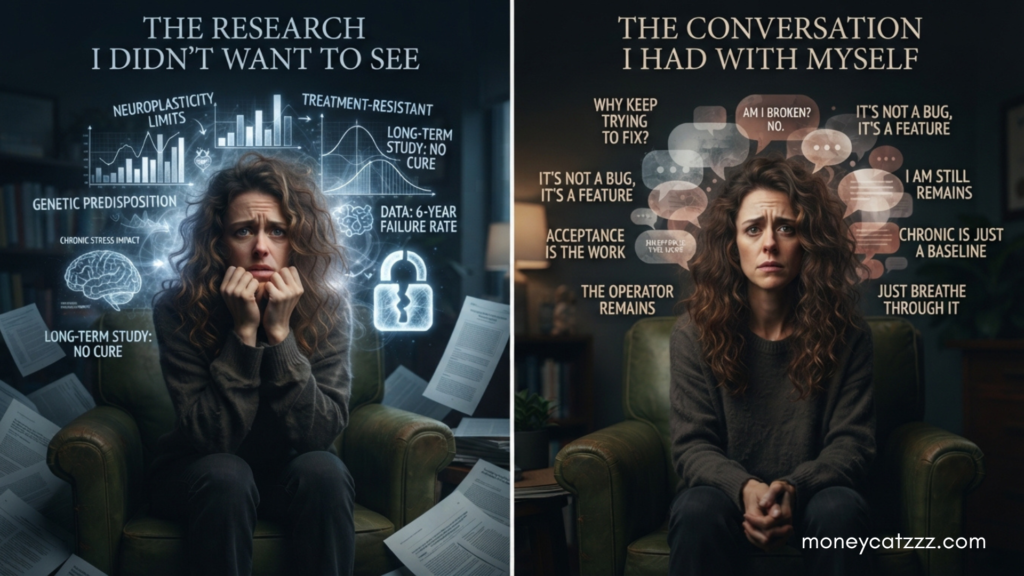
The Research I Didn’t Want to See

I cross-referenced the research that night. The findings for generalized anxiety are stubborn: trying to manage the sensation keeps the nervous system on high alert, while acceptance actually calms it down.


Direct intervention works when a problem is situational. Remove the immediate stressor, and the anxiety resolves. It is a logical, closed-loop equation.


Generalized anxiety is chronic, ambient, and untethered to a single trigger. It is neurological, genetic, and developmental. The fixing mindset treats it like a puzzle with a missing piece, so when you fail to solve it, you assume you lack discipline. The weariness isn’t from the anxiety itself. It comes from trying to engineer a solution for a condition that doesn’t have moving parts.

The literature isn’t promising a cure. Acceptance doesn’t eliminate anxiety; it stops the secondary war you launch against it. You still have anxiety, but you stop having anxiety about having anxiety. You stop draining your energy trying to fix a foundational setting.


The realization made me angry. Then sad. Then something quiet, like relief.

The Chronic Condition: When Anxiety Is Not Figureoutable
[The Chronic Condition: When Anxiety Is Not Figureoutable | moneycatzzz.com]

The Conversation I Had With Myself

Every time I type the word acceptance, my fingers instinctively reach for the backspace key. I want to delete it and write about persistence, resourcefulness, or grit; anything that sounds like a fight I can win.


Accepting that my anxiety is chronic feels like admitting defeat. It feels like proof that I failed at basic troubleshooting. If Marie Forleo was right and everything is figureoutable, then my inability to repair my own nervous system meant one thing: I wasn’t resourceful enough.


The intervention stack still has value: clinical care, lifestyle adjustments, and somatic regulation all have their place. They soothe the physical response, widen the buffer zone, and make the baseline livable, but they do not cure it. The shift is subtle but massive. I’m not trying to eliminate my anxiety. I’m trying to have anxiety without it controlling my whole day.


That is not surrender. That is simply reading the specs correctly.

Where Forleo’s Framework Still Works

The logic holds up for broken plumbing, failed code, and bad logistics. It breaks down the moment you turn it inward on your own nervous system.


Everything is figureoutable. When you’re facing a solvable problem, you’ve convinced yourself that it’s impossible. Career change? Figureoutable. Difficult relationship? Often figureoutable with communication and boundaries. Project management, skill development, and financial planning? All figureoutable.

anxiety slide 1

I used Forleo’s framework last year to switch careers. It worked perfectly. Clarify, break down, take action, adjust. Six months later, a new job.


The framework is brilliant for solvable problems. It fails when applied to chronic conditions.


The issue isn’t the book. The issue is the assumption that every problem belongs to the same error class.


My career was a solvable problem. My anxiety is a chronic condition.


Different frameworks for different situations.

Operational Reality

I still wake up with anxiety: my chest tightens, thoughts spiral, and my nervous system fires on schedule. The difference is that I no longer view it as a failed troubleshooting attempt.


I implemented the intervention protocol, which involved deep breathing, grounding exercises, and targeted medication. Sometimes I wait out the spike while continuing my work.


In the past, high-anxiety days triggered immediate diagnostic loops:

  • What did I miscalculate?
  • What setting failed?
  • What new protocol do I need to test?

Learn to thrive in a changing world | advaya.life | promotion

Now, a bad anxiety day is simply that: a bad day. It arrives, peaks, and subsides by afternoon.


Conversely, low-anxiety days used to trigger false victories. I assumed I had discovered the final patch, the ultimate fix, and the permanent solution.


Now, a clear day is just a clear day. It is a temporary lull, not an actual cure.


This is the reality of managing an ongoing condition:

  • Fluctuations are not failures; they are standard operating conditions.
  • Therapy does not eliminate the condition; it maintains the system.
  • Fixing assumes a broken machine, a completed repair, and a final resolution.

Management accepts an ongoing operational reality. You identify the parameters, apply the inputs, and keep the system livable.

Diagnostic Limits

I am not entirely at peace with this framework, yet. Part of me still searches for an undiscovered patch, a better intervention, or a superior method. Acceptance is rarely a permanent state; it is an active, daily recalculation.


The anxiety is sitting right here with me. It is a persistent background hum, a familiar operating frequency, and a permanent occupant of the system. It has opinions on every task, but I have stopped treating its presence as proof of personal weakness.


That is neither triumph nor defeat. It is simply what chronic means.


Marie Forleo’s manual remains useful for external challenges: career pivots, relational boundaries, and logistical projects respond to strategy, but an internal nervous system cannot be managed like a task list.


Learning to classify which problem belongs to which domain is far more useful than the troubleshooting framework itself. My anxiety is not figureoutable, and forcing it through a repair protocol only yields friction.


The anxiety remains. The operator remains. We co-exist within the same sphere.

“Anxiety is not a puzzle waiting for the right key. It is just the weather in the room, and you learn to work around it.” — Lizabeth Johns.

_______________________________________________

The Library of False Cures: Why Every New Manual Fails

716HN28zjhL. AC AIweblab1378949T2 FMavif SF516.0327.0 PQ65


Everything Is Figureoutable

by Marie Forleo

Amazon Button

71VrNbnfjrL. AC UY218


Radical Acceptance

by  Tara Brach

Amazon Button

71BK1eTNLKL. AC UY218


 The Antidote

by Oliver Burkeman

Amazon Button

Disclosure: This post may contain affiliate links. We only recommend products we believe in, and we may receive a commission at no cost to you! Thank you for your support!
Acknowledgment: Cover Image by moneycatzzz.com

Disclaimer: The information is provided for general information only – moneycatzzz.com makes no representations or warranties in relation to the information, including but not limited to any representation or warranty as to the fitness for any particular purpose of the information to the fullest extent permitted by law. While every effort has been made to ensure that the information provided in this article is accurate, reliable, and complete as of the time of writing, the information provided in this article should not be relied upon to make any financial, investment, real estate or legal decisions. Additionally, the information should not substitute advice from a trained professional who can take into account your personal facts and circumstances, and we accept no liability if you use the information to form decisions.

Signup to our Newsletter for regular updates:

Lizabeth Johns

Lizabeth Johns is a New Age enthusiast with a unique perspective. A digital nomad traversing around the globe, she has seen it all. She offers clarity and vision, and her vast experience in guiding and mentoring, along with her blogging background, translates into informative and engaging reads. She writes about life matters relevant to today's online fauna and her blog explores life experiences relevant to people navigating the online world.