
Listen to this essay in full. Headphones highly recommended.
 Reading Time: 8 mins #
 This post may contain affiliate links.
DUMBO, 94 Degrees, Forty-Two Days of Runway
High-stakes leadership often demands deep empathy, but without a filter, taking on every crisis will destroy your operational judgment.
The window AC unit in the DUMBO loft was rattling in its frame, blowing warm, humid air across the conference table.
Late August. The sun beat down on the exposed brick wall until the whole room felt like a drying kiln.
Across from me sat Arthur, the founder of a mid-stage logistics company I’d been advising for six months. Arthur didn’t sit still. He paced the length of the polished concrete floor, his thumb frantically flicking the wheel of an unlit metal lighter.
“Forty-two days,” Arthur said, his voice tight and paper-thin. “If the Series B paper doesn’t clear by September fifteenth, we can’t make payroll. I’ve got seventy-eight people relying on me. Their families. Their mortgages.“
He stopped, leaned over the table, and looked directly at me. His eyes were wide, bloodshot, and frantic.
My body did what it had been trained to do for fifteen years. I leaned forward. I nodded and locked eyes with him. And without realizing it, I opened every gate in my mind and let his panic pour straight into my gut.
Within three minutes, my diaphragm locked up. My heart rate doubled, matching his erratic rhythm beat for beat. A cold sweat broke out along my hairline, and a sharp, metallic pressure flared behind my left eye.
I sat there nodding, swallowing his dread, taking on his horror as if I were the one facing an empty bank account in six weeks.
Ten minutes later, Arthur took a long, shuddering breath. He dropped into a chair, his shoulders suddenly slumping down four inches.

“Man, Marco,” he said, exhaling slowly. “Thanks. Just talking to you makes me feel ten pounds lighter. You always get it. You feel exactly what I’m going through.“
He shook my hand, packed his laptop, and walked out into the hallway, visibly steady and calm.
I didn’t move for twenty minutes, glued to that chair, staring at a grease smudge on the glass table. My stomach was in knots, my hands were shaking, and an ugly, hot wave of resentment washed over me.
I felt physically sick. Drained of every ounce of creative energy. Completely incapable of making a single decision for the rest of the day.
When I finally dragged myself down the stairs and out onto Jay Street, the late afternoon sun felt like an anvil hitting my head.
For years, board members and colleagues had praised my high sensitivity in leadership as a rare asset. They called it deep empathy.
Walking toward the subway, I faced a hard truth: what everyone validated as emotional depth was actually a total lack of structural filtering.
I was acting like a sponge in a sewage pipe, absorbing other people’s panic and calling it leadership.
I thought I was being a lightning rod for the team, but I was just taking the high-voltage strike straight into my own chest.
Why Empathy Without Boundaries Isn’t Leadership
Empathy is trainable. Neuroplasticity research confirms this. You can strengthen neural networks associated with perspective-taking and compassion.
Brain scans show that compassion training shifts activation from distress-related regions to reward and social connection systems.
But most advice stops here. Assumes more empathy is always better.
In most scenarios, that is true… but more empathy without a filter is not a virtue. It’s a drain.
The Limits of Intellectualizing the Problem
In the quiet after that afternoon with Arthur, I tried to analyze my way out of the wreckage.
A 2013 NeuroImage study demonstrated that while compassion training builds resilience, raw empathy training increases distress. You rewire your brain either way; the question is what you’re training it for. I had spent years rewiring mine for total absorption.
I turned to Paul Bloom’s Against Empathy. Bloom makes a compelling case: empathy is a narrow, biased moral guide that naturally leads to burnout. His alternative is rational compassion; caring deeply about outcomes without drowning in the immediate visceral feeling.

[The Tension in the Room | moneycatzzz.com]
On paper, Bloom is right. Raw empathy is a terrible operational framework. But where academic theory falls short is in the implementation. Bloom talks about rational compassion as if you can flip an intellectual switch, as if a leader standing in a room with a panicking founder can choose to be “rational” on command. In the middle of an operational tailspin, cold rationality feels impossible and makes you look like an unfeeling automaton.
What the theory missed was the mechanics. It’s one thing to understand the distinction between empathy and compassion in a quiet room; it’s another to execute it when someone across the desk is panicking.
That lesson didn’t come from a page. It came to me three days later over a cup of black coffee in Fulton Market.
The Paper Towel Fallacy
I was sitting in a vinyl booth at a diner near Fulton Market, staring down a cup of black coffee.
I was sitting across from Evelyn, a mentor who’d spent thirty years running global logistics through every crisis on record. She didn’t waste time coddling people.
She looked at me over the rim of her glasses.
“You look like sh*t, Marco,” she said bluntly.
“I’m burnt out,” I said, rubbing the bridge of my nose. “I’ve been spending forty hours a week carrying everyone’s crisis. When my founders panic, I sit there and take the hit with them. I thought that’s what steady leadership required; bearing the weight so they don’t have to.”
Evelyn set her mug down with a sharp clink.
“You’re acting like a paper towel,” she said.
I blinked. “A what?“
“A paper towel. Someone spills hot coffee on the counter, and you throw yourself flat on top of it. You soak up the mess, get soggy, fall apart, and end up in the trash. Tell me, Marco: does the paper towel fix the leak?“
“No,” I admitted. “It just holds the liquid.“
“Exactly. Soaking up the spill doesn’t repair the pipe. It just gives you two ruined things instead of one: a broken pipe and a soggy towel. You think taking on someone else’s distress makes you a good mentor? It makes you an accomplice to their collapse.”
I leaned back against the red vinyl booth. “If I don’t feel what they’re feeling, don’t I just come off as cold? If I build a wall, I lose the signal.”
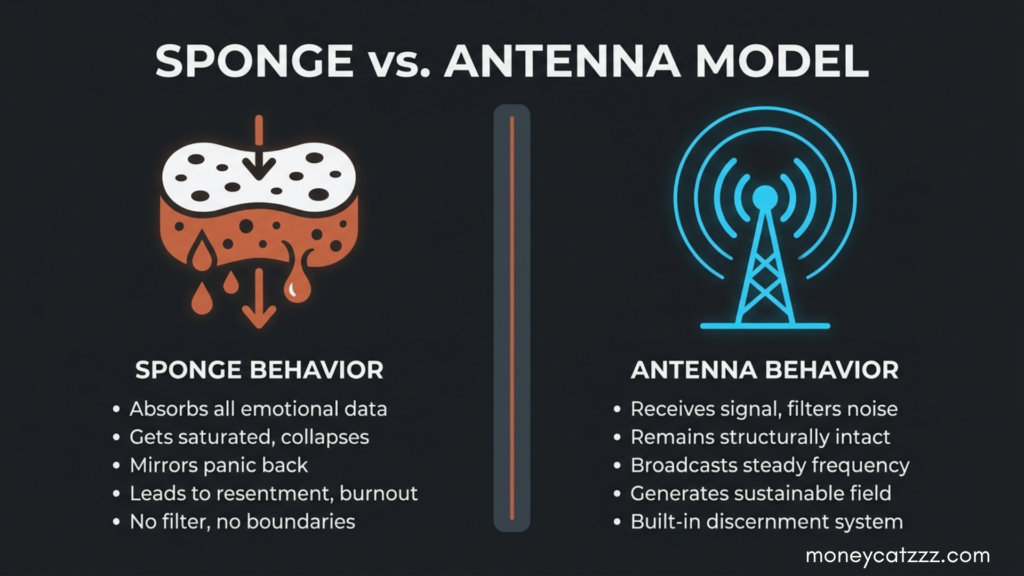
“Who said anything about building a wall?” Evelyn leaned forward, tapping her index finger on the laminate table. “Walls are for cowards who are afraid of information. You don’t need a wall. You need to switch models entirely. You need to stop being a sponge and start being an antenna.“
She motioned out the diner window toward a steel broadcast tower rising against the slate-grey sky over the river.
“Look at that tower,” she said. “That antenna receives millions of high-voltage signals every single second. Panic, news, music, noise. It catches the signal perfectly. But it never holds onto the charge. The wave passes through the frame, is filtered, and is broadcast as clear sound. The second that tower tries to hoard the electrical current, the transformer blows up, and the whole grid goes dark.“
She paused, letting the street traffic outside fill the silence.
“A tuning fork has no choice but to vibrate when hit with someone else’s noise; an antenna simply registers the frequency without shaking.”
She stared straight at me until I looked back up.
“Your job isn’t to hold their terror,” she said softly. “Your job is to read the signal, filter out the static, and give them a clear frequency so they can find their way back to solid ground.”
How to Stop Absorbing Emotions: The 4:15 PM Field Test
The test came less than twenty-four hours later.
I was back in my office, finishing an operational report, when Frank, a regional operations director, kicked my door open without knocking. His face was flushed red, his necktie was pulled loose, and he was carrying a stack of client printouts like a weapon.
“We’re done,” Frank slammed the papers onto my desk. “Vanguard just pulled the Q4 shipping contract. They gave us until 5:00 PM to present a recovery plan, or they will walk entirely. That’s forty percent of our regional revenue gone by sunset.”
My old habit flared up like a reflex; jaw clenched tight. My breathing turned shallow. My chest compressed as I prepared to dive right into his tailspin.

[The Saturated Pivot | moneycatzzz.com]
Antenna, Evelyn’s voice echoed in my head. Catch the signal. Drop the charge.
I planted both feet flat on the floor. Physical stability first. My shoulders dropped two inches. I let out a quiet, slow exhale through my nose.
I forced myself to look at Frank not as a storm to be absorbed, but as a broadcast frequency carrying raw operational data wrapped in a thin layer of emotional noise.
The data: Vanguard pulled the contract. The noise: Frank’s panic.
I didn’t nod sympathetically. I didn’t lean forward in shared panic. I sat entirely still.
“Sit down, Frank,” I said. My voice came out lower and slower than his.
He blinked, thrown off by the lack of immediate panic in the room. He didn’t sit, but he stopped pacing.
“Marco, you don’t understand—“
“I hear the urgency,” I cut in calmly, keeping my voice rooted firmly in the lower register. “Vanguard wants a recovery plan in forty-five minutes. That’s the signal. The panic doesn’t matter. Show me the exact gap between what they asked for and what we currently have on the floor.”
Frank stood there for three seconds, his chest heaving.
Because I hadn’t absorbed his frenzy, there was nothing in the room for his panic to feed on. He had no mirror reflecting his terror at him.
He pulled out the leather chair across from me and sat down. His breathing slowed. He unbuttoned his top collar, took a pen from his pocket, and spread the documents flat across my desk.
“Okay,” Frank said, his voice dropping an octave. “Here’s the actual gap.“
For thirty minutes, we worked through the logistics line by line.
I didn’t get a headache. My heart rate stayed at sixty-five beats a minute.
At 4:52 PM, we sent the revised plan. Vanguard accepted it before 5:05 PM.
When Frank walked out, he didn’t just feel lighter; he had solved his own problem.
And I sat at my desk with a clear head, energy to spare, and a complete lack of residual bitterness.
The antenna worked.
[The Sponge vs. Antenna Analogy | moneycatzzz.com]
Rewiring the Reflex
The transition from sponge to antenna requires immediate physical intervention. The moment a founder starts dumping panic across the table, the reflex kicks in:
- Unclench the diaphragm: Panic forces shallow breathing; forcing a low breath prevents sympathetic resonance.
- Separate signal from noise: Strip away the emotion to extract the single actionable variable.
- Return the frame: Offer a steady, clear next step instead of matching their emotional pitch.

[MindValley Promo | Rewire your mind, transform life. | Nir Eyal]
The Real Cost of the Sponge
Arthur’s company made payroll two days before the deadline. Frank kept the Vanguard contract, and his team ran cleaner after that meeting simply because I hadn’t drowned alongside him.
Evelyn was right: the paper towel doesn’t fix the leak, and the antenna doesn’t hold the charge.
That reflex doesn’t vanish overnight. Some days, I still catch myself taking on everyone else’s stress and ending up completely drained by the evening. The difference now is that I catch it in real time. I plant my feet, drop my shoulders, and reset the filter.
Carrying everyone’s panic feels like leadership right up until you run out of gas. Staying grounded takes daily practice, but it’s the only way to actually be of any use when the room starts spinning.
________________________________________________
Essential Reads: From Sympathetic Resonance to Sharp Discernment

Against Empathy


The Body Keeps the Score

Boundaries



Disclosure: This post may contain affiliate links. We only recommend products we believe in, and we may receive a commission at no cost to you! Thank you for your support!
Acknowledgment: Cover Image by moneycatzzz.com
Disclaimer: The information is provided for general information only – moneycatzzz.com makes no representations or warranties in relation to the information, including but not limited to any representation or warranty as to the fitness for any particular purpose of the information to the fullest extent permitted by law. While every effort has been made to ensure that the information provided in this article is accurate, reliable, and complete as of the time of writing, the information provided in this article should not be relied upon to make any financial, investment, real estate or legal decisions. Additionally, the information should not substitute advice from a trained professional who can take into account your personal facts and circumstances, and we accept no liability if you use the information to form decisions.