Reading Time: 8 mins #
This post may contain affiliate links.

“The tuning fork does not try to match the frequency of the room. It just vibrates at its own frequency, and waits for something to vibrate in response.”
The meeting had been running for forty minutes, and I had said eleven words.
Â
I counted, not because I was disengaged. I was working so hard to appear engaged, tracking the word count was the only honest thing happening in my body. I was nodding, maintaining eye contact at the intervals that signal active listening; the resonance produced the small affirmative sounds that indicate a person is present and processing.
Â
I am sitting there, yet I was not present. I was projecting presence, which is a different operation entirely, and it costs significantly more.
Â
This is why the connection is draining. It isn’t the actual building of it, but the simulation of it in rooms where no genuine connection is possible. Projecting resonance into environments never designed to produce it creates a dangerous friction trap. You have been running this externalization for years, and the fatigue you carry is not from the work itself. It is from the gap between the frequency you are broadcasting and the one you are being asked to produce.
The Physics of the Problem
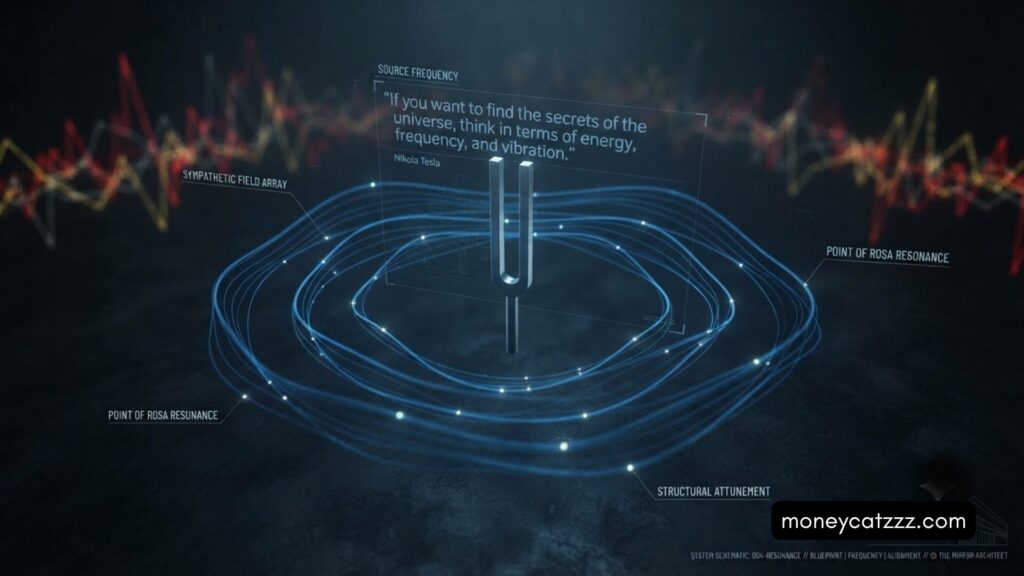
“If you want to find the secrets of the universe, think in terms of energy, frequency, and vibration.” – Nikola Tesla.
Here is the basis of the truth regarding tuning forks: strike one, and it vibrates at a single, pure frequency. Bring another fork with a matching or harmonically compatible frequency into proximity, and something happens that feels impossible: the second fork begins to vibrate without physical contact—no force, no effort. Just the presence of a compatible frequency in the same space. That is resonance. It is not a skill or a technique; it is what happens when two systems are genuinely compatible and structurally attuned.
Â
You are a tuning fork. You have a frequency. The problem is not that you cannot resonate; it is that you have spent so long trying to match frequencies that are not yours that you have lost the signal of your own
Hartmut Rosa argues that genuine resonance, being truly moved and responsive to the world, is the precise antidote to the alienation of modern accelerated life. In his landmark work on resonance theory, Rosa identifies that the enemy of resonance is not isolation. It is the compulsive effort to perform connectivity in environments engineered for transaction rather than contact. You are not disconnected; you are vibrating at the wrong frequency and burning significant resources maintaining the mismatch.
Â
The true cost of not resonating is the erosion of your capacity to feel it when it actually arrives, and it compounds.
[The Sympathetic Frequency Array | moneycatzzz.com]
The Suppression Log
Suppression hides behind productivity. You see it in the transactional addict whose calendar is a masterclass in busyness, yet whose output yields nothing of substance.
Â
Three years ago, I managed a professional network that served as a convincing facade of social capital: constant coffee meetings, industry dinners, and a calendar packed with interactions that signaled an engaged, connected operator. I was mass-producing connections.
Â
Almost none of it resonated. I would sit across from someone and feel the dissonance immediately; the friction of two systems vibrating at incompatible frequencies, attempting to force a coherence that didn’t exist. I became an expert at masking the gap. I learned the technical adjustments required to make a conversation simulate warmth. I modulated my output to mirror the room, dampened my actual responses, amplified the expected ones, and walked away from every interaction more depleted than when I arrived.
Parker Palmer calls this the “divided life“ in A Hidden Wholeness: the chronic gap between your inner frequency and your outer expression. The longer you sustain it, he argues, the more the inner signal degrades. You stop hearing your own frequency, not because it disappears but because you have been drowning it out for so long that you can no longer locate it in the noise.
Â
The signal has not vanished, but you stop hearing your own frequency because you have spent years drowning it in the noise of your own posturing.
The Moment the Signal Returned
I found it by accident, the way you usually find things you have stopped looking for.
Â
I fell into a conversation with an acquaintance, a two-hour exchange devoid of professional utility. I flipped the switch on my internal autopilot and stopped monitoring my output. I stopped transmitting engagement signals, stopped calibrating warmth, and stopped tracking reciprocity. I held my presence, and in that exchange, I found a resonance I hadn’t touched in months.
Â
Resonance doesn’t appear as a whisper; it hits like a sudden drop in pressure. It is that specific, hollow click; the sound of a tension you had normalized, finally snapping into place. You don’t realize how hard you’ve been fighting your own rhythm until you stop the fight, and the vibration suddenly aligns.
Finding your resonance isn’t an engineering endeavor or a manufactured output. It’s what remains when you finally stop the noise. The conditions are simple: brutal honesty about what actually moves you, and the tactical discipline to avoid rooms where that honesty is a liability. A tuning fork doesn’t compromise its pitch to accommodate the room; it holds its frequency, unyielding, and waits for the world to resonate in turn.
Â
Most of us have been adjusting our frequency for so long that we have forgotten this is an option.
[The Suppression Log: How Mass-Producing Connection Erodes Your Signal | moneycatzzz.com]
What Stops When You Stop Obliging
I went back to the calendar. The industry dinners. The coffee meetings. The dense network of high-volume, low-resonance interactions I had been maintaining was like infrastructure.
Â
I cut forty percent of it.
Â
No manifesto. No fanfare. Just a quiet, practical realization: the energy expenditure wasn’t creating connection; it was actively degrading my capacity to resonate when it was actually available. Finding your frequency is a subtraction exercise. You don’t find the signal by cranking the volume; you find it by stripping the noise.
Â
The professional anxiety was real. The network is supposed to be an asset, and shrinking it feels like shrinking your surface area for opportunity. But the result was the opposite. The interactions that remained, the ones I kept because they held weight, became significantly more productive. I was finally present, instead of operating.
Robert Cialdini’s research on influence consistently shows that genuine engagement, the kind produced by actual interest rather than performed interest, is more persuasive and more memorable than technically proficient social performance. The room feels the vibration, or it feels the performance. It cannot be fooled consistently. Neither can you.
The Frequency Is Still There
There are rooms where I do not resonate, and that’s okay. That has not changed and will not change completely. The professional world is not organized around tuning compatibility, and it is not about to reorganize itself.
Â
What changed is the intention. I stopped tuning my output to match frequencies that aren’t mine, forcing connection signals where there is only silence, and treating mismatches as failures to be fixed. Sometimes the room is in a different key. That resonant frequency is information, not a problem to solve.
Â
The tuning fork does not try to match the room’s frequency. It vibrates at its own frequency and waits. Sometimes something in the room vibrates back. When that happens, the resonance is immediate and unmistakable and worth every room where it didn’t.
Â
You already know what your frequency sounds like. You have just been drowning it out.
Â
Stop. Listen. Vibrate.
__________________________________________________
Disclosure: This post may contain affiliate links. We only recommend products we believe in, and we may receive a commission at no cost to you! Thank you for your support!
Acknowledgment: Cover Image by moneycatzzz.com
Disclaimer: The information is provided for general information only – moneycatzzz.com makes no representations or warranties in relation to the information, including but not limited to any representation or warranty as to the fitness for any particular purpose of the information to the fullest extent permitted by law. While every effort has been made to ensure that the information provided in this article is accurate, reliable, and complete as of the time of writing, the information provided in this article should not be relied upon to make any financial, investment, real estate or legal decisions. Additionally, the information should not substitute advice from a trained professional who can take into account your personal facts and circumstances, and we accept no liability if you use the information to form decisions.