
 Reading Time: 8 mins #
 This post may contain affiliate links.
There is a shelf behind the customer service desk at an old department store. You have seen it. Filled with lost items nobody came back for. A single glove. A scarf. A pair of reading glasses. Things someone once valued enough to keep but not enough to retrieve.
I realized last year that I built the same shelf in my own life.
Forty-seven unfinished online courses. Seventeen books with highlighted first chapters and blank pages after. A Trello board with nine projects labeled “planning” and zero labeled “done.” I started learning three languages on Duolingo. A guitar in the corner, I told myself I would learn during the pandemic. That was four years ago.
I was not lazy. I worked hard. I just worked hard on the wrong part. I loved the purchase. The download. The setup. The announcement. The moment I told someone, “I am finally going to do this.”
The moment after that? The actual work? I was already gone. Looking for the next thing to collect.
The Cost of an Unclaimed Trophy
The shelf in the department store is sad because someone valued that item enough to keep it, but not enough to return it. The item sits there waiting. Eventually, the store throws it away.
Unfinished projects guilt works the same way. Every course you bought and abandoned. Every habit tracker you used for three days. Every goal you announced on social media and never touched again. These things sit on your shelf; they are not neutral, they are evidence. Evidence that you do not follow through.
I calculated what my shelf cost me last year. Not in monetary terms, though that was bad enough. Close to two thousand dollars on courses I never finished. But the real cost was worse—that I stopped believing in myself.
When I said “I am going to write that book” or “I am going to launch that side project,” even I rolled my eyes. My word meant nothing to me. That is the definition of a broken self-trust. You become the person who cannot count on themselves.
Research from the American Psychological Association shows that repeated goal failure directly reduces self-efficacy. Each abandoned project makes the next one harder to start because you already know how it ends, not with completion but with another trophy on the shelf.
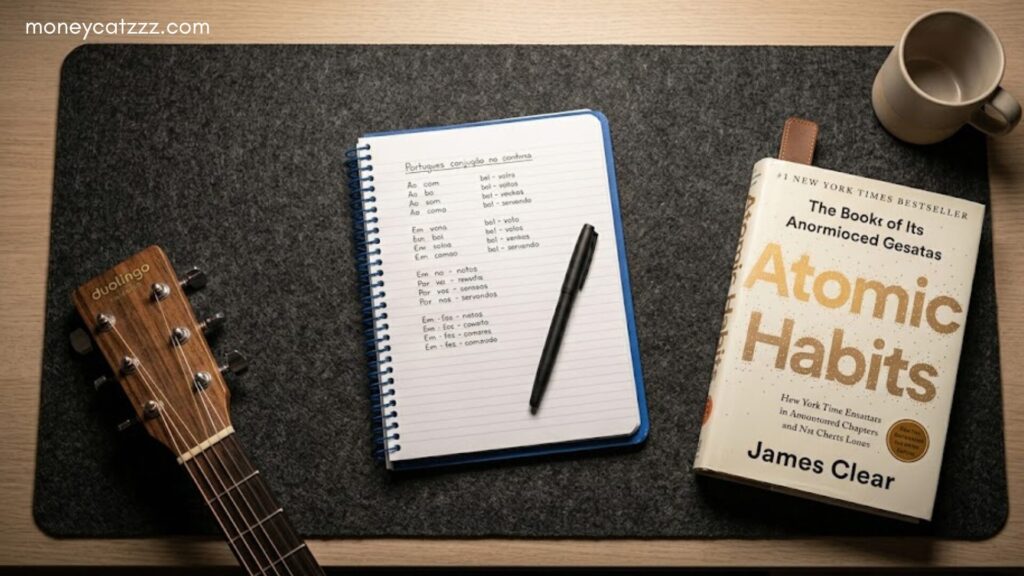
[“The Rule of Three” – Image by moneycatzzz.com]
Why You Keep Collecting
So, what gives? Know that you don’t have a character flaw; you have a feedback loop problem.
You’ve been optimized for the ‘buy,’ not the ‘build.
Acquisition gives a hit. Completion requires work. Your brain learns this quickly. Buy the course: dopamine. Download the course: dopamine. Tell your friend about the course: dopamine. Open the first lesson: less dopamine. Do the exercises: even less. Finish the course: work.
So you stop. Not because you are weak. Because you trained yourself to chase the hit, not the finish line.
This is why I never finish anything is the wrong question. You already know why. It’s because finishing is boring. Because the middle part of any project is just grinding. Because the dopamine comes at the beginning and the very end, and the middle is a long flat stretch with no reward.
James Clear calls it the “Valley of Disappointment.” A fitting term to describe the gap between starting and seeing results. Most people quit right after the start, not because the goal is wrong, but because they expected the motivation to last longer than it did.
I expected motivation to carry me through. It did not. It never does.

The Shelf Audit
Here is what changed everything for me. I did not try harder. I did not buy a new productivity app. I did not make a vision board.
I scrutinized the shelf.
I wrote down everything I had started but not finished. Every course. Every book. Every project. Every promise to myself. The list was eighty-three items long. Eighty-three trophies I had collected and never claimed.
Then I did something painful. I deleted 80% of them.
Deleted. Not “saved for later.” Not “put in a folder called someday.”
Deleted. Archived. Unsubscribed. I admitted to myself that I would never finish that Spanish course. Never going to build that woodworking bench. Never going to master that software.
The cost of keeping those items on the shelf was higher than the cost of admitting to myself that I was never going to do them. Each unfinished item whispered, “You are not a finisher,” every time I scrolled past it. Removing the whisper did not fix me overnight, but it stopped the bleeding.
Seth Godin is right when he says the difference between strategic quitting and failure is knowing when the thing you are doing is not worth finishing. Most people never quit anything, so they never finish anything either—they accumulate.
I was not failing because I quit. I was failing because I never decided to quit or finish. I just let everything sit in purgatory. Eighty-three open loops in my brain—no wonder I could not think straight.
The 3-Trophy Rule
After the audit, I made one simple rule.
Three active trophies at a time. No more.
I could have three things I was actively working to finish. A course. A book. A project. That was it. I could not add a fourth until I finished one of the three.
This forced me to face something uncomfortable. If I wanted to start something new, I had to finish something old. Or quit it deliberately. Either way, the shelf stopped growing.
The first month was brutal. I wanted to start six new things. I could not. So I sat with the three I already had. I finished a short writing course. Took me two weeks. Then I finished a book I had been reading for four months. Took me three days once I actually committed. Then I had room for something new.
Following through on goals is not about motivation. It is about capacity management. You only have so much attention. Every open project drains a little. Close the ones that do not matter so you have energy for the ones that do.
Jon Acuff writes about this in Finish. His advice is brutal but correct. Cut your goal in half. Then cut it in half again. Most people fail because their goals are too big. They collect trophies that they never had a chance of claiming. Not because they are lazy. Because they overestimated their time and energy.
I mutilated my ambitions until they were small enough to survive my schedule. A six-month goal became three months. Then six weeks. Then I actually finished something for the first time in years. The feeling was strange, not the massive dopamine hit I expected—just quiet relief. The shelf had one fewer item.
How to Stop Starting Over
How to stop starting over requires accepting that starting is the easy part. Anyone can start. Starting feels good. Starting gets applause.
Finishing is lonely. Finishing is on Thursday night when nobody is watching, and you still do the work. Finishing is the last 20% of a project when the novelty is gone, and all that remains is stubbornness.
I developed three tests before I allowed myself to start anything new.
The 48-hour test: If I want to start something, I wait 48 hours. If I still want it after two days, I can consider it. Most wants disappear overnight. The ones that survive are worth attention.
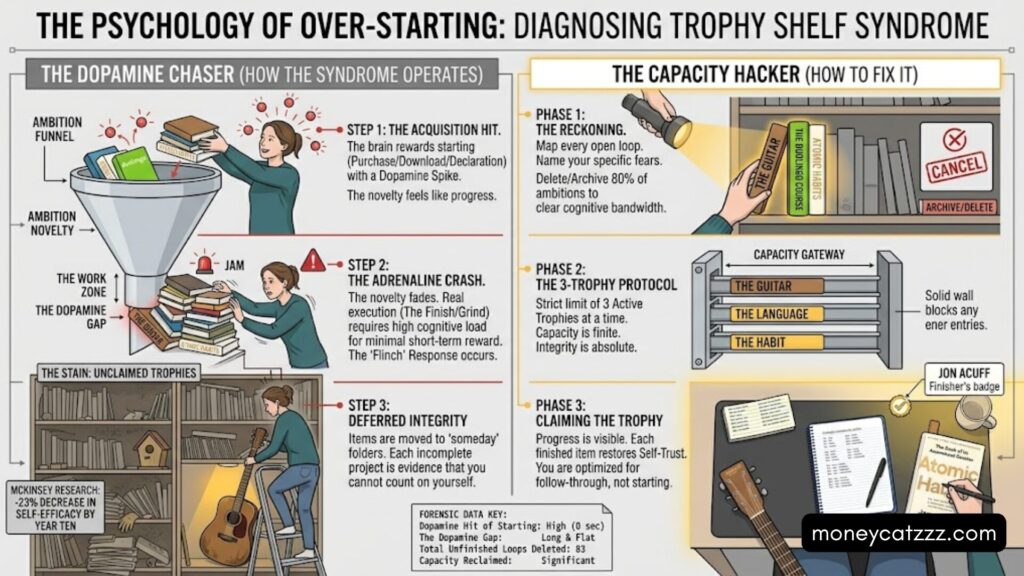
[“The Psychology of Over-Starting” – Image by moneycatzzz.com]
The shelf test: What am I quitting or finishing to make room for this? If the answer is nothing, I cannot start. Something must come off the shelf first.
The completion test: Have I finished anything in the last 90 days? If not, I do not get to start something new. I have to finish something small first. Prove to myself that I can still do it.
These tests might sound strict, and they are. My broken self-trust was not going to heal on its own with gentle encouragement. I needed a system that said ‘no’ to me. I had proven to myself that I could not say no to myself.

The Empty Shelf
Six months after the purge, my shelf looked different. Not empty. But intentional.
Three active trophies. A few finished items I actually claimed. No pile of guilt sitting in the corner, reminding me of who I failed to become.
The biggest change was internal. I started believing my own word again. When I said I was going to do something, I meant it—not because I became a different person, but because I stopped pretending I could do everything. I admitted my capacity was three things at once. Four, if I were redlining. Everything else was just a lie I told myself to feel productive without ever having to finish.
Following through on goals became possible not because I found a secret hack, but because I stopped hoarding ambitions I never intended to pay for. I got honest about my actual capacity. It was smaller than I wanted. But it was real—and for the first time in years, it was enough.
The Final Forensic Polish
If you have a shelf, reckon with it this week. Write down everything you started but didn’t finish. Feel the weight of the paper. Then, delete most of it. Keep three things. Finish one before you allow yourself the luxury of starting anything new.
The department store eventually throws away unclaimed items. Do not wait for someone else to clear your shelf. Do it yourself. Then claim something worth keeping
The Exit Strategy: 3 Manuals for Claiming Your Trophies
Finish

The Dip
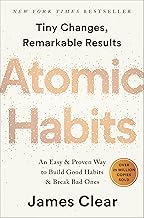
Atomic Habits
Disclosure: This post may contain affiliate links. We only recommend products we believe in, and we may receive a commission at no cost to you! Thank you for your support!
Acknowledgment: Cover Image by moneycatzzz.com
Disclaimer: The information is provided for general information only – moneycatzzz.com makes no representations or warranties in relation to the information, including but not limited to any representation or warranty as to the fitness for any particular purpose of the information to the fullest extent permitted by law. While every effort has been made to ensure that the information provided in this article is accurate, reliable, and complete as of the time of writing, the information provided in this article should not be relied upon to make any financial, investment, real estate or legal decisions. Additionally, the information should not substitute advice from a trained professional who can take into account your personal facts and circumstances, and we accept no liability if you use the information to form decisions.