
 Reading Time: 8 mins #
 This post may contain affiliate links.
There is a scene in Eternal Sunshine of the Spotless Mind where Clementine’s hair dye stains a pillowcase, and even after Joel erases her from his memory, the color is still there—fading into the fabric. Impossible to fully wash out. The person is gone, but the residue persists, leaking into the fibers of a place that was supposed to be safe.
Your bedroom has pillowcases like that. Not stained with hair dye, but with something harder to identify and far more stubborn. You have a limbic leak, and it’s been running so long you’ve mistaken the drip for silence.
I discovered mine not through meditation or therapy or any deliberate act of self-examination, but because Voltaire refused to sleep on my bed.
He’d slept there for two years without interruption, always in the same corner, same kneading ritual, and same slow-motion collapse onto the duvet like a building being professionally demolished. Then one week, he just stopped, stood at the bedroom door, looked at the bed the way you look at a restaurant where you once got food poisoning, and walked to the living room couch instead.
I changed the sheets. I checked for drafts. I bought a new pillow, thinking the old one had developed some offensive smell only feline nostrils could detect. Nothing worked. Voltaire had decided the room was wrong, and no amount of lavender spray was going to overrule his assessment.
It took me three more weeks to understand what he already knew.
The Sweater in the Closet
The bedroom is the most absorbent room in your home. Not in terms of moisture or airflow, though those matter. In terms of nervous system permeability. It functions as a sensory sponge, soaking up whatever emotional frequency you marinate in for seven or eight hours every night. When that frequency is safe, your parasympathetic system does what it was designed to do: restore, repair, consolidate. When that frequency is contaminated, you wake up exhausted from a full night of sleep and blame the mattress.
We talk endlessly about air quality. HEPA filters, humidity percentages, and the off-gassing of synthetic foams. But nobody discusses what I’ve come to think of as emotional off-gassing, the slow-release toxicity of objects that carry the neurochemical signature of your worst years.
I’m talking about specific things. The cardigan from the relationship that ended in a voicemail. The journal you kept during the burnout year, filled with handwriting that looks like it belongs to someone drowning, and the ceramic bowl you bought at a craft market when you were trying to perform “healing“ for an audience of nobody. You’ve kept these items because you believe you’re honoring your history. Your amygdala disagrees. Your amygdala thinks you’ve surrounded your sleeping body with evidence that the threat is still active.
This is the limbic leak. Not metaphorical. Neurological.
Why Your Brain Can’t Tell Time
Here is something your limbic system never learned: the past tense.
Your prefrontal cortex understands chronology. It can file an experience under “2019″ and move on. But your amygdala processes threat in the eternal present. It doesn’t timestamp memories. It tags them with sensations, smells, textures, and ambient light. And when an object associated with a high-cortisol period sits three feet from your unconscious head for six hours every night, your amygdala runs that association on a loop. Somatic playback. Not the dramatic kind, not flashbacks or nightmares necessarily, but the low-grade, cellular kind. The kind that keeps your nervous system idling at a frequency just elevated enough to prevent genuine rest.
Bessel van der Kolk writes extensively about how trauma embeds itself not in narrative memory but in the body’s own sensory makeup. Your muscles remember. Your breathing patterns, remember. The lamp on your nightstand, the one that sat on the desk where you read the rejection email that rearranged your sense of self, is a conduit for that remembering. It doesn’t matter that you’ve “processed” the experience intellectually—the limbic leak doesn’t care about your cognitive conclusions. It responds to proximity and sensation, and it never sleeps even when you do.
This is your limbic load; the cumulative neurobiological weight of every trauma-adjacent object in the room where you are most vulnerable.

[“Why Your Amygdala Sees the Past in the Present” – Image by moneycatzzz.com]
Voltaire’s Diagnostic
Cats are extraordinary environmental assessors, and they audit without sentiment.
Voltaire didn’t stop sleeping on my bed because he was being dramatic. He stopped because the room’s frequency had shifted. I had moved a box of old notebooks from storage into the bedroom closet, temporarily, I told myself, just until I sorted through them. The notebooks were from 2020, the year I nearly lost my business and gained an intimate familiarity with the ceiling at 3 AM — they smelled like the lavender candles I used to burn during panic attacks, a scent my conscious mind found “calming” and my nervous system apparently filed under “active emergency.”
Voltaire could feel what I couldn’t admit. The sensory sponge of my bedroom had absorbed something rotten. He wanted no part of it. He was performing his own somatic playback assessment, instinctively reading the room’s emotional charge the way he reads a change in barometric pressure before a storm — he didn’t need a framework or a vocabulary for it. He refused to rest in a space that wasn’t restful.
I moved the notebooks to the garage that evening. Voltaire was back on the bed by midnight, kneading the duvet with the self-satisfied rhythm of someone who’d been proven right and never doubted it.
The Measuring Tape
To find your own limbic leak, you have to stop being a curator of pain and start investigating it. This requires what I call the forensic sensory audit, which is not the same as decluttering.
Decluttering asks: Do I use this? Does it spark joy? The examiner asks something sharper: What does my body do when I hold this object?
The Pulse Check. Pick up the item. Not quickly, not casually. Hold it. Notice what happens below your neck. Does your chest constrict? Does your jaw tighten? Do your shoulders migrate toward your ears? That is somatic playback. That is your body recognizing the neurochemical era this object belongs to and preparing for a threat that no longer exists in reality but persists in residue.
The Era Analysis. Every object belongs to a period. Some periods were golden. Some were led. If the item in your hand belongs to a lead era, it is contributing to your limbic load regardless of its aesthetic value, its price tag, or the story you’ve constructed about why keeping it makes you “stronger.” Beauty is not immunity. An elegant reminder of suffering is still a reminder of suffering.
The Nightstand Rule. Your nightstand is the closest surface to your unconscious brain. It is, square inch for square inch, the most consequential real estate in your entire life. If anything, sitting on it signals a past threat rather than present safety; it is a source of the limbic leak. It doesn’t matter that it’s “just a photo” or “just a ring dish.” If it belongs to the festering of a wound, it is keeping the wound architectural.

The Decommissioning
Ending a limbic leak is not about decluttering. Decluttering is organizational. This is neurological. You are not tidying. You are decommissioning the surveillance system; your environment has been running against you.
When you remove trauma-coded objects from your neural sanctuary, something shifts that is difficult to describe but impossible to miss. The room feels physically lighter. Not because anything has changed about the air or the square footage, but because your brain has stopped rendering the grief associated with those objects. The sensory sponge begins absorbing different information. Safety instead of vigilance. Present tense instead of somatic playback.
You are not erasing your history. You are not dishonoring the lessons. You are telling your nervous system, in the only language it understands, that the emergency is over. That this room, this bed, this darkness is no longer a theater for rehearsing old catastrophes. You are reclaiming your neural sanctuary not through affirmation or intention but through the most concrete act available: removing the evidence.
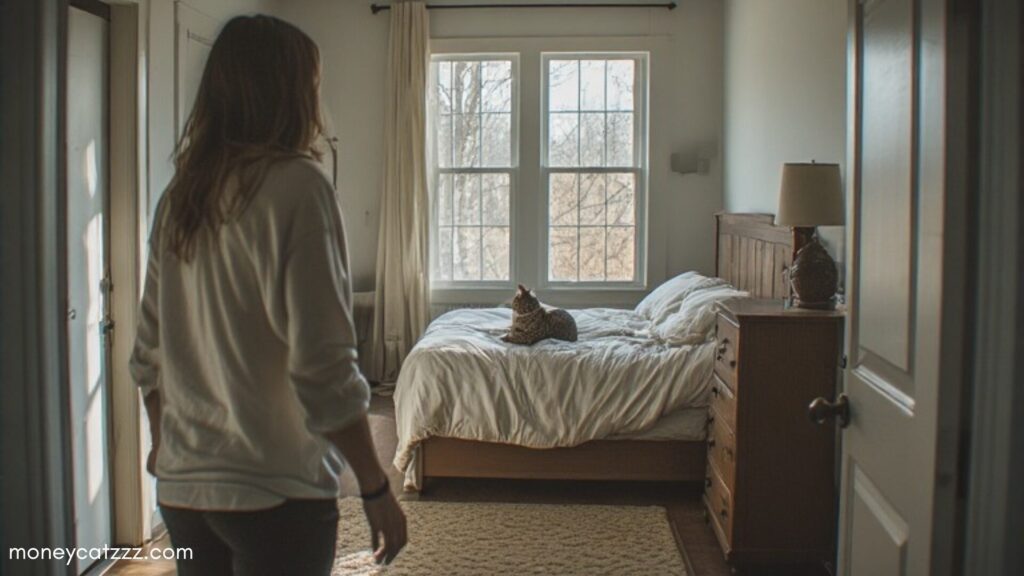
[“Curating Your Parasympathetic Environment” – Image by moneycatzzz.com]
What Voltaire Already Knows
My bedroom is different now. Spare. Warm. The nightstand holds a reading lamp, a water glass, and nothing else. The closet contains clothes from the current chapter, not costumes from the previous ones. The sensory sponge is clean.
Voltaire sleeps in his corner, untroubled. He has no opinion about my emotional growth. He does not care that I spent three weeks journaling about attachment to objects before I could let them go; he cares that the room feels right. That the frequency matches the rest. The limbic leak has stopped dripping.
He knew before I did, of course. He always does — cats don’t sentimentalize their environments, they assess them with the honest, unsentimental clarity of a creature that has never confused comfort with nostalgia and never will.
Your bedroom is either a place of restoration or a museum of your wounds. It cannot be both. And somewhere in your closet, on your nightstand, woven into the very fabric of where you lay your head, there is an object leaking a version of you that no longer needs to exist into the room where the current version of you is trying to heal.
What would your cat refuse to sleep next to?
Valuable and Science-Backed Resource for Deeper Dives
1. The Neuroscience of Emotional Residue: Why Your Space Never Forgets
- Anchors your “Limbic Load” concept in Bessel van der Kolk’s work, providing a clinical foundation for how physical environments trigger somatic memory.
2. The Eternal Present: How the Amygdala Processes Environmental Threats
- A definitive Harvard Health guide that validates your “Why Your Brain Can’t Tell Time” section, explaining how the brain reacts to past-tense triggers in real-time.
3. Environmental Psychology: The Impact of Personal Objects on Mental Health
- Expand your “Forensic Sensory Audit” to the broader field of environmental psychology, showing how the environment shapes our parasympathetic response.

Disclosure: This post may contain affiliate links. We only recommend products we believe in, and we may receive a commission at no cost to you! Thank you for your support!
Acknowledgment: Cover Image by moneycatzzz.com
Disclaimer: The information is provided for general information only – moneycatzzz.com makes no representations or warranties in relation to the information, including but not limited to any representation or warranty as to the fitness for any particular purpose of the information to the fullest extent permitted by law. While every effort has been made to ensure that the information provided in this article is accurate, reliable, and complete as of the time of writing, the information provided in this article should not be relied upon to make any financial, investment, real estate or legal decisions. Additionally, the information should not substitute advice from a trained professional who can take into account your personal facts and circumstances, and we accept no liability if you use the information to form decisions.