 Reading Time: 8 mins #
 This post may contain affiliate links.
The Doomsday Clock is at 85 seconds to midnight. Global existential risk sits at its highest recorded metric in modern history.
Meanwhile, sitting in sweatpants on your couch, you just fired off a career-limiting reply-all email because a vendor took forty minutes to answer a Slack ping.
You need to take a few seconds and pause; the last thing the world needs is another headless chicken.
A red notification badge poses no biological threat, yet your nervous system responds with the panic reserved for an apex predator. Recalibrating that reflex requires neither a two-week digital detox nor a mountain retreat. It simply takes five seconds of strategic friction between an incoming signal and your execution to verify that an unread message will not end the world.
You have been running zero-latency workflows for years. The gap between intention and execution keeps breaking right at the handoff.
The 11:58:35 PM Execution Failure
It was 11:58:35 PM. You were sitting on the edge of an unmade bed, running entirely on stale coffee and decision fatigue.
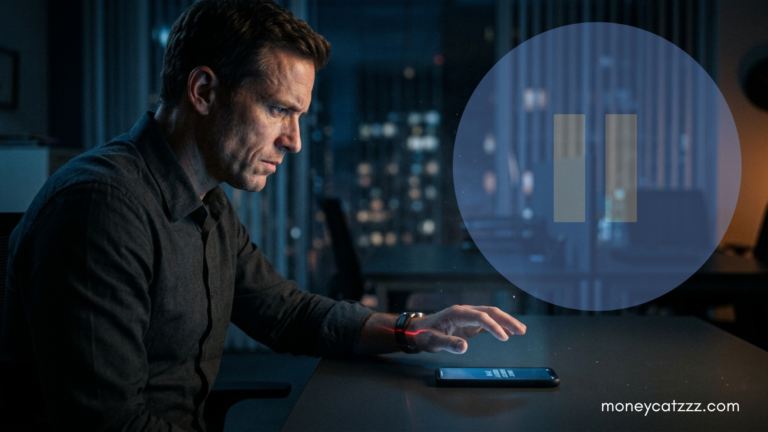
The screen illuminated. A banner notification from your sister appeared: “You always do this.”
Four words. You know the exact history and unspoken resentment behind those four words.
You didn’t verify the input. You executed immediately. A fast, defensive reaction pushed directly through the keys.
You hit send. Your eyes drift to the “next” while your brain takes a few microseconds to file the task as “done.”

[MindValley Promo | Rewire your mind, transform life. | Vishen Lakhiani]
The realization suddenly hits, unlike any “deja vu.” Sitting in the blue glare of your phone, you realize you’ve tripped over the same wire again. The cleanup is always messy: the administrative energy lost to damage control, the defensive back-and-forth, and the middle-of-the-night apology you’ll have to draft tomorrow.
It’s an unforced error, almost a default repeating failure loop with line managers, clients, and colleagues during quarterly review meetings.
The trigger lands. You react without verification and spend the next forty-eight hours managing the fallout. The sequence feels automatic, but it’s simply a system lacking a buffer. The pause sits right there on the nightstand, completely unused.
The Verification Gap
“Between stimulus and response, there is a space. In that space is our power to choose our response. In our response lies our growth and our freedom.” – Viktor Frankl.
Frankl isolated that space inside a concentration camp. You are managing it while looking at an inbox.
The space is real, measurable, and biological. All it takes is five seconds to clear the pipeline.
Yet we bypass this critical buffer constantly because speed is routinely mistaken for competence. An incoming alert hits, the reaction fires, and we call it responsiveness. It isn’t responsiveness; it is an unverified reflex. Your internal architecture doesn’t automatically differentiate between an operational crisis and an inconvenient calendar invite. Engineering that distinction is where you earn your fees.
Zero-latency looks like operational perfection. The flaw in perfection is that it breaks under pressure, whereas the pause is a readily available structural protocol.
The Five-Second Latency Injection
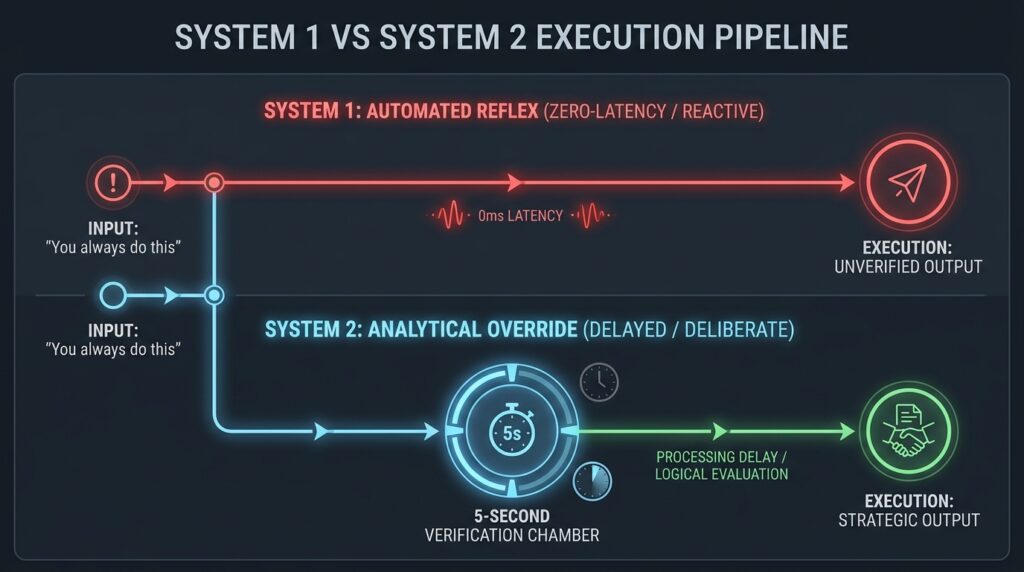
Daniel Kahneman mapped the dual mechanisms driving human decision-making. He summarized these mechanisms into two systemic protocols, System 1 and System 2, as illustrated in this structural execution pipeline:
[Daniel Kahneman’s dual mechanisms System 1 & 2 | moneycatzzz.com]
The Processing Delay
Five seconds isn’t designed to solve a complex strategic crisis on the spot. It simply buys enough time to intercept an unverified impulse before it becomes part of the public record.
This is basic operational hygiene; mindfulness does not come into the equation. Neurological data show that a brief buffer forces your analytical brain to override a raw threat response. Those five seconds are all that stand between a calibrated decision and a week of reputation repair.
Unfiltered speed isn’t engagement; it is un-monitored automation. When you execute without latency, you aren’t communicating – you are just reacting on cue.
The Compound Cost of Unforced Errors
Global systems face genuine structural stress: resource limits, institutional erosion, geopolitical instability. Your unread inbox items do not constitute systemic threats.
When you refuse to build latency into your personal operating system, the damage isn’t always explosive. The cost isn’t paid in a single crisis; it compounds across a trail of burnt opportunities. You become a risk factor that others have to manage. Destabilization is rarely intentional; it is simply the byproduct of executing too fast to notice the structural damage in real time.
The Five-Second Audit
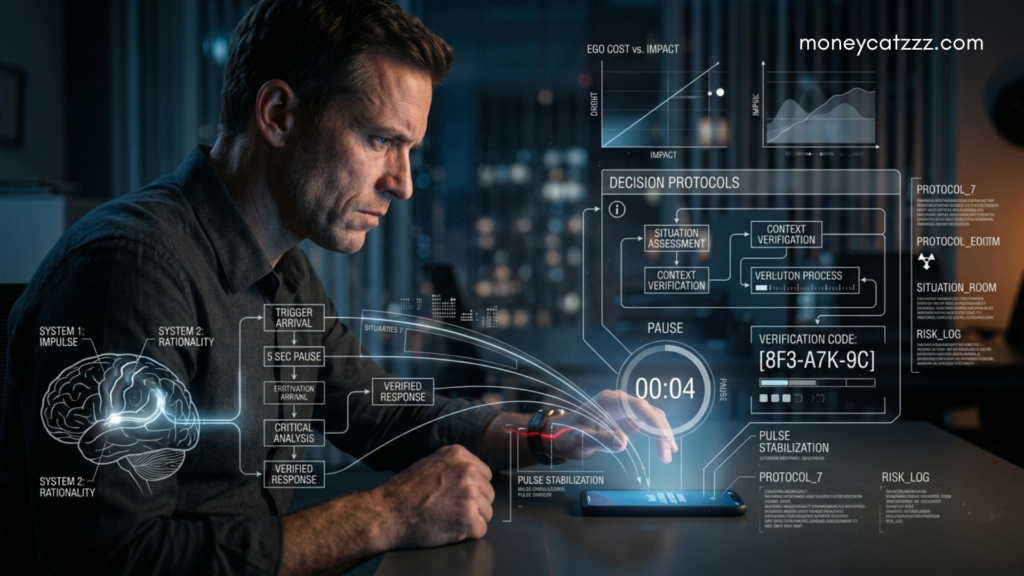
To convert this concept into an operational framework, implement three mandatory verification checks before releasing any output:
- Signal Origin: Identify whether the impulse is driven by tactical necessity or defensive ego.
- Impact Horizon: Evaluate if the response resolves the core issue or merely transfers immediate friction.
- Latency Guarantee: Hold the response for a full five-second count to allow System 2 verification.
If the output fails any check during the five-second window, scrap the draft and recalculate.
The pause isn’t emotional suppression; it is risk mitigation. Five seconds to observe the trigger before your reaction becomes the primary operational threat.
The Verification Environment
The pause can be considered a designated verification chamber.
The trigger opens the input gate; the response seals the output gate. The pause represents the mandatory calibration taking place inside the chamber while the gates are open.
You don’t need to block the incoming data. Do not suppress the physiological spike. Hold the output for five seconds.
In that chamber, you can register the physical signal: the tightened jaw, the elevated heart rate, without letting those physiological markers authorize an immediate send.
Most people panic and bypass the chamber entirely. Input to execution in under two seconds: no verification, no protocol, no freedom.
The chamber remains available on every pass; you have to enforce the latency.
Operational Application: The Director’s Critique
I still experience system breakdowns. I still catch myself drafting aggressive replies before running a sanity check. But latency is now an integrated part of my decision-making framework.
During a recent review, a director dismissed two weeks of my team’s primary analytics with an offhand remark. The biological trigger fired instantly: a spike in body heat, a locked jaw, and an impulse to sharp-shoot his numbers in front of the room.
I started to reply, but held the line.
I stayed in the verification chamber for five seconds and looked at the whiteboard, letting System 1 burn through its initial payload during that window.
The irritation did not disappear, but I ceased operating as an extension of that state. I became the observer running a diagnostic.
When I spoke, I requested clarification on his baseline assumptions. The thread never devolved into an ego battle, and I avoided an entire afternoon of damage control.
That is the true utility of the pause. It does not eliminate anger or render you immune to a trigger; it simply keeps your outputs unautomated.
The trajectory of key relationships shifts when you stop deploying unverified responses. You stop issuing communications that require late-night containment strategies.
[The 5-Second Pause Protocol | moneycatzzz.com]
Implementing Strategic Friction
You don’t need custom productivity tools or complex routines to build this protocol. You need a mechanical rule enforcing five seconds of latency:
- Acknowledge the Signal: Identify the immediate physical indicator upon trigger arrival, such as a tight chest, a locked jaw, or the urge to type rapidly.
- Execute the Buffer: Enforce a mandatory five-second count before committing to any verbal or physical output.
- Interrupt the Automation: Use that window to strip impulse from your response and re-evaluate your position.
Serenity is irrelevant to this process. You are enforcing an operational pause, not a state of Zen.
Your application will be imperfect. Occasionally, the buffer will hold, and that single interruption changes the outcome’s trajectory.
The pause restores the precise agency Frankl identified. If that agency could be maintained inside a concentration camp, it can be maintained while holding a smartphone.
The Failure of Direct Control
Attempting to suppress the initial reaction directly is a design error. You are targeting the wrong stage of the pipeline.
You cannot control the incoming trigger: the late-night message will drop, the sharp comment will occur during the meeting, and the urgent email will be added to your workflow. Nor can you prevent the immediate System 1 signal. The physiological heat will rise, and the defensive posture will register.
Stop trying to block the signal. Focus entirely on controlling the five seconds between the signal and your execution.
The pause isn’t about hiding your response; it’s about delaying its deployment until it can be verified. It is the distinction between feeling an intense impulse and launching an unverified reaction into the world.
Five seconds provides adequate latency.

The Latency Mandate
The Doomsday Clock remains fixed at 85 seconds to midnight. The broader environment stays complex, volatile, and indifferent to your personal bandwidth.
You will remain at your workstation. Still receiving alerts. You will still be managing inputs. The persistent pull toward instantaneous execution remains.
You will now find that the structure contains a built-in release valve, a native feature of your own decision-making pipeline: no external tools required, no custom scripts.
Five seconds. That is the entirety of the operational requirement, and it is entirely within your control.
The workflow does not require faster reactivity. Your notifications are not emergency alarms. The pause is a practical verification system; five seconds to confirm that the current input is not the end of the world.
The fishbowl was always an illusion. The verification chamber remains available on every pass; you have to enforce the latency.
Take five seconds. Breathe. Hold. Process.
_______________________________________________
Required Reading: Books That Master the Space Between Impulse and Action

Man’s Search for Meaning

Thinking, Fast and Slow

The Game of Life and How


Disclosure: This post may contain affiliate links. We only recommend products we believe in, and we may receive a commission at no cost to you! Thank you for your support!
Acknowledgment: Cover Image by moneycatzzz.com
Disclaimer: The information is provided for general information only – moneycatzzz.com makes no representations or warranties in relation to the information, including but not limited to any representation or warranty as to the fitness for any particular purpose of the information to the fullest extent permitted by law. While every effort has been made to ensure that the information provided in this article is accurate, reliable, and complete as of the time of writing, the information provided in this article should not be relied upon to make any financial, investment, real estate or legal decisions. Additionally, the information should not substitute advice from a trained professional who can take into account your personal facts and circumstances, and we accept no liability if you use the information to form decisions.