
 Reading Time: 8 mins #
 This post may contain affiliate links.
Habits of Successful People: A Comprehensive Guide
Time is the one resource we can never get back. Once it’s gone, it’s gone for good, which makes how we spend it one of the most important decisions we make every day.
A McKinsey study found that executives now spend an average of 23 hours a week in meetings—yet up to 70% of that time is considered unproductive. At the same time, data from RescueTime reveals that the average knowledge worker manages just 2 hours and 48 minutes of truly focused, productive work each day. These numbers highlight a sobering truth: even our busiest days can leave us feeling unfulfilled and behind without mindful time management.
Habits of Successful People don’t just come from hard work—it comes from making space for the right work. And that starts with being intentional about how we spend our hours.
“Time is more valuable than money. You can earn more money, but you cannot earn more time.” – Jim Rohn.
One of the quiet superpowers of highly successful individuals is their ability to manage time with clarity and intention. They’ve come to understand that not everything deserves their attention—and some things aren’t worth the minutes they steal.
In the sections, we’ll explore eight everyday habits and distractions that high achievers deliberately avoid. Consider this a gentle invitation to reflect, simplify, and reclaim your time—so you can focus more fully on what truly moves you forward.
Let’s dive in.
1: Procrastination: The Silent Productivity Killer
Procrastination is the most insidious time-waster. A Journal of Clinical Psychology study found that 20% of adults are chronic procrastinators. Successful people, however, tackle tasks head-on.
James Clear, the bestselling author of Atomic Habits, reminds us that meaningful change doesn’t come from grand intentions alone but from the small, steady actions we take each day. As he wisely puts it:
“You do not rise to the level of your goals. You fall to the level of your systems.“
High achievers know this truth intimately. Instead of relying on bursts of motivation or willpower, they build structures around their habits—systems that make it easy to begin, stay focused, and follow through.
Whether setting up their workspace the night before or using simple cues to trigger action, they create an environment where procrastination has less room to thrive. It’s not about perfection—it’s about consistency and making the right choice just a little bit easier, day after day.
To overcome procrastination:
- Break large tasks into smaller, manageable steps
- Use the “two-minute rule “: if a task takes less than two minutes, do it immediately
- Set specific deadlines for tasks and hold yourself accountable

2: Endless Social Media Scrolling: The Modern Time Trap
In our digital age, social media has become a significant time sink. The average person spends 2 hours and 24 minutes daily on social media, according to GlobalWebIndex. Successful people recognize this trap and limit their social media use.
In his book “Deep Work,” Cal Newport argues for the importance of focused, uninterrupted work. He suggests that the constant switching between tasks, often prompted by social media notifications—severely hampers our productivity.
To curb excessive social media use:
- Set specific times for checking social media
- Use apps to block social media during work hours
- Remove social media apps from your phone

3: Toxic Relationships: Emotional Energy Drains
Successful people understand that time isn’t just about minutes on a clock—it’s also about emotional energy. They avoid spending time with individuals who consistently drain their energy or bring negativity into their lives.
In “The 7 Habits of Highly Effective People,” Stephen Covey emphasizes the importance of surrounding yourself with positive influences. He writes:
“The key is to keep company only with people who uplift you, whose presence calls forth your best. “
To manage toxic relationships:
- Set clear boundaries with negative individuals
- Spend more time with people who inspire and motivate you
- If necessary, be willing to end relationships that consistently bring you down
4: Perfection Pursuit: The Enemy of Progress
While attention to detail is essential, an obsession with perfection can be paralyzing. Successful people understand that done is often better than perfect.
In “Essentialism: The Disciplined Pursuit of Less,” Greg McKeown argues for the importance of progress over perfection. He states:
“If you focus on your lack, you lose what you have. If you focus on what you have, you gain what you lack. “
To overcome perfectionism:
- Set realistic standards for your work
- Embrace iteration—improve your work over time rather than aiming for perfection from the start
- Practice self-compassion when things aren’t perfect
5: Indecision: The Paralysis of Overthinking
Analysis paralysis can be a major time-waster. Successful people know when to gather information and when to make a decision and move forward.
Jeff Bezos, founder of Amazon, uses a “regret minimization framework” for decision-making. He asks himself which choice he’s least likely to regret when he’s 80, then acts on that decision, empowering himself with the confidence to make timely decisions.
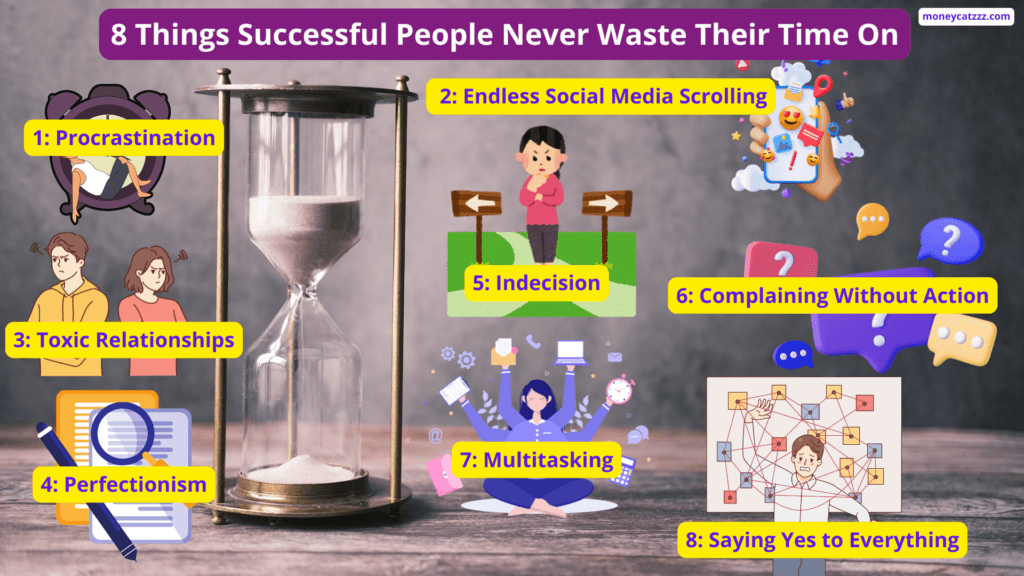
[“8 Things Successful People Never Waste Their Time On” – moneycatzzz.com]
To overcome the trap of indecision:
Start by giving yourself clear deadlines for making choices—big or small. Decisions can stretch endlessly without a boundary, draining your energy and momentum.
Try using the 5-second rule, popularized by Mel Robbins: the moment you feel the instinct to act on a goal, count down—5, 4, 3, 2, 1—and then physically move. Whether it’s sending the email, making the call, or getting out the door, that slight shift from thought to motion can break the cycle of hesitation.
And remember this: most decisions aren’t permanent. You can course-correct. In many cases, taking any step is far less risky than staying stuck in a loop of overthinking. Clarity often comes from action, not endless reflection.
6: Complaining Without Action: The Unproductive Habit
Successful people understand that complaining without taking action to address the issue is a waste of time and energy—they focus on solutions rather than dwelling on problems.
As Tony Robbins often says:
“Identify your problems but give your power and energy to solutions. “
To move from complaining to problem-solving:
When a challenge arises, resist the urge to dwell on what’s wrong—and instead, train your mind to ask, “What can I do about this?” Begin by brainstorming possible solutions, even if they feel imperfect at first. The goal isn’t to have all the answers right away but to shift into a mindset of action and possibility.
Focus your energy on what’s within your control. External factors will always be part of the equation, but your response—your attitude, your effort, your next step—is something you do get to shape.
And when negativity creeps in, practice gratitude. It’s not about ignoring problems but about widening your perspective. Gratitude helps reframe your thinking, reminding you of what’s still working, what you’ve already overcome, and what’s still possible. From that place, solutions come more easily—and so does peace.

7: Multitasking: The Productivity Myth
We often pride ourselves on our ability to juggle multiple tasks simultaneously—but the science tells a different story. Research from Stanford University found that multitasking can slash productivity by as much as 40%.
Despite its widespread appeal, multitasking isn’t a badge of efficiency—it’s one of the biggest drains on focus and output. When we constantly switch between tasks, our brains struggle to keep up, leaving us scattered and less effective. Truly productive people know that doing one thing well, with full attention, is far more powerful than doing five things halfway. In the end, presence beats busyness every time.
Successful people know the power of doing one thing at a time. By giving their full attention to a single task before moving on, they’re able to focus better and produce higher-quality work.
Want to improve your focus? Try this:
- Use the Pomodoro Technique: work for 25 minutes, then take a short break
- Clear distractions from your space
- Practice mindfulness to train your attention and stay present
- Small changes like these can make a big difference in how deeply—and effectively—you work.
8: Saying Yes to Everything: The Overcommitment Trap
Successful people understand the power of saying “no.”—only saying “yes” to opportunities that align with their goals and values.
Warren Buffett famously said:
“The difference between successful people and successful people is that successful people say no to almost everything. “
To avoid overcommitment:
- Define your priorities and goals clearly
- Before saying yes—ask yourself if the opportunity aligns with your objectives
- Practice saying no graciously but firmly
Case Studies: Tim Ferriss
When Tim Ferriss realized his 80-hour workweeks were draining his life, he didn’t just make tweaks—he reimagined everything. Through bold experimentation, he discovered that much of what consumes our time is neither urgent nor important. By outsourcing, batching similar tasks, and saying no to anything misaligned with his goals, he compressed his workweek to just four hours—giving him space to do what truly mattered—write, create, and connect. The result is a bestselling book that sparked a global movement, a thriving podcast, and a lifestyle prioritizing freedom over busyness. Ferriss’s story reminds us that when we reclaim our time—we reclaim our lives.
Final Thoughts
Truly successful people treat their time with the same care and intention as their health or finances. They understand that once spent time is gone forever—and how they use it shapes their productivity and their entire life trajectory. By consciously steering clear of common time traps, they create space for the work that matters most, the relationships that fuel them, and the rest that restores them. It’s not about grinding harder or packing more into each day—it’s about making wiser choices with the time you already have.
Start today by identifying which time-wasters are most prevalent in your life. Choose one to focus on eliminating this week. Small, consistent changes in managing your time can lead to transformative results in your personal and professional life.
Disclosure: This post may contain affiliate links. We only recommend products we believe in, and We may receive a commission at no cost to you! Thank you for your support!
Acknowledgement: Cover Image by Unsplash.com
Disclaimer: The information is provided for general information only – moneycatzzz.com makes no representations or warranties in relation to the information, including but not limited to any representation or warranty as to the fitness for any particular purpose of the information to the fullest extent permitted by law. While every effort has been made to ensure that the information provided in this article is accurate, reliable, and complete as of the time of writing, the information provided in this article should not be relied upon to make any financial, investment, real estate or legal decisions. Additionally, the information should not substitute advice from a trained professional who can take into account your personal facts and circumstances, and we accept no liability if you use the information to form decisions.