
Reading Time: 8 mins #
This post may contain affiliate links.

“The silence you fear is louder than the words you won’t speak.”
Six months ago, I approved an overly optimistic project budget. The sequence crashed. A colleague spent three consecutive weekends fixing the operational fallout of my choice, while I stayed silent. I kept drafting explanatory emails, editing them for tone, and deleting them.
Â
The imaginary line between silence and admission was a complete illusion. I was bleeding critical cognitive capacity on an imagined future of judgment and loss of credibility. None of those consequences had actually happened, as no action was taken.
Â
This corporate stalling technique is a common trap. Professional plotting isn’t preparation—it’s a cage with an open door. You forgot that you built it yourself.
The Pattern I See Everywhere
One founder I advised spent fourteen months designing her exit from a toxic partnership. Angela consulted three separate attorneys and ran exhaustive financial models. She rehearsed the confrontation endlessly. Yet, she took zero real action.
Â
Another executive spent eight weeks preparing to fire an under-performing VP of Sales. He read management guides, spoke with HR, and compiled redundant metrics. Meanwhile, the sales pipeline collapsed. The team became demoralized—the plotting continued.
Â
I see this pattern everywhere. High-performers substitute elaborate plans for direct execution. They think they are being strategic. In reality, they burn energy on a performance of preparation that replaces the actual work.
The Energy Economics of Strategic Delay
Every hour spent over-analyzing an avoided conversation means carrying the dead weight of delay. Angela spent over a year in perpetual exit planning. It split her focus and divided her operational attention.
Â
The underlying drain came from the unresolved decision, not the partnership itself. Research on decision fatigue by psychologist Roy Baumeister shows that unresolved decisions continuously drain cognitive resources. Ongoing plotting blocked action. It forced Angela to spend energy on a resolved issue as if it were still up for debate. Delay compounds the cost.
[The Invisible Leak: Cognitive Fatigue Under Stagnation | moneycatzzz.com]
The Taboo You’re Protecting
Most corporate stalling protects an unspoken taboo.
Â
For me, the taboo was admitting a clear failure. Acknowledging the bad budget call felt like a display of incompetence. For Angela, the taboo was admitting a bad structural hire. Smart founders aren’t supposed to pick the wrong partners. For the executive stalling the termination, it was a violation of his self-image as a compassionate leader.
Â
Â
The extensive planning functioned as psychological protection. As long as he stayed in “due diligence,” he wasn’t the executive firing someone. Protecting this personal taboo cost his company $40,000 per month in missed targets. Brené Brown writes in Dare to Lead about how we avoid hard conversations to protect ourselves from discomfort, and in doing so, we create bigger problems that require harder conversations later. The plotting is a down payment on a larger bill that accrues interest.
Books to Shatter Executive Silence and Rewrite Your Leadership Blueprint
The First Step
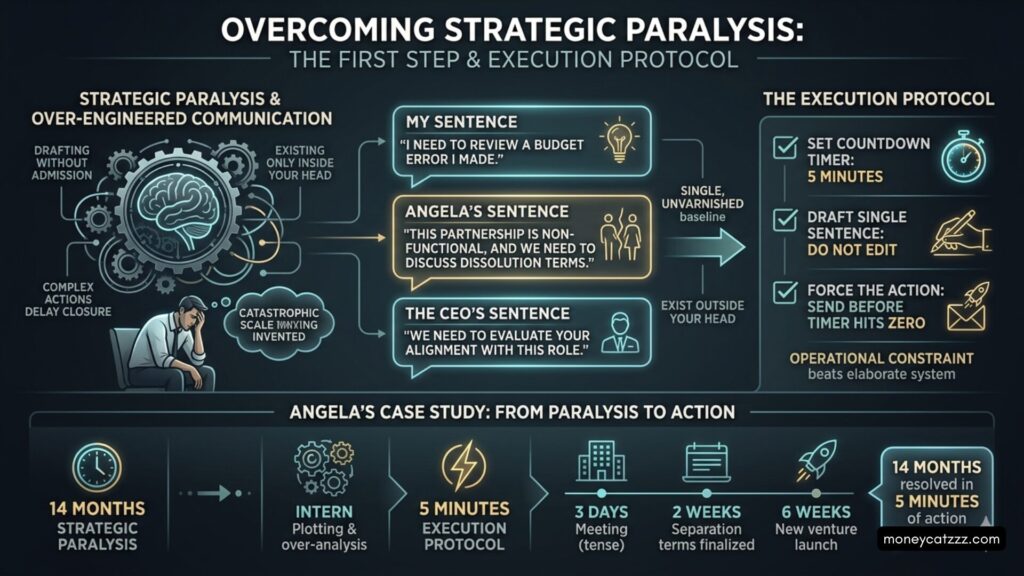
Breaking this loop requires an immediate, imperfect baseline. Forget grand corporate addresses or flawless presentations. The first step is a single, unvarnished sentence.
- My sentence: “I need to review a budget error I made.”
- Angela’s sentence: “This partnership is non-functional, and we need to discuss dissolution terms.”
- The CEO’s sentence: “We need to evaluate your alignment with this role.”
This communication needs no defensive scaffolding. It just needs to exist outside your head. I finally sent my email late on a Tuesday. The timing wasn’t strategic. I had stopped editing. The reply arrived the next morning: “I know. Thanks for finally addressing it.” The delay only amplified the friction.
The Execution Protocol
To break the cycle of over-engineering communication, use a strict operational constraint instead of an elaborate management system:
- Set a countdown timer for five minutes.
- Draft the single sentence you are avoiding. Do not edit.
- Force the action by sending it before the timer hits zero.
Angela deployed this method. After fourteen months of strategic paralysis, she spent five minutes drafting and sending a single line about dissolution. The meeting occurred three days later. It was tense.
Â
However, it lacked the catastrophic scale she had spent a year inventing. They finalized the separation terms within two weeks. The new venture launched six weeks later. Fourteen months of internal plotting resolved through one focused action.
[The Execution Protocol & First Step | moneycatzzz.com]
The Hidden Cost of Avoidance
The executive who stalled the VP termination spent eight weeks preparing for a meeting that lasted twelve minutes.
Â
The true cost was the cultural rot within the sales division, not the short meeting. Three of his highest-performing reps resigned during those eight weeks, exhausted from carrying the slack.
Â
The delay cost more than any direct action ever could. High-performers mistake procrastination for thoroughness because the real task threatens their identity. They reframe avoidance as careful preparation while the balance sheet pays for their comfort.
Reclaiming Cognitive Capacity
My colleague was frustrated by the silence, not the budget error. The unacknowledged mistake eroded his trust far more than the broken spreadsheet. The apology didn’t fix the numbers, but it halted the internal plotting and plugged the energy leak.
Â
The moment you cross that line, the heavy burden shifts. The relief of direct action is immediate because you stop spending capital on concealment. Taking an imperfect first step returns that misallocated energy directly to real-time operations.
Erasing the Line
The boundary between planning and execution feels massive from the wrong side of the line. Once crossed, you realize the barrier was entirely self-inflicted, reinforced daily by rehearsed scenarios.
Â
Action comes from realizing the line is an illusion. Taking the first step proves it.
Â
The execution protocol works because it cuts off the recursive loop before it hardens into permanent paralysis. Write the line. Send it before you can refine it into a safe, useless compromise. An imperfect message sent on a Tuesday night drives a real resolution by Wednesday morning.
Â
Identify the exact sentence you are currently hiding inside your head. The perfect moment does not exist, and the text won’t fix itself. You must take an imperfect first step to break the stagnation. Stop planning, initiate action, and run the play.
Â
The silence you are protecting degrades your leadership more than any clean, direct action ever will. Open the door and take that imperfect first step today.
_______________________________________________
Disclosure: This post may contain affiliate links. We only recommend products we believe in, and we may receive a commission at no cost to you! Thank you for your support!

Acknowledgment: Cover Image by moneycatzzz.com
Disclaimer: The information is provided for general information only – moneycatzzz.com makes no representations or warranties in relation to the information, including but not limited to any representation or warranty as to the fitness for any particular purpose of the information to the fullest extent permitted by law. While every effort has been made to ensure that the information provided in this article is accurate, reliable, and complete as of the time of writing, the information provided in this article should not be relied upon to make any financial, investment, real estate or legal decisions. Additionally, the information should not substitute advice from a trained professional who can take into account your personal facts and circumstances, and we accept no liability if you use the information to form decisions.