
 Reading Time: 8 mins #
 This post may contain affiliate links.
James Dyson bypasses the sanitized safety of research sessions and planning committees. He skips the endless, circular debates over cyclonic theory. Instead, he commits to 5,126 distinct, physical collisions with reality: raw, mechanical attempts that result in 5,126 broken machines before he finds the one that works.
His preparedness is forged in the grime of the workshop, not the syllabus. He doesn’t rehearse the invention; he invents it badly, repeatedly, and with the understanding that the only research that matters is the kind that leaves grease on your hands.
I think about Dyson every time I watch someone spend three years trapped in a Cognitive Loop of preparation for something that could have been validated in three weeks. They are protecting themselves from the vulnerability of the “First Pot” by hiding behind a shield of professional development.
I have a friend. Smart, capable, genuinely talented. Seven years ago, he decided he wanted to make documentary films. Reasonable ambition. Achievable goal. He read every book on cinematography. He completed four online screenwriting courses. He attended film festivals across three continents to “understand the industry.” He built a $15,000 equipment setup before filming a single frame; he is still preparing to this day!
Zero films. Seven years. A perfect rehearsal for a performance that never came.
What I eventually realized, and what took me an uncomfortable conversation to say out loud to him, was that this career change required no research at all. It required a decision. The research wasn’t prepared. It was protection. Protection from the vulnerability of making something real that real people could judge. The equipment wasn’t an investment. It was a costume for a character he hadn’t decided to become yet.
This is the Rehearsal Addiction. And it is far more common and far more sophisticated than anything we typically label procrastination.
The Pathology of a Life in Rehearsal
Every theater company has one. The actor who knows every line of every play ever written. Who has studied every great performance on record? Who has taken every masterclass available? Who can discuss Stanislavski and Meisner with genuine authority? Who has never once walked onto a stage.
They’re not untalented. They’re not even particularly nervous. They’re addicted to the rehearsal itself because rehearsal is safe, contained, and always improvable. There is always one more technique to study, one more performance to analyze, one more workshop to complete before the real thing begins.
In actual theater, this addiction has a natural cure: opening night arrives whether you’re ready or not, the director calls places, and the curtain moves. You either perform, or you don’t. The deadline is structural, built into the setup itself.
In life, there is no opening night unless you build one yourself. Without a forced deadline, the rehearsal can expand to fill every available year. The curtain doesn’t come down on rehearsal—it comes down to the performance, and for some people, it comes down before they ever perform at all.
This is the central problem with preparedness culture: it has removed the opening night from the equation entirely.
The Sophisticated Disguise
What makes the Rehearsal Addiction so difficult to identify and interrupt is that it looks, from every external angle, like exactly the right thing to be doing. The person taking their fourth course before launching their business looks responsible. The writer reading their fifteenth book on craft before starting their novel looks serious about their work. The entrepreneur running their third round of market research before making a single sale looks thorough.
We celebrate this. We mistake it for diligence. We often participate in it ourselves while advising others, to start.

Steven Pressfield identified the mechanism precisely in calling it Resistance, the force that prevents creative work from being made, and his crucial insight is that Resistance is most dangerous when it’s most disguised. Fear is identifiable. You can name fear and argue with it. But the Resistance is wearing professional development clothing, carrying a course syllabus, and explaining that you need a little more knowledge before you begin. That’s almost impossible to confront because it sounds completely reasonable.
The internal logic of the rehearsal addict is always defensible in isolation:
“I’ll launch when I have more savings.” Reasonable.
“I’ll write when the children are older.” Understandable.
“I’ll start the podcast when I’ve mastered audio production.” Sensible.
Together, these statements form a life that never quite begins. Each one is a trapdoor, dropping you further into the readiness trap disguised as wisdom.
The Research That Makes It Worse
Psychologist Barry Schwartz spent years studying what he labels “maximizers,” people who need to identify the optimal option before committing to any decision. His findings, detailed in his TED Talk on the Paradox of Choice, are both fascinating and quietly devastating.
Maximizers consistently achieve objectively better outcomes than people who choose “good enough.” They also report lower life satisfaction, higher rates of depression, and persistent regret, even after achieving successful decisions.
The reason is structural. Overthinking has no natural endpoint. There is always more information available, always another variable to consider, always a slightly better option that might emerge if you wait a little longer. The maximizer’s brain treats incompleteness as a problem to be solved rather than a condition to be accepted. So the research continues. The decision doesn’t arrive. The years pass.
This is analysis paralysis in its most educated form. Research published in the Journal of Personality and Social Psychology confirms Schwartz’s findings. Beyond a certain threshold of information, additional data consistently decreases decision quality and increases regret. The preparedness that feels like it’s reducing risk is actually manufacturing it.
TED Talk on the Paradox of Choice | Barry Schwartz – courtesy of YouTube/TED Talk
What You’re Really Protecting
When I finally cornered my filmmaker friend, the silence grew uncomfortable. I bypassed the accusatory “Why haven’t you started?” and the clinical “What’s stopping you?” questions that only invite more strategic lying and defensive analysis. I asked the only question that matters: “What are you actually afraid of?”
The answer stripped away the illusion of technical inadequacy. He wasn’t fearing a lack of gear or knowledge; he was fearing the weight of being known. He was terrified of producing something ordinary that real people could judge. He was avoiding the moment where he would be seen “doing” the work and discovered to be less than the theoretical genius he’d cultivated in private.
His preparation acted as a permanent suit of armor, protecting him from that exposure at the cost of the entire enterprise. This is the true function of perfectionism. It doesn’t safeguard quality; it safeguards identity. It preserves the idea of yourself as someone extraordinary: kept in amber, never tested, never risked, and ultimately, never real.

[The Armor of Information: Hiding Behind the Syllabus | moneycatzzz.com]
The Ceramics Classroom
David Bayles and Ted Orland tell a compelling story that belongs in every conversation about preparedness and perfectionism. A ceramics teacher divides his class into two groups at the start of the semester. The quantity group will be graded solely on the number of pots they produce. Fifty pots earn an A, forty a B, and so on. The quality group will be graded on producing a single perfect pot.
At the end of the semester, the best work came entirely from the quantity group. The quality group had spent the term theorizing about perfection, studying glazing techniques, and planning their ideal pot. The quantity group had spent the term making pots, failing at pots, learning from failed pots, and making better pots as a result.
The path to quality runs directly through quantity, and readiness runs directly through unreadiness. Hardly top motivational language, but it’s the documented result of an actual classroom experiment that has been replicated across disciplines and confirmed by decades of research.
Dyson understood this intuitively. You build your way there, one failed attempt at a time, each failure teaching something no amount of preparatory study could have delivered.
The Infinite Game You Cannot Win
James Carse drew a distinction that reframes Rehearsal Addiction in a genuinely clarifying way with a game analogy. Finite games are played to win—they have defined endpoints, clear rules, and a moment of completion. Infinite games are played to continue playing. There is no winning condition, no endpoint, no final state of readiness.
The readiness trap turns your life into an infinite game. You cannot win it because winning isn’t the structure—continued preparation is. Every course completed reveals three more worth taking. Every book read generates a reading list. Every skill developed reveals an adjacent skill that has not yet been developed.
Waiting to be ready is waiting for the rules of an infinite game to suddenly produce a finish line—they won’t. Readiness is not a destination you reach through sufficient preparation. It is a feeling you manufacture in retrospect, after you have already done the thing, when you look back and realize you were capable all along.
Ask anyone who has done anything significant when they felt ready. The answer is consistent across disciplines, cultures, and contexts. They didn’t—they started anyway.
The Performance Protocol
The antidote to the Rehearsal Addiction is not recklessness. It is not abandoning preparedness as a value or treating research as inherently suspect. Some preparation genuinely serves action. A surgeon should study before operating. A pilot should train before flying.
The question that distinguishes useful preparation from the Rehearsal Addiction is simple and uncomfortable: Am I learning something that will change what I do, or am I learning something that delays when I do it?
If the honest answer is the latter, you have identified your Resistance. The preparation is not serving the action. The preparation has replaced it.

The Minimum Viable Action
The Minimum Viable Action (MVA) shifts the focus from the product to the movement. It ignores the abstraction of the “Minimum Viable Product“ and demands the smallest possible execution that constitutes “doing” rather than “planning”.
- For the writer: This means one published paragraph that bypasses the safety of a private manuscript or a polished, hidden essay in favor of a single string of sentences exposed to a public audience.
- For the filmmaker: This is a sixty-second video posted for strangers. It abandons the grand theory of a feature film or a festival entry for the raw vulnerability of a single frame that a stranger can actually watch.
- For the entrepreneur: Just one sale to a stranger with no social obligation to say “yes” that trades the vanity of business plans, logos, and registrations for the binary reality of a single, cold transaction.
The MVA breaks the seal on the performance. It artificially installs an “Opening Night” by forcing the work into the world before the preparation is complete. As it turns out, this is the only state in which the work ever becomes real.
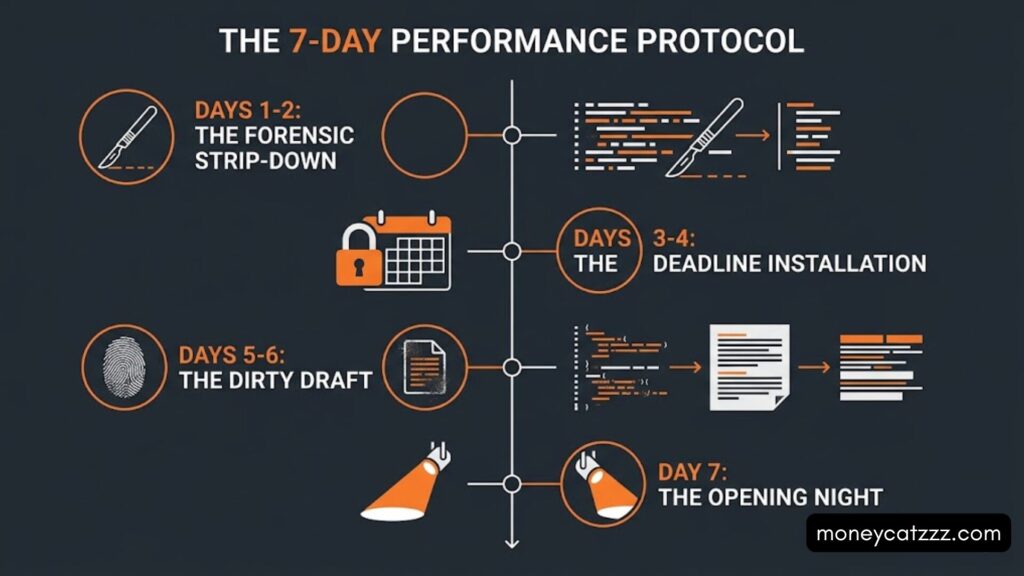
[The 7-Day Performance Protocol: A Map Out of the Wings | moneycatzzz.com]
The 7-Day MVA Challenge: From Rehearsal to Reality
If you are trapped in a Readiness Trap, your psychology will prevent you from “feeling” ready. You must use Orchestration to manufacture a start through a structural schedule.
- Days 1-2: The Forensic Strip-Down. Identify your “Sophisticated Disguise“. What research are you doing that is actually a shield? Strip your project down to its MVA: the smallest version that a stranger can judge.
- Days 3-4: The Deadline Installation. Commit to a hard date. Tell one person or pay an entry fee. Create a structural consequence for staying in the wings.
- Days 5-6: The Dirty Draft. Execute the MVA badly. Like Dyson’s prototype, it is allowed to fail. The goal is not quality; it is the “Quantity Protocol” of getting the first “pot” on the shelf.
- Day 7: The Opening Night. Publish the paragraph. Post the 60-second clip. Ask for the sale—break the seal.
The Accountability Pivot
The 7-Day MVA is not a productivity hack; it is a surgical intervention against a life spent in the wings. It forces the “Opening Night” that your internal resistance has been trying to postpone indefinitely. You must install this schedule because, left to your own devices, you will wait for a feeling of readiness that is never coming. You must act now, because while you are busy “preparing,” the clock is indifferent to your progress.
The Curtain Is Already Moving
The theatrical here is a mechanical reality: the curtain moves on schedule, indifferent to your feelings. Your life operates on the same clock. The years are already counting; they aren’t waiting for you to feel “ready”.
My filmmaker friend is forty-two with seven years of “preparedness” and zero films. The gap between his impressive knowledge and his total lack of output isn’t a technical problem—it’s a decision he refuses to make, dressed in the clothing of a research project. His research was finished years ago. Now, he either walks onto the stage or dies in the wings, perfectly prepared for a performance that never happened.
Death doesn’t wait for the dress rehearsal to end. The curtain moves regardless.
What have you already researched enough to begin?
The Exit Interview: What the Dying Actually Regret
Letting Go

Art and Fear
Finite and Infinite Games
Disclosure: This post may contain affiliate links. We only recommend products we believe in, and we may receive a commission at no cost to you! Thank you for your support!
Acknowledgment: Cover Image by moneycatzzz.com
Disclaimer: The information is provided for general information only – moneycatzzz.com makes no representations or warranties in relation to the information, including but not limited to any representation or warranty as to the fitness for any particular purpose of the information to the fullest extent permitted by law. While every effort has been made to ensure that the information provided in this article is accurate, reliable, and complete as of the time of writing, the information provided in this article should not be relied upon to make any financial, investment, real estate or legal decisions. Additionally, the information should not substitute advice from a trained professional who can take into account your personal facts and circumstances, and we accept no liability if you use the information to form decisions.