
 Reading Time: 8 mins #
 This post may contain affiliate links.
The contractor didn’t raise his voice. That was the worst part. He just pointed at the wall, my wall, the one I had designed around, measured three times, defended to my wife for six months, and said, “This needs to come down. It’s not doing what you think it’s doing.”
I laughed. Then I patiently explained why he was wrong. I had the blueprints. I had the load calculations. I had spent three weeks researching foundation types. I was right.
He nodded and said, “Okay. Get a second opinion.”
So I did. The second opinion agreed with him. Then a third opinion agreed with both of them—four professionals; zero confidence in my wall. And me, Mr. Know-it-all, was red-faced, standing in my half-renovated studio, holding a folder full of research that apparently meant nothing.
The moment of my humbling had begun. I was wrong. I realized I had confused being right about details with being right about the whole.
The Wall I Refused to See
The renovation was supposed to take four months. It took eleven. It was mainly a combination of supply chain issues and bad weather, but mostly it was because of me. I had drawn a line in the concrete and refused to cross it. That wall was staying. I had built the entire project around that assumption. Removing it meant admitting that weeks of work had been wasted. That I had been wrong about something fundamental.
So I defended. I found articles that supported my position. I quoted experts who agreed with me (two, both from forums, both anonymous). I told myself the contractor was being overly cautious. I told myself the second opinion was covering his liability. I told myself a lot of things.
Adam Grant calls it “cognitive entrenchment,” the tendency to hold onto our beliefs even when the evidence crumbles beneath them. We don’t defend our ideas because they’re strong. We defend them because admitting they’re weak feels like admitting we’re weak.
I was not weak. I was standing in a room full of people who could see what I couldn’t.
The humbling feeling arrived in waves. First came the irritation; the contractor was obviously wrong, then came the anxiety: what if he wasn’t? What followed was worse—the quiet realization that I had been defending a wall that was, according to every person who actually knew what they were talking about, cracked at the foundation.
Ryan Holiday describes this as the “war of art,“ the battle between what we want to be true and what actually is true. The ego doesn’t protect us. It protects the story we tell ourselves, and no matter how well constructed, it collapses the first time reality pushes back.
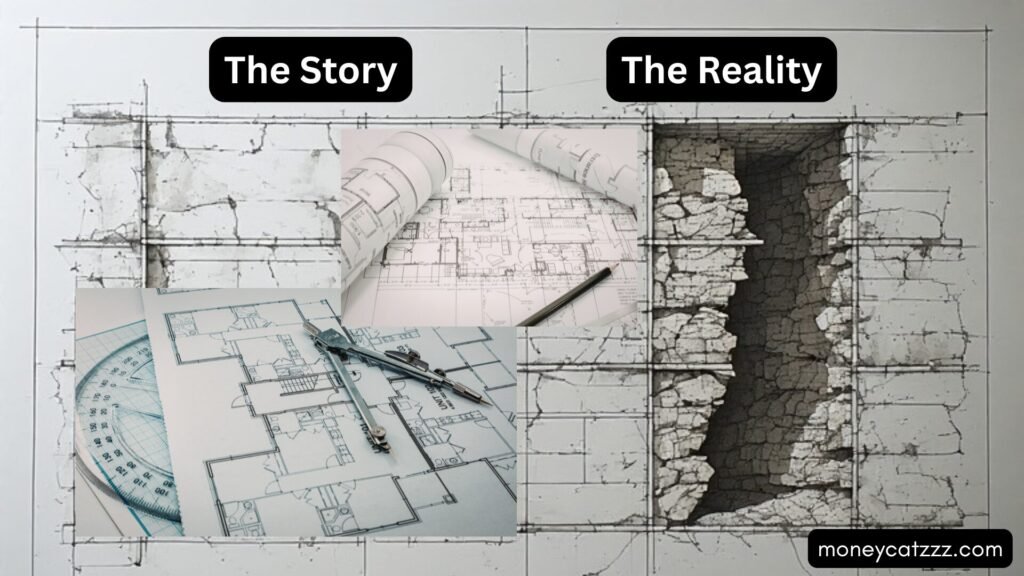
[“Cognitive Entrenchment vs. Reality” – Image by moneycatzzz.com]
What Ego Protects (And What It Destroys)
So what I was protecting: my reputation as someone who does things correctly. My identity as a person who doesn’t waste time or money. My sense of being competent enough to manage my own renovation without being made a fool of.
Here is what my ego destroyed: three months of calendar space, two thousand dollars in wasted materials, my wife’s patience, and the trust of a contractor who had been trying to help me from day one.
Ego is not confidence. Confidence says, “I can figure this out.” Ego says, “I have already figured it out, and anyone who disagrees is wrong.” One is open to new information. The other is a fortress with no doors.

The Dunning-Kruger effect, first documented at Cornell and the University of Michigan, shows that people with low competence in a domain consistently overestimate their ability. The less you know, the more certain you feel. The more you learn, the more you realize how much you don’t know.
I had learned enough about renovation to be dangerous. Not enough to be right. Just enough to believe I was.
This “what you see is all there is” cognitive bias leads us to make decisions based only on the information in front of us and to assume whatever is missing doesn’t matter¹. I saw my blueprints. I saw my measurements. I did not see the crack in the foundation because I had not looked for it. And I had not looked for it because finding it would have made my life harder.
The humbling sensation is not a punishment; it is the feeling of reality entering a room where you have been sitting alone with your assumptions.
The Certainty Trap
Certainty feels good, but it is a trap. Your brain releases dopamine when you are sure about something. Being right is chemically rewarding. Being wrong feels like a threat. So your brain learns to protect certainty at all costs, even when that certainty is killing your project, your relationships, or your reputation.
I spent eleven months in the certainty trap. Every time the contractor suggested an alternative, I felt attacked. Every time my wife asked if I was sure about the wall, I felt doubtful, and every time I walked into the studio, I felt a low-grade anxiety that I had refused to name.
The trap works like this: you mistake defense for strength. You mistake resistance for conviction. You tell yourself you are standing your ground when you are actually just afraid to move.
An Atlantic post on humble leadership found that CEOs with higher humility ratings have teams that perform better, stay longer, and report greater job satisfaction. This is not because humble leaders are soft, but because humble leaders update their beliefs when new information arrives—they don’t defend; they adapt.
I was not adapting. I was digging in. The wall was not getting stronger, and neither was I.
Your Defenses Are a Map
The breakthrough came when I stopped asking “Am I right?” and started asking “What am I protecting?”
Every defense mechanism is a map that shows you exactly where you feel vulnerable. The things you refuse to question are the things you are most afraid to lose. That fear is not a weakness. It is a signal.
I was defending the wall because I was afraid of looking stupid. Afraid of wasting money. Afraid of admitting to my wife that I had been wrong for months. Those were not bad fears—they were just poorly placed. I was spending enormous energy protecting my ego when I could have spent that energy fixing the actual problem.
The humbling was not the moment I admitted I was wrong. The humbling moment was when I realized I had been working against myself. The wall was not my ally. It was my cage.
The Laws of Human Nature has a chapter on ego that I reread until the pages softened. Greene writes that the ego’s primary function is to protect us from pain. But the ego cannot tell the difference between useful pain (learning something new, admitting a mistake, changing course) and destructive pain (insults, attacks, genuine threats). So it blocks everything, including the information that could save you.
My ego had been blocking the contractor for months. It was not because he was threatening me, though he did occasionally. It was because he was threatening my story about myself—my ego would rather lose money, time, and peace than lose that story.
The Humility Reckoning
Here is the protocol I developed after the wall came down. I call it the Humility Reckoning. It takes eight weeks, and it will save you years of defending things that are already broken.
Week 1-2: Track Your Certainty
Every time you feel completely sure about something, write it down: do not judge the feeling, do not try to be less certain. Just track it. What topics trigger certainty? What situations make you defensive? Who do you refuse to listen to? You are not looking for answers yet; you are looking for patterns.
Week 3-4: Find Your Load-Bearing Wall
Review your certainty log. What are you defending most aggressively? If it is your wall, name it. “I am certain that my way of running meetings is correct.” “I am certain that my partner is wrong about our budget.” “I am certain that my business strategy does not need revision.” Naming creates distance, and distance creates clarity.

Week 5-6: Test the Foundation
Pick one wall and test it. Ask someone you trust to give you counter-evidence. Ask them to be brutal. Do not defend. Do not explain. Just listen. Take notes and ask yourself: if this wall came down, what would actually happen? Not what your ego fears. What would really happen? The answers are seldom as catastrophic as you imagine.
Week 7-8: Remove One Brick
You do not have to tear down the whole wall. Just remove one brick. Change one small thing. Admit to one small wrong. Try one alternative approach and see what happens. Most of the time, the wall stays standing. Eventually, you’ll realize you had room to move that you did not know existed.
This “foundation check“ is not about becoming a person with no opinions. It is about becoming a person who knows which opinions stand up to something real and which block the door.

[“Removing the Ego’s Load-Bearing Lie” – Image by moneycatzzz.com]
What Remains When the Wall Falls
The contractor removed the wall in four hours. I watched from the doorway, doing nothing. It was the most useful one I had been on the entire project.
Behind the wall was nothing—just space. The wall had not been protecting anything valuable. It had been hiding unused square footage behind a facade of purpose. I had spent eleven months defending a lie.
When the wall was gone, the studio opened up. I saw light coming in from a window that I had forgotten existed. The floor plan finally made sense. My wife walked through and asked, “Why didn’t we do this months ago?”
I did not have an answer. Because the answer was embarrassing: I was too busy being right to see what was right in front of me.
The humbling experience did not destroy me. It freed me. I lost the wall. I gained the room. I lost my certainty. I gained the ability to learn. I lost the story I had been telling myself. I gained the actual life I was living.
Ryan Holiday insisted that ego is the enemy, not because it makes you mean. Because it makes you stupid, it closes your eyes to information, isolates you from feedback, and convinces you that the wall you are defending is holding up the sky. It is not. It is just a wall. And the world does not need it to stand.
Your humbling is due, and it will come for everyone who confuses confidence with competence, certainty with correctness, and defense with strength. The only question is whether you will wait for the contractor to point out the crack or look for it yourself.
One way costs you time, money, and peace. The other costs your ego. And your ego, I promise you, is not load-bearing.
The Burden of Deception: Why the Ego Favors the Wall over the Room

Laws of Human Nature
Ego is The Enemy
Disclosure: This post may contain affiliate links. We only recommend products we believe in, and we may receive a commission at no cost to you! Thank you for your support!
Acknowledgment: Cover Image by moneycatzzz.com
Disclaimer: The information is provided for general information only – moneycatzzz.com makes no representations or warranties in relation to the information, including but not limited to any representation or warranty as to the fitness for any particular purpose of the information to the fullest extent permitted by law. While every effort has been made to ensure that the information provided in this article is accurate, reliable, and complete as of the time of writing, the information provided in this article should not be relied upon to make any financial, investment, real estate or legal decisions. Additionally, the information should not substitute advice from a trained professional who can take into account your personal facts and circumstances, and we accept no liability if you use the information to form decisions.