 Reading Time: 8 mins #
 This post may contain affiliate links.
I existed like a watermark, technically present but only visible when held to the light at precisely the right angle. I had come searching for a different way to be, a place where invisibility wasn’t the default. It was in Rajasthan, in the dusty, dedicated village of Bagru outside Jaipur, that I found it. There, watching women slam wooden blocks into fabric with the force of their entire bodies, I realized I had spent forty-three years avoiding exactly this: the irreversible act of pressing down, leaving evidence, being permanent. The fear of leaving your mark is so very real; it had turned me into a woman who apologized before speaking, who chose to blend in beige with everything, and also the person who stood in the back of every photo, as if I were already planning my disappearance.
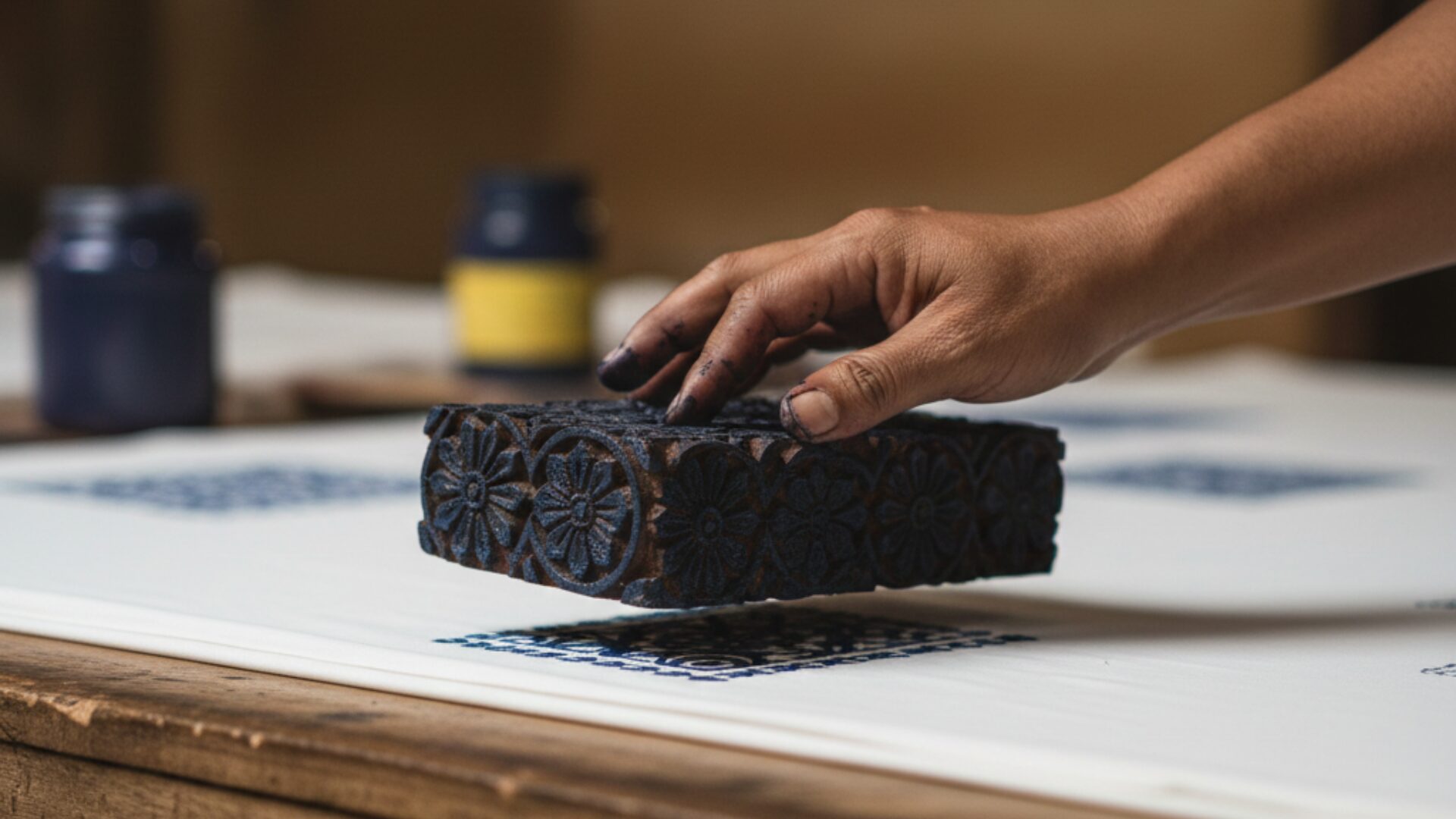
The workshop smelled of madder root and indigo, with earthy and metallic notes. Women sat cross-legged on the ground, fabric stretched before them like blank maps, wooden blocks worn smooth from generations of hands, and the sound…. “thap, thap, thap”, rhythmic as heartbeat, decisive as declaration.
Rashida, the master printer, looked at my hands hovering uncertainly over the fabric.
“You afraid?” she asked in accented English.
“Of what?” I lied.
“Of being seen after you’re gone. This is what Bagru printing is: being seen after you’re gone.”
The Bagru Printing Tradition
The Bagru printing tradition dates back 450 years in this dusty village, where the Chhipa community has passed wooden blocks from mother to daughter, treating them like heirlooms. The UNESCO Intangible Cultural Heritage list recognizes this craft, but what struck me wasn’t its history; it was the unapologetic force with which these women marked fabric.
“Indian block printing is not gentle,” Rashida explained, demonstrating. She raised the block above her shoulder and brought it down with her whole weight. The fabric received the blow, held the pattern. “Gentle printing disappears in the first wash. You must mean it.”
I thought about my life of gentle printing: the résumé I never submitted, the book I wrote but never showed anyone, the opinions I swallowed, the space I refused to claim. Overcoming invisibility seemed impossible when visibility felt like a form of violence.
Rashida’s daughter, Priya, was seventeen and worked beside us. Her movements were fierce and confident. She printed like someone who had never questioned her right to leave marks. I envied her cellular certainty.
Learning the Weight of Impact
My first attempt was pitiful. I pressed the block so lightly that the pattern barely whispered onto the cotton. Rashida laughed, not cruelly but genuinely puzzled.
“Are you printing or you petting?” she asked. “Fabric is not a cat. Needs force.”
She stood behind me and placed her hands over mine on the block. “Whole body,” she said. “Not just hands. Whole body says ‘I am here.'”
Together, we raised the block and slammed it down. The pattern appeared: clear, bold, permanent. My nervous system recoiled. Too much. Too visible. Too late to take back.
“Good,” Rashida said. “Now you do alone.”
My fear of leaving your mark manifested physically: shortened breath, contracted shoulders, the urge to run. But I was here to learn the opposite of disappearing.
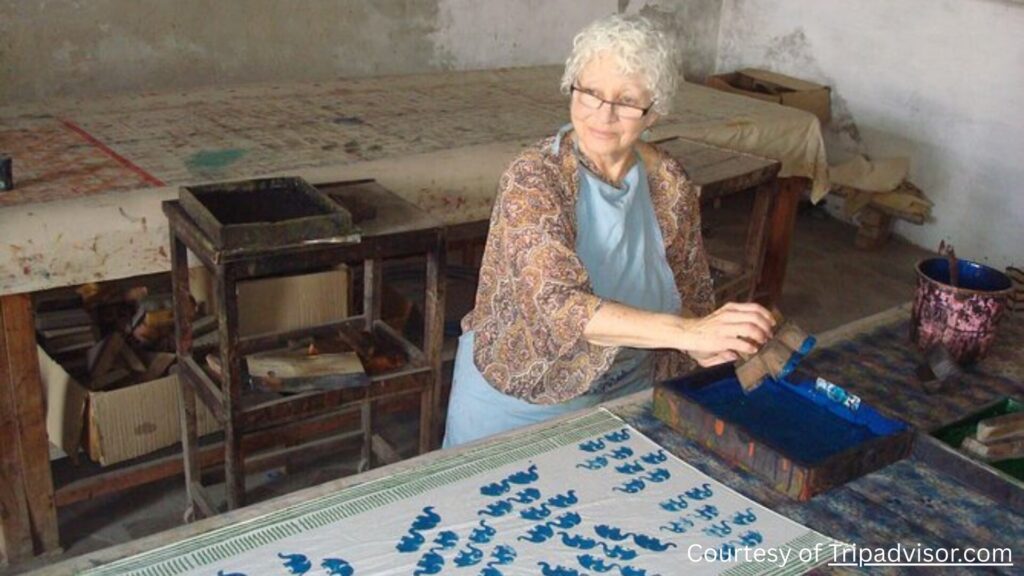
[“Bagru Block Printing” – Courtesy of Tripadvisor.com]
The Philosophy of Repetition
Indian block printing requires the same pattern to be repeated hundreds of times across the fabric. At first, this terrified me more, not one mark but hundreds, each one showcasing evidence of my existence.
But Priya taught me something essential: “Each print is a little different. See?” She showed me her fabric, the same lotus pattern repeated, but each unique. “This is beauty, same but not the same. Like people. We all leave marks, all a little different.”
The Crafts Council of India documents how this repetition becomes meditation, but for me, it became exposure therapy; overcoming invisibility one print at a time.
The Colors of Courage
The Bagru printing tradition utilizes natural dyes that require a significant commitment. Once indigo touches fabric, there’s no undoing it. The madder root creates reds that bleed into the cotton’s heart. Turmeric stains with joy that won’t apologize.
“In cities,” Rashida said, mixing indigo that stained her hands blue to the wrists, “everything is temporary. Delete, undo, restart. Here, we commit. Mistake becomes a pattern. Accident becomes design.”
I watched her work: no hesitation, no second-guessing. When a print smudged, she incorporated it. When the dye splattered, it became stars around the moon of her design.
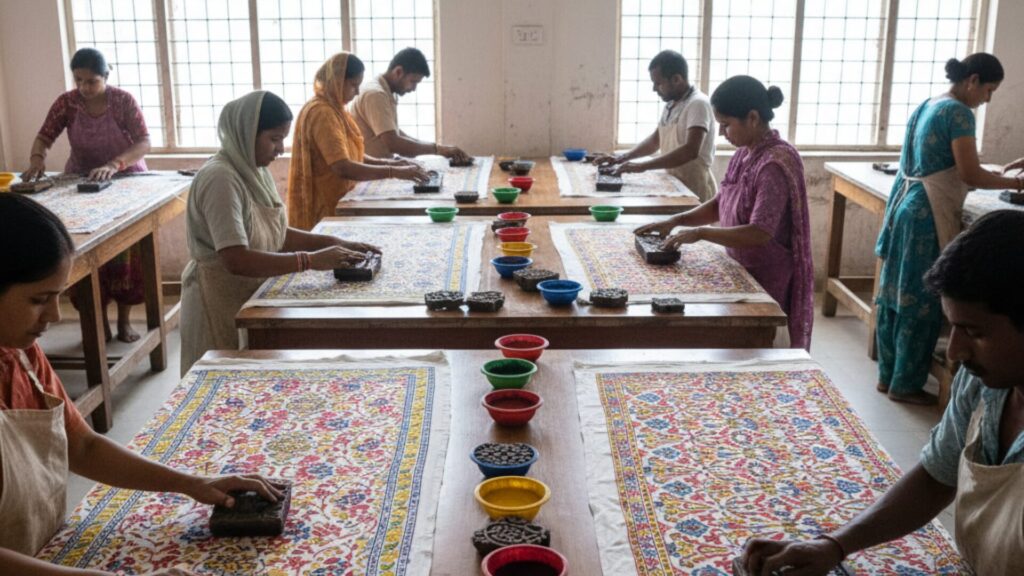
[“The Discipline of Preparation (Bagru Block Printing)” – Image by moneycatzzz.com]
The Breakthrough Moment
Day four, something shifted. Maybe exhaustion from holding back, perhaps the heat, maybe Priya’s grandmother, who kept bringing chai and saying “Shabash!” well done, even for my faintest attempts.
I picked up the heavy teak block carved with peacocks and raised it high. Brought it down with everything: my disappointment at living so small, my anger at being taught invisibility was virtue, my grief for decades of self-erasure.
THAP.
The peacock appeared magnificent, bold, and undeniable.
“Now you printing!” Rashida cheered. “Now you’re saying ‘I am here!'”
I printed another. Another. The fabric filled with peacocks, each one shouting my existence. My body learned what my mind resisted; making your mark mindfully means using your whole self, not just the parts that feel safe.
What I Brought to Support the Journey
Before leaving for India, specific tools became essential for facing my fear of leaving my mark:
A handmade wooden journal where I could practice making marks in private first, pressing hard with a pen, letting words be permanent.
MAC Ruby Woo lipstick, the reddest red I’d ever worn. “If you’re going to leave marks,” my therapist had said, “start with your own face.”
A block printing starter kit to continue the practice at home, to keep teaching my hands that they deserve to press down.
The Fabric That Came Home
I brought home three meters of fabric I’d printed: imperfect, bold, undeniably mine. The peacocks are uneven. Some prints are too light, others are too heavy. Dye splattered in places, creating accidental stars.
I made it into a dress. I wear it to important meetings, to difficult conversations, and to moments when I want to disappear. It reminds me: you already left your mark. Let’s keep going.
The Victoria & Albert Museum has similar pieces from the 18th century, women’s marks still visible after centuries. This perspective shift that marks are gifts to the future, not impositions on the present, changed everything.
Making Your Mark Mindfully
Overcoming invisibility doesn’t mean becoming loud, aggressive, or taking up more space than you need. The Indian block printing tradition taught me about intentional impact: choosing your pattern, mixing your colors, pressing with purpose.
Back home, I practice making your mark mindfully:
- Speaking once, clearly, without an apology preface
- Choosing one bold color in every outfit
- Signing emails with my name, not “sorry to bother you.”
- Standing in the middle of photos occasionally
- Submitting the manuscript I’d hidden for three years
Small prints, but permanent ones.

[“The acceptance of error and the permanence of the mark” – Image by moneycatzzz.com]
What Rashida Knew
On my last day, Rashida gave me a small wooden block, a simple flower, worn smooth and worn.
“For remembering,” she said. “You have marks to make. The world needs to see them.”
She was right about fear of leaving your mark; it’s really fear of being remembered, of mattering, of taking up space in history, even in the smallest way.
The women of Bagru print like they’re writing letters to the future. Every fabric they create will outlive them, carrying their marks forward. They don’t apologize for this permanence. They celebrate it.
The Revolution of Pressing Down
The Textile Research Centre documents how block printing empowers women economically, but what I experienced was different; it empowered me existentially. Each time I pressed that block, I voted for my own visibility.
Fear of leaving your mark keeps us living in draft mode, never committing to the final version. But the Bagru printing tradition insists: press down, mean it, let the fabric remember you.
Today, when I feel myself shrinking, speaking in whispers, choosing beige, I remember the sound: thap, thap, thap. The sound of women who know their marks matter. The sound of claiming space. The sound of saying: I was here, I am here, and I will be remembered.
My hands are still faintly stained with indigo, even after months have passed. Good. Let them stay marked. Let them remember the weight of that block, the force of impact, the joy of finally, finally, pressing down hard enough to be seen.
The watermark woman is gone. In her place: someone who prints peacocks, wears red lipstick, speaks without apology, someone who understands that overcoming invisibility isn’t about being perfect or loud or essential.
It’s about pressing down, which means it. And trusting the fabric to hold your mark with the same grace it has held everyone else’s: permanent, imperfect, necessary.
Books That Gave Permission for the Journey

Women Who Run….

The Art of Possibility

Radical Candor
Disclosure: This post may contain affiliate links. We only recommend products we believe in, and we may receive a commission at no cost to you! Thank you for your support!
Acknowledgment: Cover Image by moneycatzzz.com
Disclaimer: The information is provided for general information only – moneycatzzz.com makes no representations or warranties in relation to the information, including but not limited to any representation or warranty as to the fitness for any particular purpose of the information to the fullest extent permitted by law. While every effort has been made to ensure that the information provided in this article is accurate, reliable, and complete as of the time of writing, the information provided in this article should not be relied upon to make any financial, investment, real estate or legal decisions. Additionally, the information should not substitute advice from a trained professional who can take into account your personal facts and circumstances, and we accept no liability if you use the information to form decisions.