
 Reading Time: 8 mins #
 This post may contain affiliate links.
You fixed the bug. Deployed the patch and watched it run green for three weeks.
The same error popped up, coupled with the same stack trace. The sinking feeling from before resurfaces.
The issue was a behavioral loop, not a technical problem. Most people repeat mistakes because they confuse activity with learning. We will address them in this post.
We’ll diagnose:
- Why are you stuck in a cycle?
- What is the capacity to learn?
- Break down the lies we tell ourselves.
- How to break free.
Below are five mechanical steps. There will be no carousels, no spinning metaphors. Just a detailed look at the feedback loop you’ve been ignoring.
The Recurring Bug Syndrome
Recurring mistakes occur for a reason; software engineers have a name for this: a Heisenbug. The “error” disappears when you try to observe it, then crashes the system when you stop looking. Know this: if it can be seen, it can be caught.
Your career, team, or personal projects operate and run the same way. You swear you’ve learned the lesson and promise not to repeat the mistake. Six months later, you’re debugging the same failure.

Why?
The answer lies in the underlying condition you had failed to change. You just restarted the process and hoped for different results. Former U.S. Army General Gordon R. Sullivan was right: “Hope is not a strategy.” Or you can always blame it on Einstein’s old line about insanity, but the real mechanism is simpler: you lack a closed-loop feedback system.
Humans have a knack for overweighing recent events and underweighing structural patterns. Daniel Kahneman claims the pain of the mistake is felt immediately. However, the feeling fades, then you revert to the default operating system, which was never upgraded.
To avoid repeating mistakes, you need to make the feedback mechanical rather than emotional.
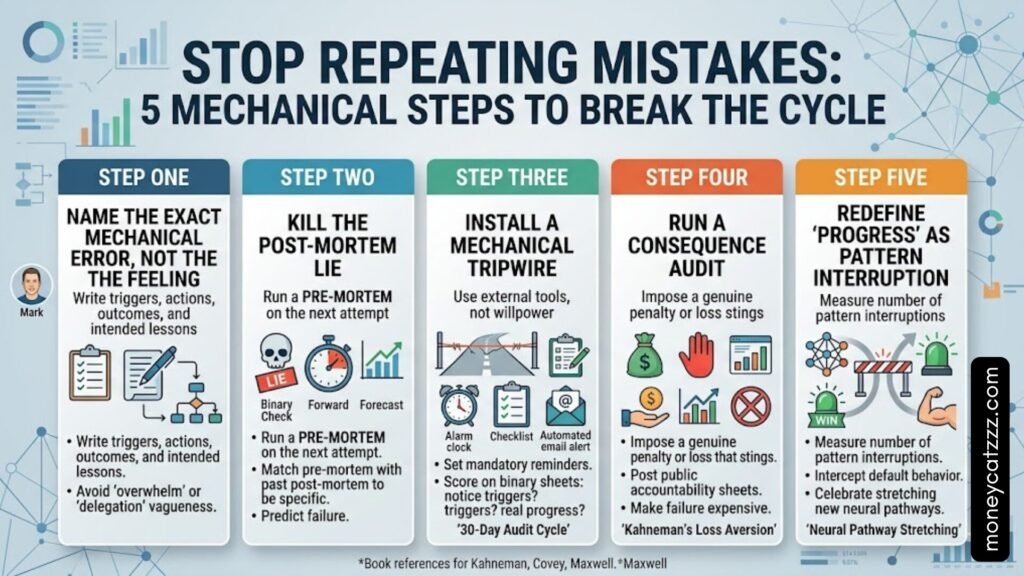
Step One: Name the Exact Error, Not the Feeling
Most people describe their cycle in emotional language.
“I keep getting overwhelmed.“
“I always hire the wrong person.“
“I end up in circles on every big decision.“
Feelings are not data. Not quantifiable in our equation.
The overall picture matters. Write down the last three times you landed back where you started.
Use this template:
- What was the trigger (specific date, event, input)?
- What action did you take?
- What was the outcome?
- What did you think you learned?
You’ll notice a pattern, not a vibe. A pattern.
Mark and the Hamster Wheel (H3)
Mark kept telling himself, “I failed to delegate.“ In reality, he had only delegated tasks he didn’t understand, neglected to review the work, and accepted subpar results. The error wasn’t in “delegation.“ It was “understanding and learning the task before delegating it.“
You stop repeating mistakes by naming the mechanical fault, not the emotional residue.
Step Two: Kill the Post-Mortem Lie
Most organizations follow standard procedures. After a failure, they run an internal post-mortem. They identify the “What went wrong?” file a report, close the ticket, and move on.
That’s theater. Real learning requires a pre-mortem on the next attempt.
In The 7 Habits of Highly Effective People, Stephen Covey called this Habit 2: begin with the end in mind. He confirms that most people apply it to goals, not to failure prevention.
The shift is simple: before you restart the cycle, write down how this attempt could fail in the same way, knowing the outcome in advance. Match the pre-mortem with the post-mortem, be specific. “I will again postpone the hard conversation until week three.” “I will again add scope because I can’t say no.“
Now you have a prediction. Run the project. Check the prediction. If it comes true, you’ve just gained the capacity to learn – because you measured the gap between foresight and behavior.
Did the predicted failure happen? Yes or no. That’s not abstract, it’s binary.
[5 Mechanical Steps To Stop Repeating Mistakes | moneycatzzz.com]
Step Three: Install a Mechanical Tripwire
Install a failsafe system so you do not forget. Memory is state-dependent. When stress hits, you revert to your most practiced response, which is usually the one that created the cycle.
System-wide fixes are external, not internal:
Set a 30-day review reminder after any major decision. Label it: “The 30-Day Audit Cycle.“ Use a simple scoring sheet:
- Did I stop repeating mistakes from the last time? (1-5)
- Did I make real progress toward the actual goal, or just activity? (1-5)
- Am I stuck in a cycle again without noticing? (Yes/No)
This is your tripwire to interrupt the autopilot.
Leadership expert John C. Maxwell calls this the Law of the Lid: your leadership ability determines your effectiveness ceiling. The same applies here. Your ability to install external checks determines how quickly you break the cycle of repeating failures.
Installing a trip-wire is simple, requiring no willpower, just foresight.
Step Four: Run a Consequence Audit
The effects of going around in circles are measurable: the cost of repeating the mistake is lower than the cost of changing.
People say they want real progress, but their system is optimized for short-term comfort. Changing a behavior requires upfront pain: learning a new skill, admitting fault, losing face.
Repeating the mistake feels familiar. Ask:
What actually happens when I make this error again? Frustration.
Do I get fired? Rarely.
Are there any financial losses? Sometimes, but not enough.
Do I feel embarrassed? Yes, but that fades.
[The Consequence Jar | moneycatzzz.com]
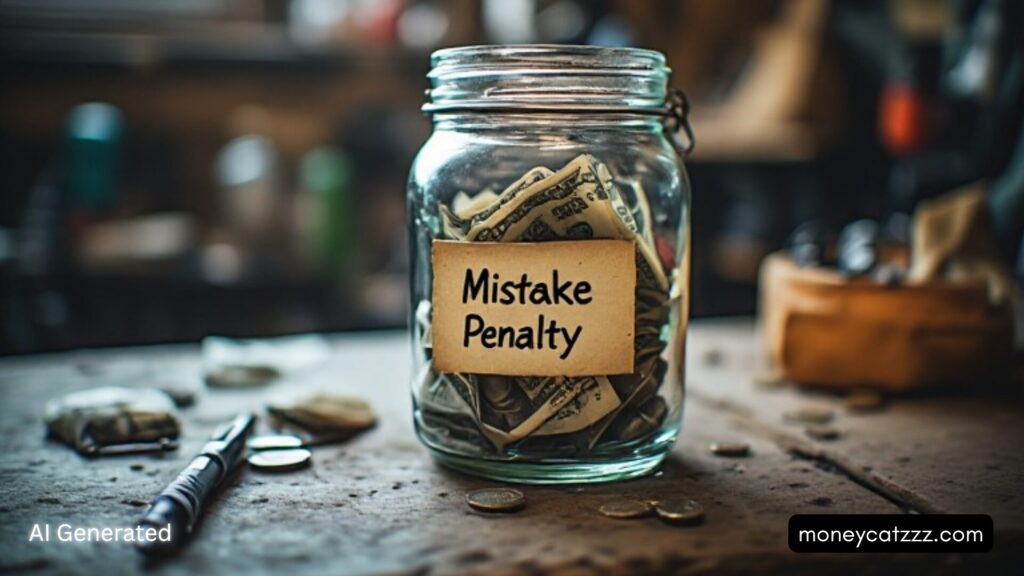
The problem persists when there are no real consequences.
To refrain from repeating mistakes, you need to impose a consequence, a financial penalty of some sort. Post a public accountability sheet. Create a loss that stings.
Fear of loss is stronger than hope of gain. Kahneman proved that. Take full advantage of it.
Step Five: Redefine “Progress“ as Pattern Interruption
Progress is often mostly measured by outcomes: revenue up, weight down, project completed.
However, there is seldom consideration for lag, and when they don’t arrive, you get discouraged and fall back into the old cycle.
A better progress meter is the number of pattern interruptions.
Every time you catch yourself about to repeat the old mistake and do something different, even if the new thing fails – that’s a win. You just stretched the neural pathway.

Why Habit 5 fits
Covey’s Habit 5 is usually interpersonal: listen to another person before trying to be understood, the underlying logic being diagnostic. You cannot respond appropriately until you have mapped the system you are interacting with.
In your own behavior, the “other person“ is your past self – specifically, the pattern of triggers, actions, and outcomes you documented in Step One. That pattern is data. If you try to change the outcome (the response) without first understanding the trigger pattern (the input), you are guessing.
This is a framework that treats understanding as a prerequisite for effective action; it is not a spiritual claim. It is a control theory principle: you need an accurate model of the system before applying a corrective signal.
The Only Thing That Works
Breaking free from cycles is not easy; it takes courage. Those who succeed shared one trait: they stop treating their behavior as a personality flaw and start treating it as a mechanical error.
The five steps set here are by no means exhaustive.
Do that for 90 days. Then look back at the stack trace.
It’ll look like someone else’s bug.
_____________________
Cited Works That Apply
The 21 Irrefutable Laws of

The 7 Habits of ……….
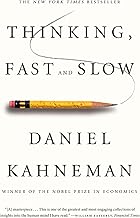
Thinking, Fast and Slow
Disclosure: This post may contain affiliate links. We only recommend products we believe in, and we may receive a commission at no cost to you! Thank you for your support!
Acknowledgment: Cover Image by moneycatzzz.com
Disclaimer: The information is provided for general information only – moneycatzzz.com makes no representations or warranties in relation to the information, including but not limited to any representation or warranty as to the fitness for any particular purpose of the information to the fullest extent permitted by law. While every effort has been made to ensure that the information provided in this article is accurate, reliable, and complete as of the time of writing, the information provided in this article should not be relied upon to make any financial, investment, real estate or legal decisions. Additionally, the information should not substitute advice from a trained professional who can take into account your personal facts and circumstances, and we accept no liability if you use the information to form decisions.