
 Reading Time: 8 mins #
 This post may contain affiliate links.
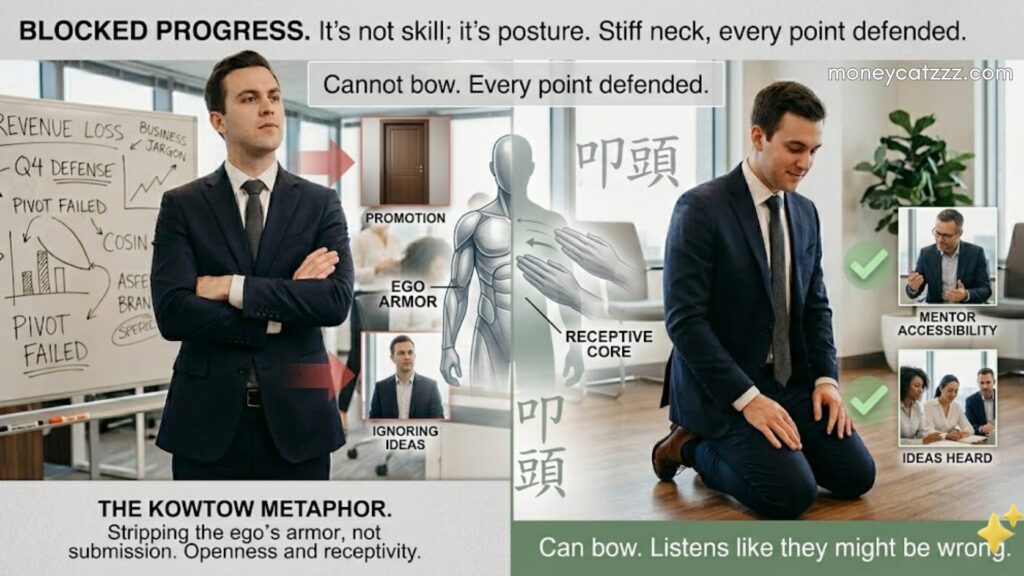
You know the feeling. The hard work, the preparation, and the right credentials are all there. Yet, something keeps blocking your progress. A promotion goes to someone else. A mentor stays distant. Your good ideas get ignored until somebody else voices them.
It’s not your skill that’s failing. It’s your posture.
There’s an old word for what you’re missing. It sounds like surrender. The word is kowtow.
Most people in the West hear that and think of groveling. A peasant bowing to an emperor. Humiliation. But they got it backward. The kowtow was never about the person receiving the bow. It was about the person doing the bowing.
The Hollow Flute
There’s a story from India. Radha once asked Krishna why his flute was always so close to his lips. Krishna said the flute had emptied itself. No pride stuffed inside. No agenda blocking the way. Just space.
Think about that reedless woodwind instrument: a hollow cylinder, empty inside. Air moves through it, and sound comes out. A flute stuffed with ego, choked by its own importance, defenses, and need to look good, makes no sound at all. It looks impressive on a shelf, but it remains silent.
The kowtow is the act of emptying oneself. True growth requires kneeling to a mentor’s mastery, bowing to a tradition you have not yet acquired, and placing your forehead flat against the bedrock of absolute humility. The hollowing process creates room for new learning, access to someone else’s wisdom, and tolerance for the uncomfortable pause where real transformation actually happens.
The opposite is the rigid spine. A solid pillar, dense with pride, cannot channel breath. It stands tall, unbending, and completely silent.

Three Things the Kowtow Teaches Us
1. Surrender is a strategy, not a loss.
Watch a martial artist in motion. A rigid frame gets thrown across the room, while a relaxed body flows like water: elemental, fluid, and impossible to break with a fist. The kowtow operates on that exact strategic yield. It ends the exhausting cycle of defense, letting an opponent’s momentum pass through the space provided harmlessly. It is a calculated pivot to gain the superior position, not a loss.
Learning this lesson proved costly. After a respected mentor abruptly stopped taking my calls, a mutual friend revealed the brutal reason why: “She finds you unteachable. You never bow. You never listen like you could be wrong.” That sentence cost me six months of stalled projects and a lot of wasted energy.
A Harvard Business Review study from 2021 found that humble leaders make faster, better decisions. It is not necessarily that they’re smarter. They spend zero energy protecting their image; that energy goes straight into resolving the problem.
A seasoned mentor once passed down a tactical rule for entering these rooms: explicitly state the assumption that the other person has knowledge you lack. Saying, ‘I am assuming you know something I do not; please show me,’ initiates a deliberate pause. The resulting silence will feel awkward, but that exact discomfort is the kowtow performing its structural work.
[The Kowtow Protocol| moneycatzzz.com]
2. The “cool” act is a cage.
We are terrified of looking stupid; paralyzed by the judgment that stalks anyone who tries too hard, cares too much, or lets their investment show. Fear acts as a deadbolt against ego death. The practical application requires no meditation retreat, only the willingness to appear foolish in a Tuesday morning staff meeting.
You cannot grow while guarding an image. Embarrassment is simply the price of admission. The physical kowtow looks absurd to a self-conscious observer, and that is precisely the point. A refusal to look ridiculous is a failure to learn anything of actual consequence.
Ego is not confidence. It is the insecure performance of confidence, a costume that gets heavier the longer you wear it. The kowtow strips that costume away. What is left is just you, which, by the way, is plenty. (Ryan Holiday – Ego Is the Enemy)
A daily cringe works:
- Introduce yourself as a beginner.
- Ask a question that everyone else seems to know.
- Bow your head to your desk for ten seconds before a hard task.
The discomfort is the tuition. Pay it and move on.
3. People who bow don’t break.
Consider a conflict between two opposing forces. The first is incapable of the kowtow: every point must be defended, every slight instantly returned. This posture is purely reactive—a machine operating without an off-switch or an internal thermostat.
The second possesses the capacity to bend. This individual can concede a point, pause deliberately, or step back six inches to reassess. Because their intrinsic worth is decoupled from the immediate outcome of the exchange, they retain total strategic control.
Who has more power? The second. Always.
Psychologists call this heroic humility. The American Psychological Association has a model (Worthington & Allison, 2018) that describes it as the courage to be self-sacrificing for a larger goal. It requires strength, not passivity. It takes real confidence to kneel without crumbling. That’s the paradox the West never understood.
This intersection marks where the kaizen mindset meets the kowtow: daily, micro-adjustments to realities the ego would prefer to avoid. These deliberate concessions act as structural weights that build a functional humility muscle. Over time, an individual becomes unshakable—not through a display of toughness, but through the elimination of the need for defense. That is inner peace with calluses.
The mechanics of this shift are easy to observe in real time. Introducing a deliberate six-inch retreat into a heated disagreement, followed by a quiet acknowledgment of potential error, instantly alters the physics of the room. The opponent’s defensive posture collapses because the resistance they were bracing against has vanished.
That is the kowtow performing its structural work.
The Art of Becoming Invisible
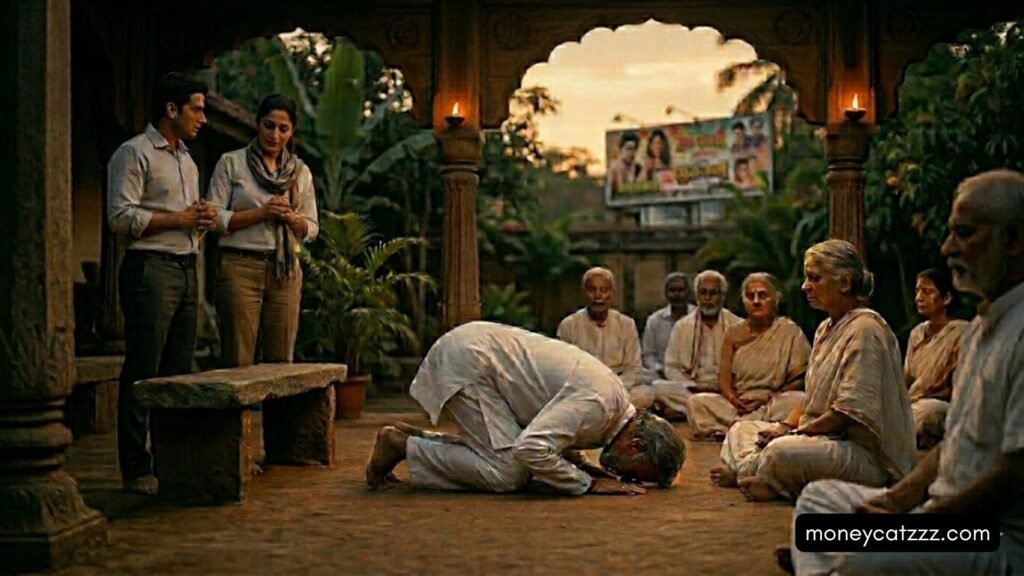
Few figures command the level of public worship accorded to the Indian cinematic icon Rajinikanth—a man whose likeness routinely adorns billboards taller than buildings. Yet, during an address in Bengaluru, he recounted a deliberate retreat from that massive orbit, tracking a journey to a remote spiritual ashram where his multi-million-dollar image was entirely useless.
Walking through the grounds, he anticipated the familiar disruption of fan hysteria, but encountered absolute stillness instead. The devotees remained deep in meditation, entirely indifferent to his presence. For an icon accustomed to universal recognition, the sudden invisibility initially provoked a flash of resentment—the reflexive anger of an ego demanding its accustomed tribute.
[Rajinikanth recalled a time when he stayed at the Art of Living centre – CNN-News18]
As the hours passed, however, observation replaced agitation. He recognized that the screaming cinema crowds are a temporary currency, while the internal frame of those meditating figures was permanent, entirely decoupled from public applause.
A planned two-day visit was extended to fifteen. He later acknowledged that the experience thoroughly dismantled his ego. This is the practical manifestation of the kowtow: a public figure possessing immense cultural wealth bending to a truth vastly larger than his own fame.
He chose to yield, and in doing so, preserved his structural integrity.

A Simple Guide: Do This, Not That
Do this | Not this |
|---|---|
| Kneel to a mentor’s experience | Kneel to anyone who abuses power |
| Bow to the daily process of improvement | Perform the bow as a performance (that’s just ego in a costume) |
| Say “I don’t know” out loud, at least once a week | Bow to fear – only bow to what serves your growth |
| Physically bow your head for ten seconds before hard tasks | Confuse surrender with servility |
[Invisible in the Crowd | moneycatzzz.com]
Your Three-Step Protocol
Each step will feel a little counterintuitive the first time. That’s how you know it’s working.
Step one: Find your stiff neck. Where are you defending instead of learning? With a colleague? A partner? A skill you’ve plateaued on? Pick one place where you’ve been unteachable. That’s your target; it is where your humility muscle needs the most work.
Step two: Do a micro-kowtow. Before your next interaction in that area, lower your head for ten seconds. You don’t have to kneel on the floor. Just drop your chin to your chest. Say to yourself: “I am a student here.” Your body leads your mind. This is the kowtow in miniature.
Step three: Ask the dumb question. In the conversation, ask something you’ve been afraid to admit you don’t know. “What am I missing?” “Explain that like I’m five.” “Show me where I’m wrong.” The fear you feel is the growth happening. It’s where the kaizen mindset is applied directly to your ego.
Do this every day for two weeks. Then notice what changed.
What Happens If You Don’t Bow
The person who cannot kowtow cannot grow. Too stiff. Too proud. Too afraid of looking small. They stand there, perfectly vertical, while the ground shifts beneath them.
Stiff people get left behind. The market doesn’t care about your pride. Your competitors are bowing to their mentors right now, learning what you refuse to learn, hollowing themselves out while you fill yourself with defense.
An individual is not defined by the last mistake, nor by the internal voice that claims preset mastery. True authority resides in the awareness that notices the stiffness—and chooses to flex.
Bend the knee to the process. To the person. To the truth.
Then watch what flows through you.
Resources for The Syllabus for Ego Disruption
Ego Is the Enemy

The Mountain Is You
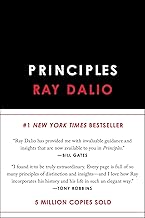
Principles
Disclosure: This post may contain affiliate links. We only recommend products we believe in, and we may receive a commission at no cost to you! Thank you for your support!
Acknowledgment: Cover Image by moneycatzzz.com
Disclaimer: The information is provided for general information only – moneycatzzz.com makes no representations or warranties in relation to the information, including but not limited to any representation or warranty as to the fitness for any particular purpose of the information to the fullest extent permitted by law. While every effort has been made to ensure that the information provided in this article is accurate, reliable, and complete as of the time of writing, the information provided in this article should not be relied upon to make any financial, investment, real estate or legal decisions. Additionally, the information should not substitute advice from a trained professional who can take into account your personal facts and circumstances, and we accept no liability if you use the information to form decisions.