Reading Time: 8 mins #
This post may contain affiliate links.

The question landed like a stone, forcing an immediate opinion before I could even process the prompt. “What do you think about the new policy?“
Â
I was at a dinner party. The room was warm, and the wine was drinkable. The conversation had been flowing, and I had been flowing with it. Sharing easy thoughts on the vintage and the building renovation should have been the warning. I was running through the motions, putting on a front. Then the room turned to me, expecting an instant, confident pose.
Â
I opened my mouth as the words began forming. It was a half-formed stance designed to keep the conversation moving forward.
Â
Then I stopped.
Â
I said, “I have not decided yet.”
The room went quiet. It was a curious quiet that waits. I felt exposed by the sudden lack of commentary. The page is completely blank.
Â
Something unexpected happened, and the person who asked the question nodded. “Me neither,” he said. “I keep going back and forth.”
Â
The dialogue shifted instantly as the artificial weight evaporated, allowing us to abandon the projection of certainty and actually engage. That is the moment the blank page became visible. I had been covering it for years because I feared the quiet.
Â
Realizing you are putting on a show is only step one. Stepping out of the spotlight takes a deliberate choice.
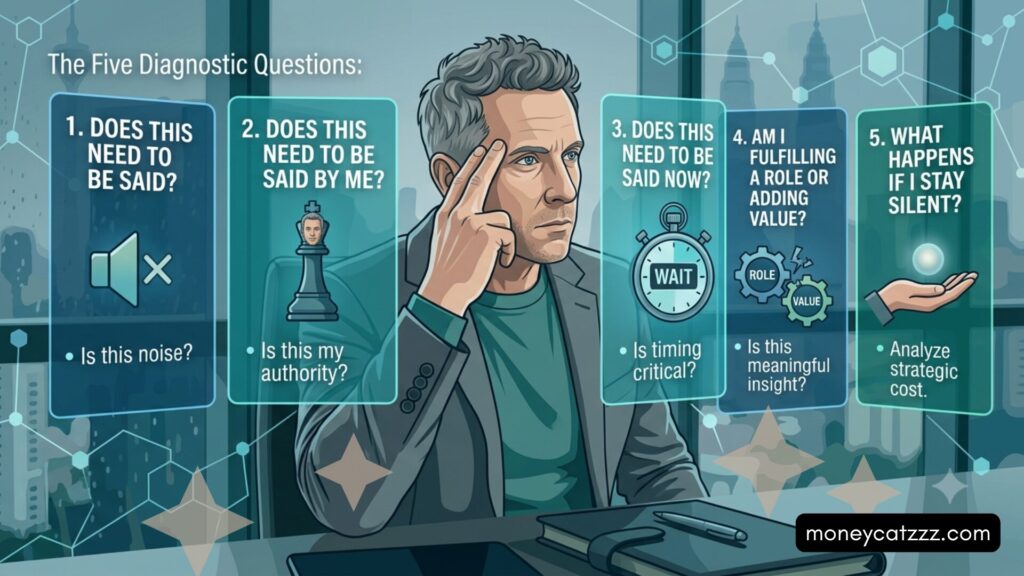
The Five Diagnostic Questions
Â
Before offering your next unearned take, test your motivations against these five core questions:
Â
Question 1 – Why Do I Feel the Need to Have an Opinion About Everything?
I keep talking because I am terrified of being exposed as uninformed. It stems from the terror of appearing ignorant or losing status in the executive arena. This explains how to stop having an opinion on everything if you want to protect your strategy.
Â
Years of prejecting authority closed my eyes to the fact that I was mistaking a charade for actual execution. The noise on the page was just a desperate attempt to cover up a bedrock that felt like an absolute deficiency.
Â
Susan Sontag once described true intellect as a state of pure curiosity. I read that years ago and missed the point entirely. I assumed having a sharp opinion was the ultimate prize. I was wrong. Being interesting is a cheap trick. Staying tethered to reality is the actual work. The constant noise is just a defense mechanism.
Question 2 – When Did I Stop Saying “I Do Not Know”?
Admitting ignorance used to bring immediate relief. It offered the freedom of clear thinking without the burden of constant theater.
Â
The shift happened through a slow erosion. It was a gradual move from genuine curiosity to calculated performance. I traded active listening for active speaking.
Â
The first time I held my tongue in a board meeting, it felt like an admission of weakness. The second time, it felt like a deliberate strategy. I had been carrying the heavy weight of pretend certainty for ten years. Direct observation taught me what no report could: when I admitted my data was incomplete, the room dropped its guard. The room was not begging for confidence; it was starving for truth.
[The Strategic Pause | moneycatzzz.com]
Question 3 – What Am I Afraid of Losing If I Say Nothing?
I am terrified of losing my position in the hierarchy. I protect the illusion of intelligence and the safety of fake certainty.
Â
I fear being dismissed as irrelevant or uninformed. I hate being the operator who lacks an immediate angle or a formed opinion.
Â
The irony is that pretending to know has cost me real market trust. I have lost critical connections and genuine insights because my voice was always in the way.
Â
Stepping out from behind a polished posture requires a level of raw confidence I spent years avoiding. The fear of a quiet room drives terrible decisions. The defensive mind insists that silence destroys your authority. In practice, feigning false certainty is what actually wrecks your credibility.
Question 4 – What Would Happen If I Just Left a Space Blank?
I have filled every operational page with words. The space is entirely occupied, leaving no room for a real insight to form. I am so busy managing the performance that I forget the space exists.
Â
The empty page is a deliberate container, holding the room until an opinion is actually earned.
Â
I initiated a strict practice of the pause. In corporate negotiations and high-stakes briefings, I forced a hard delay. I would pause and ask myself a simple question: Do I actually have a verified insight, or do I need to speak?
Â
Most of the time, I only possessed the emotional need to make noise. I wanted to escape the immediate discomfort. Silence is unbearable for anyone hooked on constant validation.
Â
The brain naturally reaches for quick takes to bypass the heavy lift of actual analysis. Performing is cheap. Real thinking takes friction. I repeatedly chose the easy path simply because the words came quickly.
Â
Leaving the canvas blank until you have something real to say is not a loss of ground. It is basic operational control.
[The Executive Filter: 5 Steps Before You Speak | moneycatzzz.com]
Question 5 – What Do I Actually Think When I Am Not Performing?
I am not sure. That is the entire point of this dissection.
Â
Halting the show reveals a much quieter room. Stripping away rehearsed scripts creates space to tell the difference between a real insight and a polished posture. The performance has run for so long that the mask has almost fused to the face.
Â
Dropping the compulsion to have an instant take gives you operational freedom. It allows you to study raw information without defending a premature stance. Accepting that you do not need an immediate opinion changes your relationship with authority entirely.
Â
Using the phrase “I have not decided yet” works as an aggressive tactical tool. It forces the other party to expose their assumptions while you hold your ground in the quiet.
Â
The strategic pause is an assertion of control. It is where real authority lives.
The Synthesis
These five questions are not self-help prompts. They are a clinical dissection of your operational noise.
Â
Stripping down your defaults exposes how much authority you leak simply by reacting too fast. Once you remove the instinct to perform, silence no longer feels like exposure. It becomes a position of strength.
The Free Space
Weeks after that dinner party, a colleague demanded my immediate opinion on a volatile market shift. The old reflex flared instantly. I opened my mouth to deliver the usual rehearsed posture.
Â
Then I stopped myself and stayed quiet.
Â
“I have not decided yet.”
Â
The discussion filled the gap. The agenda moved on, and my standing in the room remained completely intact.
Â
Holding your position without an immediate take converts silence into raw leverage. The need to fill every blank space disappears the moment you realize noise adds zero value.
____________________________________________
Disclosure: This post may contain affiliate links. We only recommend products we believe in, and we may receive a commission at no cost to you! Thank you for your support!

Acknowledgment: Cover Image by moneycatzzz.com
Disclaimer: The information is provided for general information only – moneycatzzz.com makes no representations or warranties in relation to the information, including but not limited to any representation or warranty as to the fitness for any particular purpose of the information to the fullest extent permitted by law. While every effort has been made to ensure that the information provided in this article is accurate, reliable, and complete as of the time of writing, the information provided in this article should not be relied upon to make any financial, investment, real estate or legal decisions. Additionally, the information should not substitute advice from a trained professional who can take into account your personal facts and circumstances, and we accept no liability if you use the information to form decisions.