
pattern cover

Glitches: The Hidden Purpose Behind Your Behavioral Patterns

imagesReading Time: 8 mins #

disclosure line icon vector This post may contain affiliate links.

I over-prepare for everything.


Not in the way that looks like diligence from the outside, though it does. In the way that continues past the point where more information would change anything. I read three more articles before committing to a position I already hold. I rehearse objections from non-adversarial people. I research decisions that do not require research. I have been trying to stop this for years.

It has not stopped. At some point, I stopped trying to correct the pattern and started trying to understand it instead. I found the logic, and the shift produced something the correction attempts never did:

  • A functional explanation for why the response exists.
  • The specific conditions under which it was installed.
  • Why does it keep executing in environments that no longer require it?

The loop is not an accident. It is a signal the system learned to generate to survive something real. The conditions changed, but the signal kept firing.

Where the Code Came From

You do not start with the symptom. You start with the question underneath it:

  • When did this begin?
  • What was happening?
  • What did the reaction make possible that was not possible without it?

For the over-preparation impulse, the answer was specific. An early professional environment where being underprepared carried visible, frequent consequences. It doesn’t have to be dramatic, just public enough that the nervous system draws a direct conclusion: know more than you need to know before you enter the room; anticipate everything so exposure drops to zero.

Pattern Slide 2

That conclusion was correct for that environment. The adaptation was intelligent. It was a precise response to conditions that punished gaps and rewarded thoroughness. What developed from it was not a generalized anxiety. It was competence, calibrated to a specific set of demands.


The trouble is simple: the environment evolved, but the program didn’t.


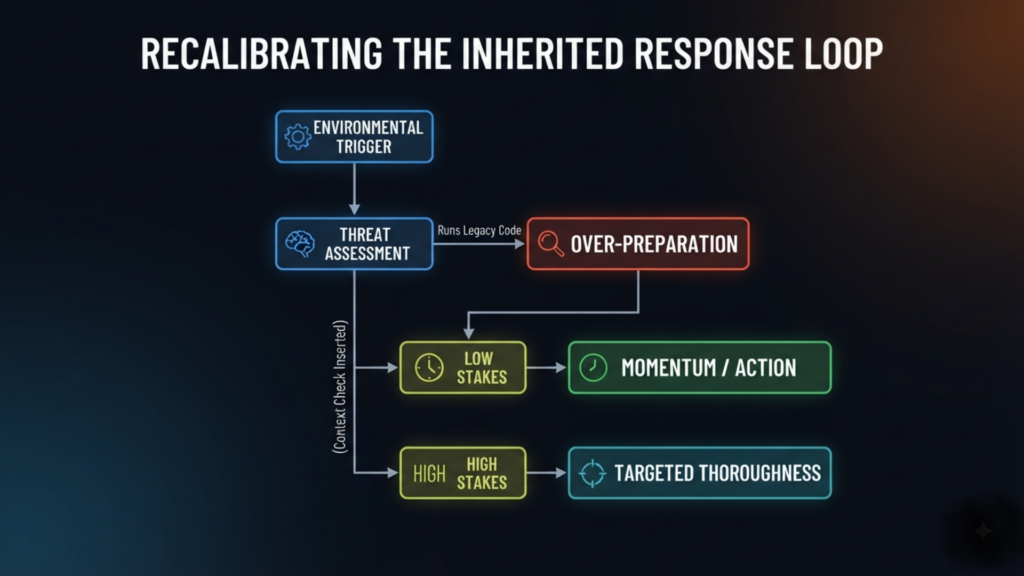
The defense mechanism operates outside linear time. It continues to execute its original protocol because it lacks the internal telemetry to verify whether the original threat still exists. It treats a casual Tuesday morning review like a hostile tribunal, burning finite executive function on baseline tasks because it doesn’t know how to do anything else.

The Glitch That Was Never Random

The framework is straightforward. A glitch is simply an unintended behavior. In architecture and systems design, some of the most powerful features began as unintended behaviors that served a vital purpose in one operational environment before causing systemic friction in another.


The distinction is not about the behavior itself. It is about fit. The glitch becomes a feature when the conditions match. The feature becomes a glitch when they do not.

pattern graph 1

My over-preparation is a glitch in low-stakes environments where momentum matters more than thoroughness. It is a feature in environments that genuinely reward precision before commitment. The response is not inherently one or the other.


Reading the glitch before fixing it is the sequence that actually produces results. You cannot update a pattern you have misread as a personal failing. You can update it once you understand it as a response to conditions that no longer apply.

The Current Cost

The adaptation is still running. That is the honest accounting.


Over-preparation in a low-stakes environment does not feel costly in the moment. It feels like care. The discomfort of committing without full information is real, and the preparation relieves it, so the habit produces a neurochemical reward loop that reinforces its execution.

What it costs is harder to see because it accumulates slowly through friction and cognitive drag:

  • Decisions are delayed past the point at which additional research or data yields diminishing returns.
  • Momentum is lost, confirming what was already known rather than executing on available insight.
  • A persistent low-grade overhead builds from maintaining a maximum-preparation standard across contexts that vary significantly in what they actually require.
  • Resource exhaustion occurs because the nervous system cannot distinguish between a high-stakes review and a routine email, burning finite executive function on baseline tasks.

The hidden logic of your habits is visible when you trace the sequence to its origin. The cost is visible when you examine what the habit is extracting in the current environment against what it is actually protecting you from.


The pattern that kept you safe does not announce its expiration date. It keeps running, producing the same outputs, in environments where those outputs are no longer appropriate. The protection feels like competence. The cost registers somewhere vaguer. A tiredness you cannot quite locate. A sense that you are working harder than the situation requires, without being able to identify where the extra effort is going.


That is when the adaptation outlives the condition. The defense is real. The threat it was designed for is no longer the primary feature of the current landscape.

pattern: Debris of Discipline
[The Debris of Discipline: Why Your Over-Preparation is a Legacy Glitch| moneycatzzz.com]

Working With It

Why you keep running old code is not a question about discipline.


It is a question about whether the protective mechanism has been correctly identified. If over-preparation is a character flaw, the intervention is a correction: apply more willpower, develop better habits, and try harder to stop. That intervention fails consistently because it targets the symptom without addressing the source. The protector keeps generating the response because it has not been informed that the threat assessment no longer fits.


The intervention that actually moves something is smaller and less dramatic.


It is a real-time context check run before the instinct fires. Not a command to stop. A question: Is this a situation where thorough preparation changes the outcome, or is this the system defaulting to preparation because that is what it does?

That question does not eliminate the habit. It creates a gap between the trigger and the automatic response. In that gap, the logic becomes visible. The protector gets consulted rather than overridden. The system receives up-to-date information rather than running the original assessment without review.


This developmental shift is simple: moving from being subject to the pattern to having it as an object. From inside the adaptation, it runs automatically and feels like reality itself. From a position slightly outside it, the habit becomes something you can observe, examine, and choose whether to deploy.


That is not a transformation. It is recalibration.


Over-preparation does not disappear; it becomes more precisely targeted.

Mindvalley promo

Still Running

I over-prepared for a client meeting last Tuesday.


Caught it in real time. Ran the context check. Assessed that the meeting did not require the preparation level I was generating. Continued anyway, because the discomfort of stopping was louder than the logic of the assessment


The work does not live in erasing the pattern. It lives in catching it the moment it appears.


The glitch is still there. The code executes before the system check even registers. Most days, the gap between the trigger and the automatic response is too narrow, and the old adaptation wins.


Some days, I catch it early enough for the check actually to run.


The hidden logic of your habits does not disappear when you find it. It just stops being invisible. You see the instinct activate. You know who installed it and what it was designed to do. You know the conditions have changed, even when the system has not fully registered that yet.


That visibility is not the resolution. It is the only position from which the resolution becomes possible.


The response was not a flaw. It was an intelligent response to real conditions.


Understanding that is not the end of the work.


It is just the first time the work has anywhere honest to start.

___________________________________________________

Recommended Reading: Books That Tear Down the Default Code

81kg51XRc1L. AC UY218


Atomic Habits

by James Clear

Amazon Button

61fdrEuPJwL. AC UY218 1


Thinking, Fast and Slow

by Daniel Kahneman

Amazon Button

81UhnGT7BvL. AC UY218


Man’s Search for Meaning

by Viktor FranklAmazon Button


Disclosure: This post may contain affiliate links. We only recommend products we believe in, and we may receive a commission at no cost to you! Thank you for your support!
Acknowledgment: Cover Image by moneycatzzz.com

Disclaimer: The information is provided for general information only – moneycatzzz.com makes no representations or warranties in relation to the information, including but not limited to any representation or warranty as to the fitness for any particular purpose of the information to the fullest extent permitted by law. While every effort has been made to ensure that the information provided in this article is accurate, reliable, and complete as of the time of writing, the information provided in this article should not be relied upon to make any financial, investment, real estate or legal decisions. Additionally, the information should not substitute advice from a trained professional who can take into account your personal facts and circumstances, and we accept no liability if you use the information to form decisions.

Signup to our Newsletter for regular updates:

Marco Ban

Marco Ban is a 42-year-old, from sunny Spain bringing 7 years of experience crafting clear and engaging content in finance and digital marketing. A digital entrepreneur by trade, he brings vast experience in digital product reviews, financial blogging, and tutorials. A silky writer with a touch of a European flare, his postings are always engaging and informative.