
 Reading Time: 11 mins #
 This post may contain affiliate links.
A VP I was coaching sat across from me, visibly exhausted. His CEO had just greenlit a go-to-market strategy he knew would fail. He had 15 years of competitive intelligence experience running this exact play at his previous company, only to see it crash.
He’d said nothing in the meeting.
“Why didn’t you speak?” I asked.
“Because I like having a job,” he said.
Six months later, the strategy failed exactly as he’d predicted. Burned through $800K, damaged two key partnerships, and set the product launch back a full year. The CEO blamed the market. The board blamed execution. Nobody blamed the VP who’d stayed silent.
Nobody thanked him either.
The cost of silence is often neither immediate nor dramatic. Just the slow erosion of your value to the organization and your trust in your own voice. He’d been given a chance to prevent a disaster and chose safety instead.
The question isn’t whether speaking up is risky. It is. The real question is why you think staying silent is any safer.
The Power Math Nobody Teaches You
Here’s what most people get wrong about workplace power dynamics:
They think rank equals wisdom, and disagreement equals insubordination.
Neither is true. Rank is positional authority. Wisdom is earned through experience and pattern recognition. Your boss might have power over your paycheck, but that doesn’t mean they are superior to you in all areas.
The VP had better information but less power, making the asymmetry of speaking feel impossible.
But here’s the energy economics of that silence: every time you watch a bad decision get made and say nothing, you’re training yourself that your expertise doesn’t matter. You’re also training your boss to see you as a “yes-person” rather than a thinking partner.

The consequences are the next opportunity for promotion or a strategic project appears: who doesn’t get considered? The person who never pushed back, never challenged, never demonstrated independent strategic thinking.
Staying quiet to stay in your job makes you replaceable.
Research on psychological safety shows that high-performing teams have members who regularly voice concerns and disagreements. The differentiator isn’t less conflict, it’s how conflict gets handled. Teams where junior members feel safe challenging senior ones outperform teams where rank silences dissent.
The silence isn’t just costing you. It’s costing the organization.
When Silence Is Strategic (And When It’s Just Fear)
I’m not saying speak up every time you disagree. That’s exhausting and ineffective. You need a filter.
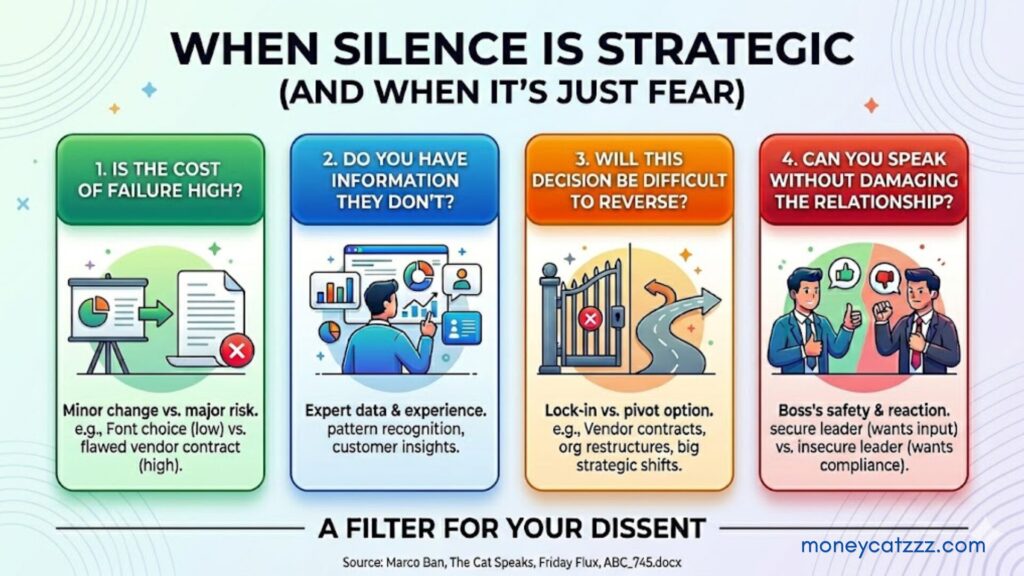
I use four criteria to decide when to speak and when to stay quiet:
Criterion 1: Is the cost of failure high?
If your boss wants to use a different font in the presentation, let it go. If they’re about to sign a contract with a vendor you know is unreliable, speak.
The $800K strategy failure met this criterion. The cost was real, measurable, and preventable. That’s when silence becomes negligent.
Criterion 2: Do you have information they don’t?
Your opinion doesn’t matter. Your information does. If you’ve run this play before, if you have data they haven’t seen, if you know something about the customer or market they don’t, you have a responsibility to share it.
The VP had run this exact strategy and watched it fail. That’s not opinion, that’s pattern recognition. He had information his CEO needed, but he didn’t provide it.

[Dissent vs. Fear: The Executive Filter | moneycatzzz.com]
Criterion 3: Will this decision be difficult to reverse?
Some decisions are simply tests: try them, review the data, and pivot if needed. Others lock you into a path with massive switching costs that deserve heavy scrutiny before commitment: vendor contracts, organizational restructures, and major strategic pivots.
The go-to-market strategy involved partnership agreements and product roadmap decisions that would take months to unwind. High reversal cost. Definitely worth speaking up.
Criterion 4: Can you speak without damaging the relationship?
This one’s the hardest to assess. If your boss is insecure, defensive, or punishes dissent, speaking up might cost you more than the bad decision would.
That’s not fair, but it’s real. You need to read the room and the person in it. Some leaders genuinely want input. Others want compliance. Know which one you’re dealing with.
If you’re working for someone who punishes good-faith disagreement, that’s valuable information, maybe not about this decision, but about whether you should stay in this role.
The Language That Actually Works
How you speak matters as much as whether you speak. I’ve watched brilliant people destroy their credibility by presenting good information poorly.
Kim Scott calls this “Radical Candor” in her book of the same name. The framework is simple: care personally, challenge directly. Most people do one or the other. Caring without challenging is ruinous empathy.
Challenging without caring is obnoxious aggression.
You need both.
Here’s what that sounds like in practice:
Instead of: “That strategy won’t work.”
Try: “I’ve seen this approach tried before, and I’m concerned we might hit the same obstacles. Can I walk you through what I observed?”
The first version is a verdict. The second is an invitation. Your boss can reject a verdict and save face. An invitation to hear your experience is harder to dismiss.
Instead of: “You’re ignoring the data.”
Try: “I’m seeing something in the data that’s making me nervous about this direction. Could we look at it together?”
You’re not accusing them of incompetence. You’re offering a partnership in problem-solving.
Instead of: “This is a mistake.”
Try: “I want to make sure we’ve considered X before we commit. What would need to be true for this to work, given that constraint?”
This does two things. First, it surfaces the constraint without making them wrong for not seeing it. Second, it puts the burden on the strategy to account for reality, not on you to prove it’s bad.
The Timing Nobody Talks About
Even good information delivered well can fail if the timing is wrong.
I learned this the hard way. Early in my career, I challenged my boss in front of his boss. I was right about the issue. I was catastrophically wrong about the setting. He never forgave me. I left the company six months later.
Public disagreement creates a power problem. If your boss backs down in front of others, they lose face. If they double down, they’re committed to a bad decision to save credibility. You’ve created a lose-lose.
Private disagreement gives them room to think, change their mind, and claim the better idea as their own if needed. Let them – your goal isn’t credit, it’s outcomes.
The best time to speak is:
- Before the decision is final, once they’ve announced it publicly, changing course is harder.
- One-on-one when possible. Give them space to think without an audience.
- When you have an alternative, don’t just identify the problem; bring a possible solution.
That VP? He should have requested a private meeting after seeing the initial proposal. “I want to support this strategy, and I have some concerns based on experience. Can I walk you through what I’m seeing and suggest some adjustments?“
Speaking privately, early, and solution-oriented will not trigger defensive reactions.
The Return on Calculated Dissent
When you run this protocol correctly, you don’t just save a project; you protect your organization’s core metrics. I watched a founder use these exact four criteria last month to block her board from slashing customer support by 40%. By pulling the board chair into a private, data-backed meeting before the vote, she reframed the problem in terms of shared margins and successfully redirected the cuts to low-ROI marketing spend.
She didn’t get public credit in the board minutes, but she saved her company’s retention numbers from collapsing. That is the actual return on speaking up.
The Protocol for Your Next Meeting
You’re going to be in that meeting soon. Your boss will propose something you know is flawed. Your chest will tighten. You’ll feel the pull toward silence.
Here’s what to do instead:
Step 1: Run the four criteria in real time.
Significant cost? Information they lack? Hard to reverse? Can you speak without relationship damage? If it’s three or four yes answers, you need to speak.
Step 2: Request time, don’t ambush.
“I have some thoughts on this I’d like to discuss. Can we find fifteen minutes this week?” This signals disagreement without putting them on the spot.
Step 3: Frame it as a partnership.
“I want to help make this successful, and I’m seeing some potential obstacles we should address.” You’re on the same team. The problem is external to both of you.
Step 4: Bring data or experience, not opinion.
“When we tried something similar in 2019, here’s what happened.” Specific, factual, relevant.
[When Silence Is Strategic | moneycatzzz.com]
Step 5: Offer an alternative or ask for their thinking.
“Have you considered [alternative]?” or “Help me understand how you’re thinking about [constraint]?” Don’t just poke holes. Build bridges.
Step 6: Accept their decision and move on.
You spoke. They heard you. They might still choose differently. That’s their right. You’ve done your job. Let it go.
Because executing this protocol isn’t just about saving the company from a bad play, it is about protecting your own internal architecture from the alternative.

The Cost of Not Speaking
Staying silent does not preserve your position. It simply delays how you lose it.
That VP who hid behind safety walked away eight months after the crash, driven out by a quiet reality: he could no longer respect a role that required him to mute his own expertise to keep it.
When you choose compliance over candor, the real damage isn’t external. It is the invisible, steady erosion of your own professional authority. If your current leadership team treats honest, data-backed disagreement as insubordination rather than intelligence, you aren’t protecting a career. You are just financing a slower, more resentful exit.
Your Next Move
You know the decision that is coming, and you already know what you need to say. The fear is real. Say it anyway. Do not ambush them in the meeting or try to corner them in front of an audience.
This isn’t about winning an argument. You need to approach them privately and early, coming equipped with clean data and a viable alternative.
Your job might be at risk if you choose to speak. Your professional credibility is guaranteed to be at risk if you do not.
Safety is an illusion.
Silence is not protecting your position; it is simply making you quieter.
Speak.
____________________________
3 High-Stakes Books to Shatter Executive Silence and Rewrite Your Leadership Blueprint
Leadership and Self-Deception


Never Split the Difference

Radical Candor



Disclosure: This post may contain affiliate links. We only recommend products we believe in, and we may receive a commission at no cost to you! Thank you for your support!
Acknowledgment: Cover Image by moneycatzzz.com
Disclaimer: The information is provided for general information only – moneycatzzz.com makes no representations or warranties in relation to the information, including but not limited to any representation or warranty as to the fitness for any particular purpose of the information to the fullest extent permitted by law. While every effort has been made to ensure that the information provided in this article is accurate, reliable, and complete as of the time of writing, the information provided in this article should not be relied upon to make any financial, investment, real estate or legal decisions. Additionally, the information should not substitute advice from a trained professional who can take into account your personal facts and circumstances, and we accept no liability if you use the information to form decisions.