
 Reading Time: 8 mins #
 This post may contain affiliate links.
A lighthouse doesn’t chase ships. It doesn’t swim out to rescue drowning sailors. It doesn’t apologize for only being visible in sweeps. It stands on solid rock, maintains its light, and lets those who need guidance find their way to it.
You, meanwhile, are drowning in the ocean trying to be everyone’s personal navigation system. Enforcing professional boundaries isn’t about being difficult. It’s about understanding a fundamental law of physics: You can’t guide others if you’re lost at sea yourself.
The False Beacon Economy
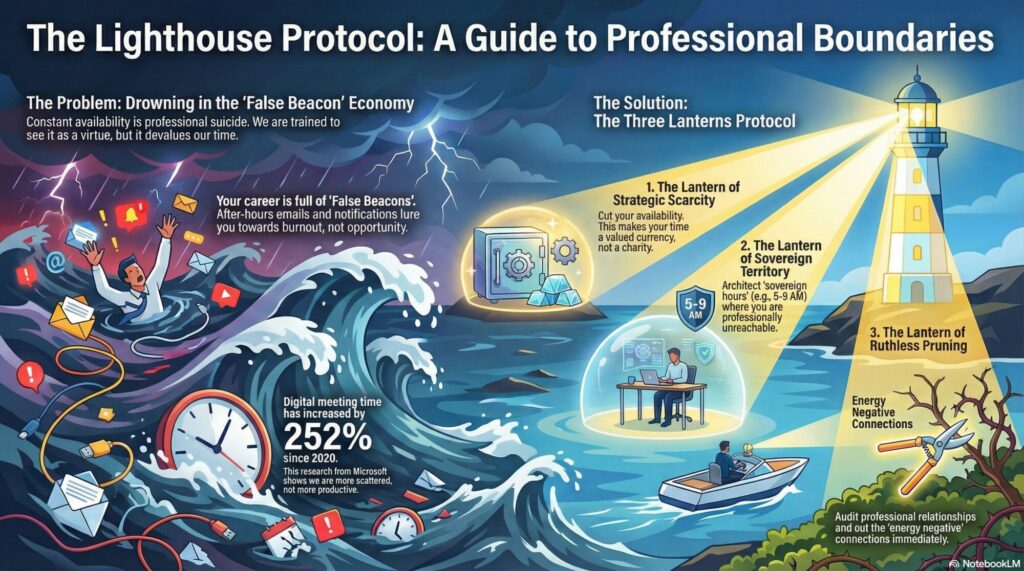
We live in an economy of false beacons. Every notification is a light promising harbor. Every after-hours email signals “opportunity.” Every weekend, Slack message whispers “commitment.” We’ve been trained to see constant availability as a professional virtue when it’s actually professional suicide.
In maritime history, “wreckers“ would place false lights on dangerous shores, mimicking safe harbors to lure ships onto rocks. They’d then pillage the wreckage. Your career is full of these wreckers, disguised as opportunities, designed to dash you against the stones of burnout while others profit from your pieces.
Greg McKeown writes in Essentialism about the disciplined pursuit of less. But it’s more than discipline. It’s physics. A light spread too thin illuminates nothing. A person spread too thin guides no one. Cultivating professional boundaries is about focusing your energy on something powerful enough to matter truly.
Research from Microsoft’s Human Factors Lab shows that digital collaboration has increased meeting time by 252% since 2020. We’re not more productive; we’re more scattered. The false beacons are winning.
The Wrecker’s Myth: The “Helpful” Trap
The most dangerous wrecker is the one inside your head saying, “I just want to be helpful.”
When you prioritize everyone else’s “quick question” over your own deep work, you aren’t being helpful. You are being compliant. Compliance is a commodity; vision is a rarity. Architecting professional boundaries allows you to move from a commodity to a rarity.

[“The Physics of Landing (Cognitive Flexibility)” – Image by moneycatzzz.com]
The Architecture of Depletion
Here’s what nobody admits: Being constantly findable is a poverty mindset disguised as ambition. It says your value is so low that you must always be available for purchase. It says your light is so weak that it must constantly prove its existence.
Successful people understand something you don’t: Acquiring professional boundaries is the difference between being successful and merely appearing busy. Scarcity creates worth. We’ve been programmed to believe our worth comes from our willingness to be consumed, but the opposite is true.
The Physics of Landing
When you fall, you have two choices: shatter or land on your feet. The difference isn’t strength; it’s cognitive flexibility: the ability to reorient mid-flight. Cats do this instinctively through their righting reflex. Humans must do it consciously by establishing clear perimeters.
Katherine May explores this in Wintering, describing seasons where withdrawal is preparation, not failure. When you are growing professional boundaries, you aren’t retreating; you are performing an internal professional recalibration that allows you to land gracefully when others crash.
Studies from Stanford on resilience show that individuals who maintain a clear distance from their problems recover faster from setbacks. They land on their feet because they’ve preserved the energy others squandered on false urgencies.
The Three Lanterns Protocol
To transform from a drowning sailor to a standing lighthouse, you need three distinct lights:
1. The Lantern of Strategic Scarcity
Suppose everyone can reach you; no one values reaching you. Enforcing professional boundaries starts with artificial scarcity. Not because you’re playing games, but because attention is finite and you’re currently bankrupting yourself.
Cut your availability by 70%. Watch what happens. The trivial requests disappear. Your time becomes a currency, not a charity. The cognitive flexibility required here involves shifting from being a “helpful person“ to being a “strategic resource.”
2. The Lantern of Sovereign Territory
A lighthouse has a room at the top where the light mechanism lives. No water can reach it. Architecting professional boundaries means establishing your personal “sovereign hours.”
Mine are 5 AM to 9 AM. During these times, I am not professionally active. My phone is off. This isn’t just about work-life balance; it’s about work-life architecture. As Tricia Hersey suggests in Rest Is Resistance, this is a form of rebellion against systems that demand constant productivity.
3. The Lantern of Ruthless Pruning
Most professional relationships are parasitic. They take light but give no energy. Mastering professional boundaries requires a relationship audit. List your connections. Mark them “energy positive“ or “energy negative.“ Cut the negatives immediately. This internal professional recalibration will feel like losing weight you didn’t know you were carrying.
[“The Lighthouse Protocol: A Guide” – Image by moneycatzzz.com]
The Innovation of Absence
Your absence creates more value than your presence. I once consulted for a CEO drowning in “quick questions.“ We implemented strict limits: he was only findable Tuesdays through Thursdays, 10 AM to 3 PM.
The first week was chaos. By week three, problems began to solve themselves. Innovation increased because people couldn’t rely on his constant input. His absence forced their evolution. This is the paradox of cultivating professional boundaries: you create value by forcing the system to grow without you.
The Lighthouse’s Schedule
When you’re architecting professional boundaries, you need a concrete schedule:
- The Morning Foundation (5 AM – 9 AM): Sovereign time. Only creation.
- The Availability Window (9 AM – 12 PM): Findable and concentrated.
- The Deep Work Block (12:00 PM – 3:00 PM): Doors are closed. Notifications off.
- The Administrative Sweep (3 PM – 5 PM): Batched efficiency.
- The Evening Sovereignty (5 PM onward): You do not exist professionally.
The Cultural Resistance
As you begin to establish professional boundaries, people may perceive you as “difficult.“ They mean “not exploitable.“ They’ll say you’re “not a team player.“ They mean “not a doormat.”
This resistance is your confirmation. The lighthouse doesn’t apologize for being solid rock instead of shifting sand.
The Landing
Right now, you’re drowning in an ocean of other people’s priorities. You’ve been trained to view mastering professional boundaries as a limitation, when in fact it is an evolution.
The most powerful thing you can do is become unfindable. Not invisible, but strategically scarce. The world doesn’t need another drowning swimmer; it requires a lighthouse. When you master this, you don’t just land on your feet when a crisis comes; you never fall in the first place.
Which will you choose: the ocean of availability, or the shore of sovereignty?
Essential Tools for Setting Personal and Professional Boundaries

Wintering

Essentialism
Rest Is Resistance
Disclosure: This post may contain affiliate links. We only recommend products we believe in, and we may receive a commission at no cost to you! Thank you for your support!
Acknowledgment: Cover Image by moneycatzzz.com
Disclaimer: The information is provided for general information only – moneycatzzz.com makes no representations or warranties in relation to the information, including but not limited to any representation or warranty as to the fitness for any particular purpose of the information to the fullest extent permitted by law. While every effort has been made to ensure that the information provided in this article is accurate, reliable, and complete as of the time of writing, the information provided in this article should not be relied upon to make any financial, investment, real estate or legal decisions. Additionally, the information should not substitute advice from a trained professional who can take into account your personal facts and circumstances, and we accept no liability if you use the information to form decisions.