
 Reading Time: 8 mins #
 This post may contain affiliate links.
I was 216 meters above the Bloukrans River in South Africa, strapped into a harness that looked as if it had been designed by someone who hated comfort, when I realized I’d made a terrible mistake. I was about to step into the unknown. Not just the bungee jumping, though that was obviously insane, but the entire chain of decisions that led to me standing on a vibrating steel walkway, trying not to vomit on my Allbirds while twenty-three-year-old gap year kids behind me chanted “JUMP! JUMP! JUMP!” like this was some sacrificial ritual.
Which, in a way, it was.
I’d signed up for this jump six wines deep at a hostel in Cape Town, trying to impress a German photographer named Klaus who had abs you could grate cheese on and who’d been talking about “pushing boundaries” and “living authentically.“ I’d wanted to seem like the kind of woman who did things like jump off bridges for fun, not the type who once spent forty-three minutes in a Whole Foods parking lot unable to choose between oat milk brands because decision fatigue is real and capitalism is exhausting.
But here’s the thing about how to overcome fear of the unknown: sometimes you have to literally throw yourself off a bridge to understand that the unknown isn’t trying to kill you. It’s trying to teach you something about being alive.
When Your Body Becomes a Traitor
Standing on that platform, my body went into what I now know is called the dorsal vagal response, which is a fancy way of saying I became a human popsicle. Not fight, not flight, freeze. Like when you see your ex at Trader Joe’s and pretend to be fascinated by organic quinoa until they leave.
My legs weren’t mine anymore. They belonged to some primitive ancestor who thought staying very still would make the sabertooth tiger go away. Except the sabertooth tiger was a 216-meter drop into a canyon that looked like God’s own anxiety attack, and staying still wasn’t going to make it disappear.
According to research on the polyvagal theory, this biological freeze response is actually our nervous system trying to protect us by playing dead. Recognizing this noise can help you feel less overwhelmed when facing the unknown, such as paying $120 to jump yourself into the void voluntarily.
The jump master, a South African guy named Pieter who had the calm energy of someone who’d watched thousands of people lose their minds on this platform, didn’t try to motivate me. He’d seen enough frozen-with-fear tourists to know that inspiration bounces off terror like rain off a windshield.
“Breathe,” he said. Not “be brave” or “you can do this.” Just breathe. Like that was a complete sentence, as if oxygen was the answer to an existential crisis.
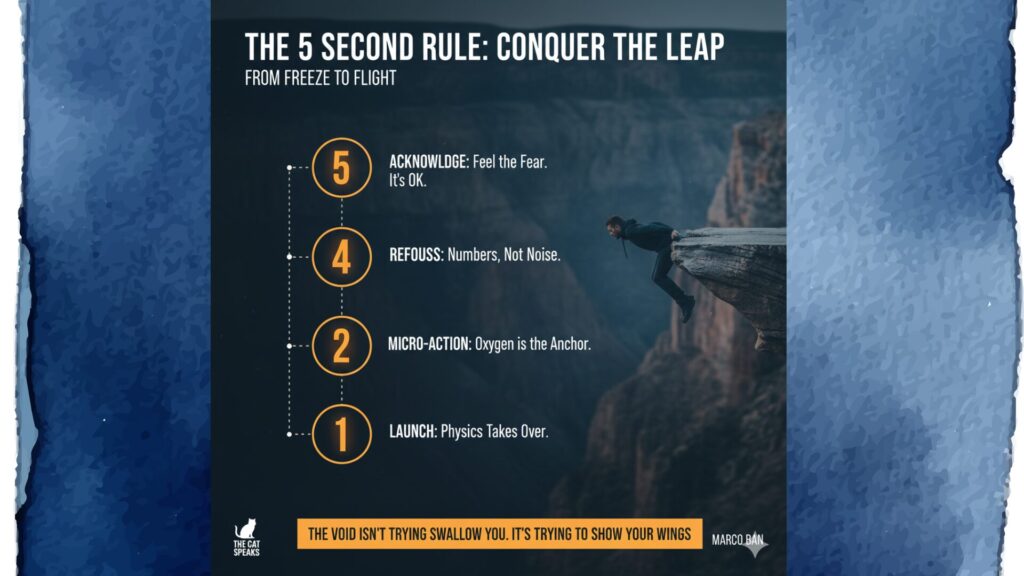
[“The 5-4-3-2-1 Rule – Mel Robbins – Image by moneycatzzz.com]
The Countdown That Changed Everything
I’d read Mel Robbins‘ The 5 Second Rule on the flight to Cape Town, highlighting passages while the man next to me snored into my shoulder. She talks about how counting backward, 5-4-3-2-1, hijacks your brain’s anxiety spiral and forces you into action. It sounded like the kind of thing that works in conference rooms when you’re afraid to speak up, not when you’re about to become a human yo-yo.
But standing there, with my heart attempting to escape through my throat, I tried it.
5: I acknowledged that I was terrified, and that was okay. Fear is just your body’s way of saying, “Hey, this seems important.“
4: I focused on the numbers instead of the drop. Math is boring. Boring is safe. Safe is good when you’re facing the void.
3: I breathed like Pieter suggested, though it came out more like hyperventilating, which probably wasn’t what he meant.
2: I identified the micro-action needed: lean forward. Not jump. Not be brave. Just lean.
1: I leaned.
And then physics took over.
The Space Where Choice Lives
Viktor Frankl wrote in Man’s Search for Meaning that between stimulus and response, there’s a space where we choose who we become. I’d highlighted that quote in three different colors in my copy, thinking it was about choosing patience in traffic or kindness in conflict.
I didn’t know it was about the 1.5 seconds between leaving a platform and feeling a bungee cord catch you.
In that space, falling toward a river that looked like dental floss, I realized that overcoming the fear of the unknown is about recognizing that resistance is the real obstacle, not the unknown itself.
For 1.5 seconds, I wasn’t afraid. I wasn’t brave either. I was present, which might be the same thing. My mind, usually a Netflix series of anxiety playing on repeat, went completely quiet. No thoughts about Klaus and his abs, no worries about my credit card debt, no replaying the fight with my mother about my “life choices.”
Just air and velocity and the weird peace that comes when you stop fighting gravity.

[“The Micro-Action (The Lean)” – Image by moneycatzzz.com]
The Rebound and the Revelation
When the bungee cord finally caught me, yanking me back up toward the bridge like God’s own aggressive hug, I screamed. Not from fear but from something else. Relief? Joy? The sudden understanding that I’d just done the thing I thought would kill me and was somehow still alive!
Bouncing there, upside down, blood rushing to my head, mascara definitely somewhere near my hairline, I started laughing. The laughing that makes people concerned for your mental health. Because I realized that learning to overcome the fear of the unknown isn’t about becoming fearless; it’s about being afraid and jumping anyway.
Pema Chödrön writes in When Things Fall Apart about a young warrior who asks fear for its weakness. Fear says, “I talk fast, and I talk a lot. If you don’t do what I say, I have no power.”
My fear had been talking nonstop since Cape Town. About death, about embarrassment, about wasting money, about Klaus thinking I was pathetic (which, let’s be honest, he probably did anyway since I ghosted him after the jump). But hanging upside down over a South African canyon, I realized fear was just noise. Background music to a movie I didn’t have to watch.
The Unglamorous After
They hauled me back up to the bridge, and I promptly threw up in a trash can, which wasn’t mentioned in any of the inspirational bungee jumping content I’d consumed. My legs shook for forty minutes. I couldn’t stop crying, but not sad crying, more like emotional overflow crying, like when you finally pee after holding it for too long on a road trip.
The German gap year kids high-fived me. Klaus texted asking if I wanted to “process the experience” over drinks. I didn’t. I wanted to sit alone in my hostel room eating peanut butter from the jar and understanding that I’d just learned something that research on post-traumatic growth confirms: sometimes you have to break to breakthrough.
Overcoming fear of the unknown isn’t a one-time lesson. It’s a practice. The bungee jump didn’t cure my anxiety any more than one therapy session cures trauma. But it gave me evidence that I could survive my own worst-case scenario.
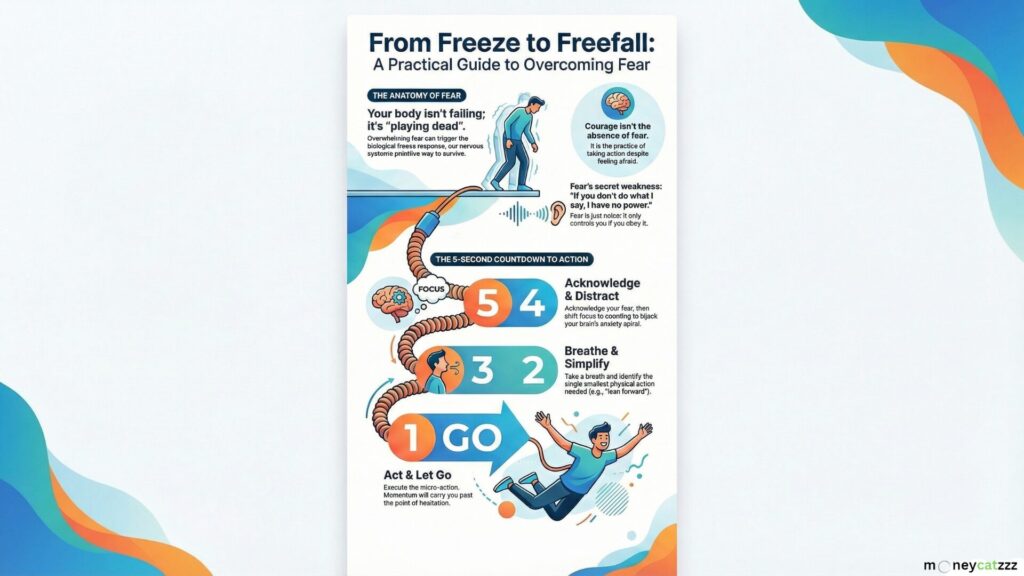
[“Guide to Overcoming The Unknown and Fear” – Image by moneycatzzz.com]
The Daily Practice of Small Jumps
Back in Brooklyn, I don’t have bridges to jump off, which is good for my insurance premiums. But I have small edges everywhere. The email I’m afraid to send. The conversation I keep postponing. The opportunity that feels too big.
Studies on courage show that it’s not the absence of fear, but rather taking action despite fear that counts. Every time I do something that scares me now, I count down. 5-4-3-2-1. It doesn’t make me less afraid. It just makes me move anyway.
Last week, I quit a client who’d been making me miserable for two years. I used the countdown. Last month, I told my mother the truth about why I don’t want kids. Countdown again. Yesterday, I signed up for a pottery class even though I have the artistic ability of a drunk toddler. 5-4-3-2-1-go.
Learning how to overcome fear of the unknown is really about developing a different relationship with uncertainty. Not conquering it, not eliminating it, just coexisting with it like roommates who’ve agreed to respect each other’s space.
The courage to jump doesn’t come from being ready; it comes from being willing. It comes from realizing you’ll never be prepared, and jumping anyway. Whether it’s off a bridge in South Africa or into a difficult conversation in Brooklyn, the physics are the same: lean forward, trust the cord, scream if you need to.
The void isn’t trying to swallow you. It’s trying to show you that you have wings, you just forgot how to use them.
Have you found your edge? What countdown is waiting for you? Share your stories of frozen moments and the courage to leap anyway.
Overcome Fear and Grow with These Resources
The 5 Second Rule


Man’s Search for Meaning
When Things Fall Apart
Disclosure: This post may contain affiliate links. We only recommend products we believe in, and we may receive a commission at no cost to you! Thank you for your support!
Acknowledgment: Cover Image by moneycatzzz.com
Disclaimer: The information is provided for general information only – moneycatzzz.com makes no representations or warranties in relation to the information, including but not limited to any representation or warranty as to the fitness for any particular purpose of the information to the fullest extent permitted by law. While every effort has been made to ensure that the information provided in this article is accurate, reliable, and complete as of the time of writing, the information provided in this article should not be relied upon to make any financial, investment, real estate or legal decisions. Additionally, the information should not substitute advice from a trained professional who can take into account your personal facts and circumstances, and we accept no liability if you use the information to form decisions.