
 Reading Time: 8 mins #
 This post may contain affiliate links.
I sat on my office floor, surrounded by seven external hard drives, three cloud storage accounts displayed on my screen, and 10,000 unorganized files dating back fifteen years. I was looking for a single client contract from 2019. After four hours of searching through digital infinity, I found myself sobbing. Not from frustration, but from a crushing realization: I had everything saved and nothing I could find. The abundance had become my prison.
The next morning, exhausted and defeated, I called my mentor Sarah, who’d successfully run an analog-first business for twenty years. I expected sympathy about digital organization. Instead, she said something that rewired my entire relationship with technology: “Your problem isn’t organization. It’s that you’ve rejected scarcity. You’re drowning in infinite options because you refuse to accept finite limits.
Until you embrace scarcity as a gift, not a curse, you’ll keep suffocating in abundance.”
She introduced me to what she called “sovereign finitude”: the deliberate cultivation of scarcity in a world designed to eliminate it. Not minimalism as an aesthetic, but scarcity as salvation. The conscious choice to limit options, restrict access, and create what she called an analog moat around your most precious resources: attention, creativity, and time.
That conversation led to the most radical act of my professional life: I deleted 10,000 files, canceled five subscriptions, and moved my core work offline. What followed wasn’t loss, but liberation.
The Abundance Trap That Nearly Broke Me
Before that September morning, I lived by the doctrine of “more is better.” More storage meant more security. More options meant more opportunity. More access meant more power. I had:
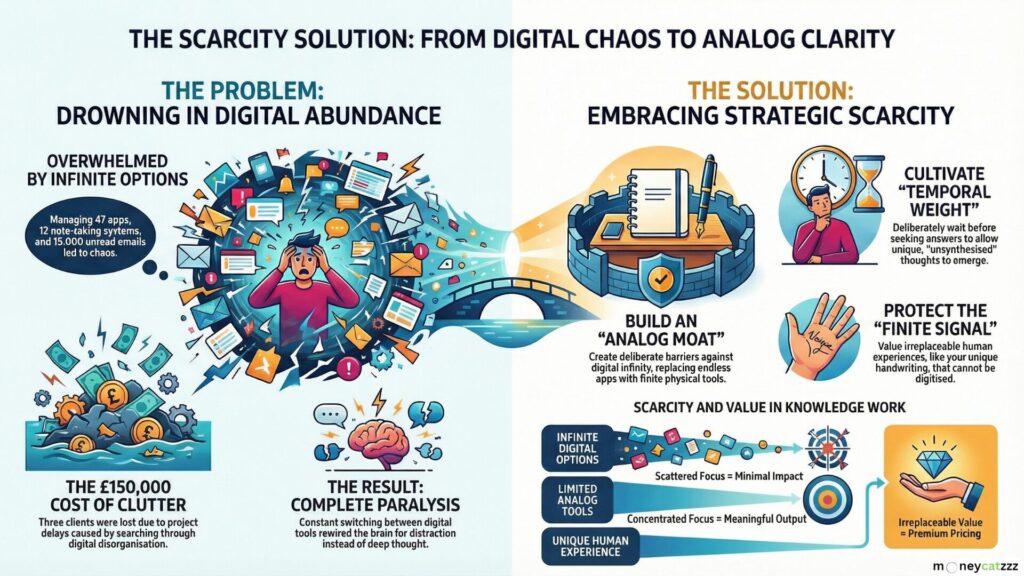
- 47 productivity apps
- 12 note-taking systems
- Unlimited cloud storage across multiple platforms
- 300 browser bookmarks
- 15,000 unread emails
- Instant access to any information, anytime
The result? Complete paralysis. I spent more time managing systems than creating value. The search for that contract wasn’t unusual; it was Tuesday. I’d lost three clients that year, not due to poor work, but to delayed delivery while I searched through infinite digital haystacks.
Nicholas Carr’s The Shallows describes exactly what was happening to my brain: the constant switching between infinite options was literally rewiring my neural pathways for distraction rather than deep thought. I had traded intellectual fidelity for digital hoarding.
The $150,000 Cost of Rejecting Scarcity
My mentor, Sarah, made me calculate the real cost of my abundance addiction:
Direct Costs:
- 10 hours weekly managing digital systems: $500/hour opportunity cost = $260,000 annually
- Three lost clients from delayed delivery: $150,000
- Subscription services I never used: $3,000 annually
Hidden Costs:
- Declining work quality from fractured attention
- Creative projects abandoned in digital graveyards
- Relationships strained by constant digital distraction
The abundance I thought was protecting me was actively destroying my capacity for meaningful work. Every saved file was a decision deferred. Every backup was an excuse not to commit. Every infinite option was a finite signal drowned in noise.
The Analog Moat: Building Walls Against Infinity
Sarah challenged me to build what she called an analog moat: deliberate barriers between myself and digital infinity. Not Luddism, but strategic scarcity creation. She showed me her system: a single leather journal for all strategic thinking, one fountain pen, and a filing cabinet with exactly 50 hanging folders.
“When you run out of space,” she said, “you have to decide what matters. That decision is where wisdom lives.”
I started with baby steps, following Cal Newport’s framework from Digital Minimalism. But instead of just reducing digital tools, I actively replaced them with scarce alternatives:
Digital → Analog Transitions:
- Endless word processor → One physical notebook with finite pages
- Infinite digital canvas → Single whiteboard that must be erased
- Unlimited cloud storage → One filing drawer that forces curation
- Always-on communication → Scheduled phone calls with defined end times
The analog moat wasn’t about rejecting technology entirely. It was about creating zones where scarcity could teach me what abundance never could: the value of limits.
Temporal Weight: The Luxury of Waiting
The most radical element of Sarah’s philosophy was what she called temporal weight: deliberately slowing down the acquisition of information to increase its value. In a world where every answer is instantly searchable, she argued, the ability to not know something immediately becomes a superpower.
I tested this with a client problem. Instead of immediately Googling solutions or prompting ChatGPT, I committed to sitting with the problem for 48 hours: no research, no outside input, just my own mind working through the challenge.
The discomfort was intense. My fingers literally twitched toward my phone. But something magical happened around hour 36: an insight emerged that was uniquely mine, what Sarah called an “unsynthesized thought.” It wasn’t pulled from someone else’s framework or generated by pattern matching. It had temporal weight because it was earned through time, not extracted through speed.

[“Temporal Weight: The Luxury of Waiting” – Image by moneycatzzz.com]
Jun’ichirō Tanizaki explores this in In Praise of Shadows, arguing that beauty emerges from scarcity and limitation, not abundance and availability. The shadow is beautiful because it conceals; the finite is precious because it ends.
Research from The Long Now Foundation confirms that extending temporal horizons fundamentally changes decision quality. When you can’t have everything now, you must choose what matters most.
The Finite Signal: What Can’t Be Replicated
In our age of AI and infinite generation, Sarah taught me to identify and protect what she called the finite signal: the aspects of human experience that resist digitization and replication.
These include:
- The specific quality of light in your workspace at 3 PM
- Your handwriting’s peculiar rhythm and pressure
- The pause before you answer a difficult question
- The way your mind connects disparate ideas when walking
- Physical exhaustion after deep work
These signals have value precisely because of their scarcity. They can’t be copied, downloaded, or artificially generated. They exist in one place, at one time, in one body. This is intellectual fidelity in its purest form: thought that bears the fingerprint of a specific human experience.
Anshadameenza.com argues that preserving these finite signals is essential for maintaining human agency in an age of artificial abundance.
My Scarcity Protocol: The 90-Day Transformation
After that September breakdown, I implemented a radical scarcity protocol:
Week 1-30: The Great Deletion
- Deleted 10,000 files, keeping only 100 essential documents
- Canceled all but two digital subscriptions
- Reduced email to once daily, 30-minute sessions
- Moved strategic thinking entirely offline
The withdrawal was real. I felt naked without my digital safety nets. But something interesting happened: without infinite options, I started making actual decisions.
Week 31-60: Building the Analog Moat
- Established a physical workspace with no digital devices
- Invested in quality analog tools (fountain pen, leather journal, mechanical timer)
- Created “temporal weight” periods: 2-hour blocks with no information input
- Practiced generating unsynthesized thoughts
My productivity didn’t just improve; it underwent a transformation. Without the friction of infinite choice, creation became fluid.
Week 61-90: Protecting the Finite Signal
- Documented my unique perspectives and experiences
- Developed signature frameworks that couldn’t be AI-generated
- Built relationships through in-person meetings, not digital communication
- Created work that required my specific presence and experience
By day 90, my business had not only recovered but expanded. Clients valued the finite signal of my focused attention over the infinite noise of digital overwhelm.
The Mathematics of Scarcity
The Schumpeter Center for New Economics demonstrates that scarcity creates value through simple mathematics:
- Infinite supply = Zero value
- Limited supply = Increased value
- Unique supply = Maximum value
Applied to attention and creativity:
- Infinite digital options = Scattered focus = Minimal impact
- Limited analog tools = Concentrated focus = Meaningful output
- Unique human experience = Irreplaceable value = Premium pricing
My hourly rate doubled after implementing scarcity principles. Not because I worked more, but because my work became impossible to replicate or automate.
The Paradox: Scarcity Creates Abundance
The strangest outcome of embracing scarcity was discovering abundance on the other side. By limiting my tools, I expanded my creativity. By restricting my inputs, I deepened my outputs. By accepting finite limits, I found infinite depth.
Sarah explained it perfectly: “Scarcity isn’t deprivation; it’s concentration. When you can’t have everything, you’re forced to choose what matters. That choice is where your power lives.”
[“Digital To Analog Clarity” – Image by moneycatzzzcom]
Your Scarcity Experiment
Start small. Choose one area where you’ll introduce deliberate scarcity this week:
Option 1: The Analog Hour
One hour daily with only paper and pen. No devices, no digital inputs. Let your mind generate rather than consume.
Option 2: The Temporal Weight Challenge
Next time you have a question, wait 24 hours before searching for the answer. See what emerges from your own experience.
Option 3: The Finite Signal Practice
Document something only you can observe: the specific way light moves through your space, the rhythm of your neighborhood, the pattern of your own thoughts when walking.
These aren’t productivity hacks or optimization tactics. They’re acts of rebellion against a world that profits from your endless consumption of infinite options.
The Morning After Digital Infinity
It’s been two years since that September breakdown. My office now contains one notebook, one pen, and one small filing cabinet. My computer has exactly the programs I need, nothing more. My phone stays in a drawer during work hours.
Yesterday, a client asked me to find a document from our first meeting. It took me thirty seconds. Not because I have a better filing system, but because I only keep what matters. The analog moat holds firm.
The temporal weight grounds every decision. The finite signal guides my work.
Scarcity saved me from drowning in my own abundance. It might save you, too.
The infinite will always be there, endlessly available, endlessly empty. The finite is where life actually happens.
Choose wisely. Choose scarcity.
Conquer Scarcity with These Resources
The Shallows


In Praise of Shadows
Digital minimalism
Disclosure: This post may contain affiliate links. We only recommend products we believe in, and we may receive a commission at no cost to you! Thank you for your support!
Acknowledgment: Cover Image by moneycatzzz.com
Disclaimer: The information is provided for general information only – moneycatzzz.com makes no representations or warranties in relation to the information, including but not limited to any representation or warranty as to the fitness for any particular purpose of the information to the fullest extent permitted by law. While every effort has been made to ensure that the information provided in this article is accurate, reliable, and complete as of the time of writing, the information provided in this article should not be relied upon to make any financial, investment, real estate or legal decisions. Additionally, the information should not substitute advice from a trained professional who can take into account your personal facts and circumstances, and we accept no liability if you use the information to form decisions.