
 Reading Time: 10 mins #
 This post may contain affiliate links.
Grow: Optimize Your Marketing Funnel for Max Results
We’ve all been there.
You spend months perfecting your offer, polishing your brand voice, launching that gorgeous new website—and then, crickets. Leads trickle in, conversions stall, and suddenly, you’re spiraling into a self-diagnosed marketing identity crisis.
“Is it the copy? The CTA button color? Mercury in retrograde?“
Before you abandon digital marketing and run off to raise alpacas in the Andes (tempting), let’s talk about something more practical: your marketing funnel.
Because more often than not, it’s not your talent or offers that’s broken—it’s the journey you’re asking customers to take. And too many businesses forget: customers don’t just “convert.” They travel. They hesitate. They ghost. They come back. They need a story to step into.
“Build relationships, not just sales.” – Zig Ziglar.
Funnel 101: More Than Just an Upside-Down Triangle
At its most basic, the marketing funnel is a map—guiding people from the moment they first hear about you to the moment they say “yes.” Yes, to subscribing. Yes to booking. Yes, to buying, referring, and cheering you on like proud parents in the front row.
But here’s the thing: most marketing funnels forget the human. They treat people like data points—measuring behavior without understanding the emotions, fears, or motivations behind it.
Instead of the very definition of “Insanity,” let’s take a different approach. Let’s walk through the funnel not just as strategists but as storytellers—your funnel isn’t just a pipeline for profits—it’s a path for connection, resonance, and trust.
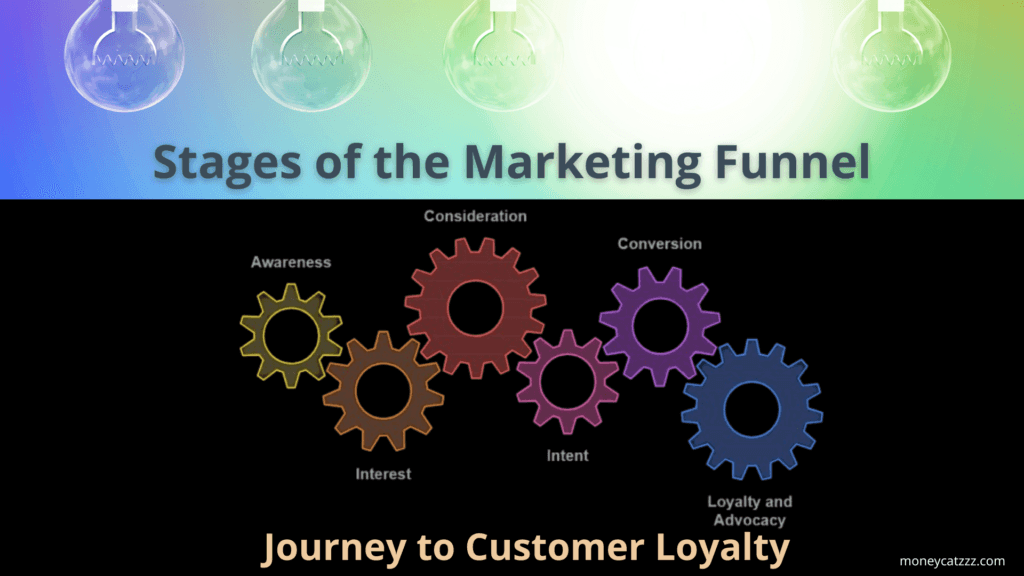
[“Stages of the Marketing Funnel” – moneycatzzz.com]
Stage 1: Awareness — When They First Hear the Music
Imagine your brand as a band. No one’s buying concert tickets until they’ve heard you play.
Awareness is where the music starts. It’s when a stranger encounters your brilliance—maybe through a blog post, Instagram Reel, podcast guest spot, or a persuasive ad featuring a dog in sunglasses.
But awareness isn’t about shouting louder. It’s about resonating deeper. It’s where you stop trying to impress and start trying to connect.
💡 Instead of: “Look at our product features!“
Try: “Here’s the problem you’ve been silently carrying—and what life could look like on the other side.”
🗣️ Donald Miller, author of Building a StoryBrand, says, “If you confuse, you lose.” Clear, empathetic messaging is what turns casual passersby into curious listeners.
Stage 2: Interest — When Curiosity Begins to Flicker
Now they’re intrigued. They’re clicking. Browsing. Lurking.
This stage is like dating in the early days. You’re trying to prove you’re not a weirdo while gently making the case that you’re incredibly desirable, emotionally available, and capable of delivering next-day shipping.
So, how do you build trust here?
- Offer lead magnets that magnet. Not generic PDFs collecting digital dust, but real solutions to real problems.
- Send emails that feel like letters, not lectures.
- Be useful, not pushy. You’re not selling—yet. You’re showing up with relevance and reliability.
And please—bring some personality. Humor. Humanity. A metaphor or two. Don’t just send “Tuesday’s Sales Email.” Send “Tuesday’s Slightly Unhinged But Incredibly Helpful Marketing Pep Talk.“
Stage 3: Consideration — The Dating Phase
Here’s where it gets serious.
Your prospects are now comparing options. They’ve seen your competitors. They’re analyzing features, reading reviews, and zooming in on that slightly blurry product photo from 2021.
This is not the time for subtlety.
You need to confidently and empathetically communicate what makes you the choice. Not a choice. The one.
This means:
- Sharing case studies with real outcomes, not vague praise.
- Addressing objections head-on (“Is this too expensive?” “Will it work for me?”).
- Demonstrating transformation, not just transactions.
Pro Tip: Host a live webinar or Q&A session. Show your face. Answer real questions. People buy from people—not faceless websites.
And if you have a quirky brand voice? Use it. Your ideal clients aren’t comparing spreadsheets—they’re looking for someone who gets them.
Stage 4: Intent — They’re Hovering Over the Buy Button
You’ve got them. Almost.
They’ve added it to the cart. They’ve scheduled the call. They’re 80% sold—but something’s stopping them.
This is the stage where your job is to clear the last hurdles.
- Simplify the checkout experience (no one wants to create an account to buy socks).
- Offer a guarantee or a “no-pressure“ exit ramp.
- Send that abandoned cart email with warmth, not guilt. (“Hey, we noticed you left this behind. If you’re still thinking about it, here’s 10% and a reminder: your future self will thank you.”)
Do urgency tactics work? They do—when they’re honest. A limited-time offer should be just that. It’s not a recurring mirage. People can smell fake scarcity from a mile away (and it smells like desperation and Black Friday).
Stage 5: Conversion — The Moment of Yes
🎉 Cue the confetti cannons and interpretive dance.
But don’t get too comfy. The relationship isn’t sealed with a sale but with what comes after.
Too many brands treat customers like conquests. But loyalty isn’t built at checkout. It’s built in the follow-through.
This is your chance to wow. Delight. Overdeliver.
- Send a thoughtful welcome or thank-you email.
- Offer onboarding support or “how to get the most from your purchase“ guidance.
- Ask for feedback—not just stars, but stories.
And yes, Amazon does crush it here. They’ve mastered seamless conversion from 1-click checkout to eerily accurate “You might also like…“ recs. But you don’t need Amazon’s budget to create a high-touch, low-friction experience.
You need intention.
Stage 6: Loyalty & Advocacy — Your Secret Growth Engine
Here’s what every great business eventually learns:
Your best customers aren’t your biggest spenders. They’re your loudest cheerleaders.
When someone loves your brand, they talk. They share. They become your unpaid marketing team, spreading your gospel across dinner tables and DMs.
So don’t just chase new leads. Nurture the ones you’ve already earned.
- Start a referral program. Make sharing easy and rewarding.
- Create community spaces where customers connect (Facebook groups, Discord, even lively comment sections).
- Celebrate your people. Feature them in your content. Show that you’re listening, not just selling.
💬 Jonah Berger, in Contagious: Why Things Catch On, explains that people share what makes them look good, feel smart, or feel part of something bigger. So give them reasons. And stories. And swag. (Swag never hurts.)
Metrics That Matter — But Don’t Lose the Plot
Yes, measure your funnel. Know your numbers.
Track:
- Traffic Sources – where are people finding you?
- Conversion Rates – how well are your pages performing?
- Bounce Rates – where are people peacing out?
- Customer Lifetime Value – because happy customers stick around.
But don’t forget: you are not your analytics dashboard.
Your funnel should reflect more than CTRs and ROIs. It should reflect your brand values, voice, and care for the people you serve.
📘 In Stolen Focus, Johann Hari reminds us that we’re not machines. Optimization is great—but not at the cost of connection, creativity, or meaning.
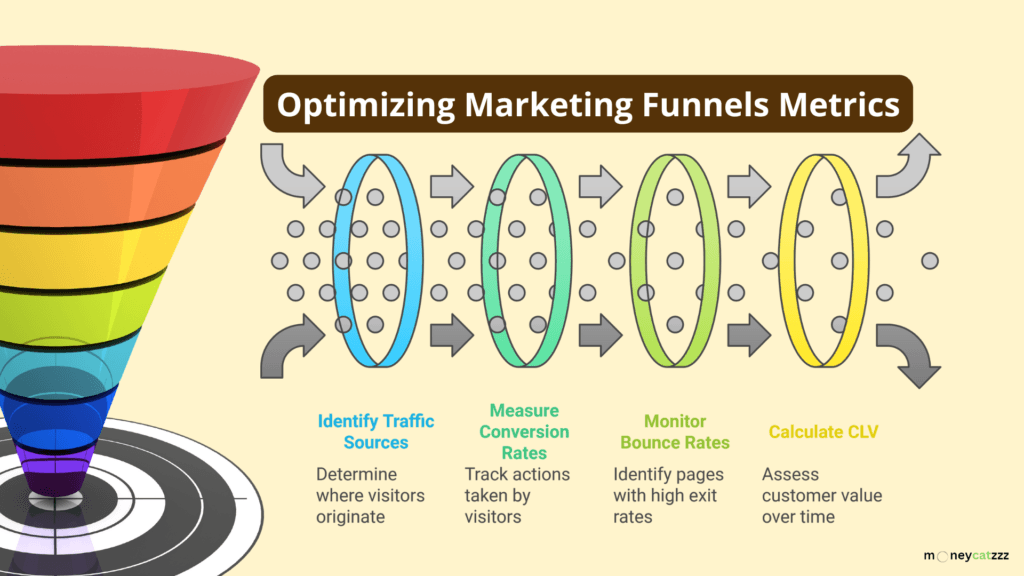
[“Optimizing Marketing Funnels Metrics” – moneycatzzz.com]
Your Funnel, Reimagined
In the end, the marketing funnel isn’t a funnel. It’s a narrative.
It’s the story of how someone goes from stranger to supporter. From “Who are you?“ to “Where have you been all my life?”
So, build your funnel like you’re building a relationship:
- With empathy at the top.
- With clarity in the middle.
- And with generosity all the way through.
Because when you lead with value, honesty, and a little personality, your funnel stops feeling like a sales tactic—and starts feeling like a journey worth taking.
And if you still want to raise alpacas, do it. Just build a funnel for that, too.

Disclosure: This post may contain affiliate links. We only recommend products we believe in, and We may receive a commission at no cost to you! Thank you for your support!
Acknowledgement: Cover Image by Unsplash.com
Disclaimer: The information is provided for general information only – moneycatzzz.com makes no representations or warranties in relation to the information, including but not limited to any representation or warranty as to the fitness for any particular purpose of the information to the fullest extent permitted by law. While every effort has been made to ensure that the information provided in this article is accurate, reliable, and complete as of the time of writing, the information provided in this article should not be relied upon to make any financial, investment, real estate or legal decisions. Additionally, the information should not substitute advice from a trained professional who can take into account your personal facts and circumstances, and we accept no liability if you use the information to form decisions.