 Reading Time: 12 mins #
 This post may contain affiliate links.
Master: The Art of Effective Decision Making
We make thousands of decisions daily—what to eat, who to trust when to speak up, and when to stay quiet. Most fade into the background. But every once in a while, a decision shapes everything: the job we take, the product we launch, the truth we admit to ourselves at 2 a.m.
And in a world drowning in data, deadlines, and dopamine hits, the ability to make clear-headed decisions isn’t just a nice-to-have—it’s survival gear.
This isn’t just about decision theory. It’s about real life. Why do smart people sometimes make spectacularly bad calls? Why your gut is sometimes a genius… and sometimes a traitor. And how to navigate complexity with clarity so you can steer your life—not just react to it.
“The quality of your decisions determines the quality of your life.“ – Tony Robbins.
Let’s dive into three critical elements of effective decision-making:
- Decision Making Frameworks – because having a map helps when you’re in uncharted territory.
- Decision Traps – the hidden sinkholes in our thinking.
- The Role of Intuition – when to trust your gut and when to check it.
First, let’s talk about structure. Decision making doesn’t have to feel like wandering in the dark. With the right mental tools, even the most ambiguous situations start to take shape.
1. Decision Making Frameworks: Structure for the Storm
When the stakes are high, and the path isn’t apparent—frameworks bring order to the chaos. They help us pause, zoom out, and think systematically. As Nobel laureate Daniel Kahneman explains in Thinking, Fast and Slow, our minds run on two systems:
- System 1: fast, emotional, intuitive. Great in emergencies. Terrible with nuance.
- System 2: slow, deliberate, analytical. The grown-up in the room.
The trick is knowing which system to activate—and when.
🧠 The WRAP Framework
From Chip and Dan Heath’s Decisive, the WRAP framework helps avoid narrow framing and hasty choices:
- Widen your options – Don’t fall for either/or thinking. Explore alternatives.
- Reality-test your assumptions – Ask: “What would make this fail?”
- Attain distance before deciding – Zoom out. Don’t let your current mood hijack the moment.
- Prepare to be wrong – Because you might be. And that’s okay.
This isn’t about perfection. It’s about giving yourself the best shot at clarity.
📊 The Eisenhower Matrix
Popular with productivity nerds and military leaders alike, this tool divides tasks by urgency and importance:
- Urgent + Important: Do now.
- Important, not Urgent: Schedule it.
- Urgent, not Important: Delegate.
- Neither: Delete and never speak of it again.
It’s a sanity-saving filter in a world obsessed with busyness.
👥 The Vroom-Yetton-Jago Model
It’s a mouthful but useful—especially for leaders. This model helps you figure out how much team involvement a decision needs:
- From Autocratic (decide solo) to Collaborative (complete consensus), the model adapts to the situation, not the ego.
It’s a reminder: sometimes democracy slows things down. Sometimes, autocracy misses blind spots. Choose wisely.
🎩 The Six Thinking Hats
Edward de Bono’s color-coded creativity booster encourages you to look at decisions from multiple angles:
- White: Facts only
- Red: Gut feelings
- Black: Risks and cautions
- Yellow: Optimism and upside
- Green: Creative alternatives
- Blue: Big-picture control
It’s like assembling a mental board of advisors—minus the scheduling conflicts.
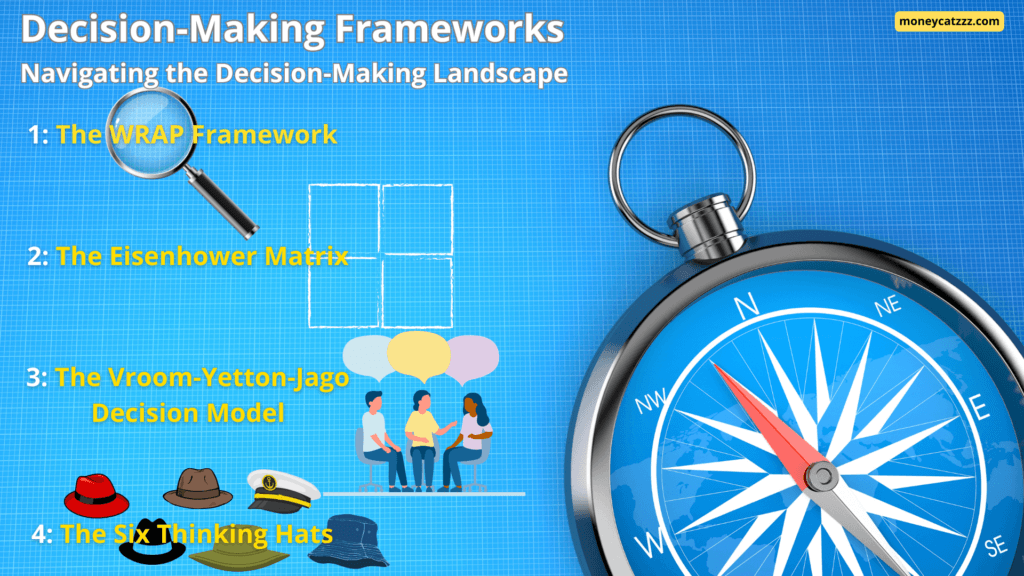
[“Decision-Making Frameworks” – moneycatzzz.com]
2. Decision Traps: The Invisible Forces Sabotaging Your Choices
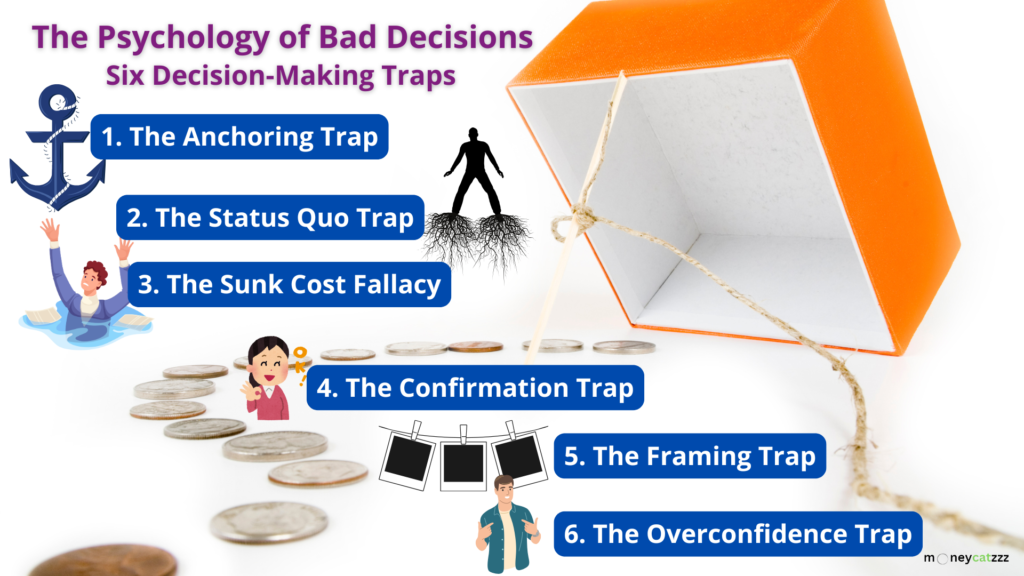
Even with the best frameworks, we’re not immune to cognitive traps. Hammond, Keeney, and Raiffa explain in Smart Choices that our brains are wired for shortcuts. Sometimes, those shortcuts lead straight off a cliff.
Here are the usual suspects:
⚓ The Anchoring Trap
You hear one number, and suddenly, everything else is relative. The first price you’re quoted. The first piece of feedback. That “anchor” becomes the lens.
Solution: Seek diverse input. Delay judgment. Ask: “If I hadn’t heard this first, would I feel the same?”
⏳ The Status Quo Trap
We stick with what’s familiar—even when it’s not working. Blame it on loss aversion and nostalgia.
Solution: Ask, “If I weren’t already doing this, would I start now?” Be willing to abandon the familiar for the better.
💸 The Sunk Cost Fallacy
You’ve already invested time, money, or pride—so you keep going, even when the ROI is dead.
Solution: Focus on future outcomes. Imagine you’re advising a friend. Would you tell them to continue?
🔍 The Confirmation Trap
We cherry-pick evidence that supports what we already believe. (Thanks, ego.)
Solution: Play devil’s advocate. Actively seek opposing views. Reward people who disagree with you respectfully.
🖼️ The Framing Trap
How a problem is presented can shape the decision more than the facts.
Solution: Reframe it. Flip gain into loss, or vice versa. Consider how a neutral third party would describe it.
💪 The Overconfidence Trap
We think we’re better at predicting the future than we are. (This is how entire banks collapse.)
Solution: Use base rates. Run worst-case scenarios. Invite others to poke holes in your plan.
Avoiding these traps won’t guarantee success. But it will massively improve your odds.
3. Intuition: Your Gut Isn’t Magic—But It’s Not Garbage Either
Malcolm Gladwell’s Blink popularized the idea that snap judgment can sometimes be spot-on. And he’s right… sometimes.
Intuition is rapid pattern recognition—your brain compares the present moment with past experiences at warp speed.
[“The Psychology of Bad Decisions” – moneycatzzz.com]
When Intuition Helps:
- In time-sensitive situations
- When dealing with people dynamics
- When your experience runs deep (i.e., you’ve seen this movie before)
When It Hurts:
- When emotions cloud judgment
- When you’re outside your area of expertise
- When biases sneak in disguised as instincts
The answer isn’t to ignore your gut. It’s to use it as a signal, not a verdict.
Tip: Let your intuition suggest. Let your analysis verify.
Over time, your intuition can become smarter—if you reflect, debrief, and keep learning from the outcomes of your decisions.
Case Studies: Decisions That Changed Everything
📺 Netflix Bets on Original Content (2013)
When Netflix rolled out House of Cards, they weren’t just launching a show. They were reinventing their business.
- Framework: WRAP is likely used, especially when challenging the status quo and reality testing.
- Traps Avoided: Status quo trap (they didn’t just stick with licensing).
- Intuition’s Role: Recognizing that streaming wasn’t just about content—it was about control.
It worked. And it changed the entire industry.
📸 Kodak Misses the Digital Wave
Kodak invented the digital camera in 1975—and then buried it.
- Framework Failure: No clear process for evaluating disruptive change.
- Traps: Status quo. Confirmation bias. Sunk cost (the film was too familiar).
- Ignored Intuition: Their engineers saw the shift coming.
This is a tragic example of what happens when ego, habit, and short-term thinking win.
Final Thoughts: Clarity Is a Skill, Not a Gift
Decision-making isn’t about being fearless or always right. It’s about being intentional.
So next time you’re facing a big choice—or even a small one that feels big—remember:
- Use a framework to structure your thinking.
- Watch for traps that distort your view.
- Listen to your gut, but don’t give it the final word.
Great decisions don’t come from perfect information. They come from better thinking—layered, flexible, and humble, like life itself.
And the best part? Every decision you make is practice for the next one.
TL;DR:
- Frameworks give you clarity—pick one that fits the situation.
- Traps are sneaky—know your brain’s blind spots.
- Intuition is powerful but partial—validate it with logic.
- Reflection turns decisions into growth—learn, adjust, repeat.
Your future is a series of choices. Make them count.

Disclosure: This post may contain affiliate links. We only recommend products we believe in, and We may receive a commission at no cost to you! Thank you for your support!
Acknowledgement: Cover Image by moneycatzzz.com on Canva
Disclaimer: The information is provided for general information only – moneycatzzz.com makes no representations or warranties in relation to the information, including but not limited to any representation or warranty as to the fitness for any particular purpose of the information to the fullest extent permitted by law. While every effort has been made to ensure that the information provided in this article is accurate, reliable, and complete as of the time of writing, the information provided in this article should not be relied upon to make any financial, investment, real estate or legal decisions. Additionally, the information should not substitute advice from a trained professional who can take into account your personal facts and circumstances, and we accept no liability if you use the information to form decisions.