
 Reading Time: 15 mins #
 This post may contain affiliate links.
Harnessing The Power of Neuroplasticity
For most of human history, we’ve believed the brain was set in stone by adulthood—a fixed organ etched with the finality of childhood development. But science has since turned that belief inside out—your brain is malleable and constantly changing in response to your experiences, thoughts, and behaviors. This revelation, called neuroplasticity, reshapes how we approach everything from healing trauma to unlocking creativity.
At the heart of this transformation is the understanding that you can rewire your brain—and doing so isn’t just possible, it’s practical.
“Whether you think you can, or you think you can’t, you’re right.” – Henry Ford.
Neuroplasticity, popularized by Dr. Norman Doidge’s book The Brain That Changes Itself, challenges the outdated notion that we’re hardwired for life. Instead, it offers something revolutionary: hope. Hope that we can recover after the injury. Hope that we can reshape our minds after years of anxiety or depression. Hope that we can learn, grow, and change at any stage of life.
Let’s explore the science behind this life-altering concept—and how you can use it to reclaim your mind, reshape your habits, and step into the fullest version of yourself.

What Is Neuroplasticity?
Your brain comprises about 86 billion neurons—each capable of forming thousands of connections with other neurons. These connections, called synapses, are your brain’s communication highways. And here’s the powerful part: they’re constantly being built, pruned, and strengthened based on what you do, think, feel, and experience.
Neuroplasticity is your brain’s ability to reorganize itself by forming new neural connections throughout life. John B. Arden, author of Rewire Your Brain, describes it this way: “Neurons that fire together, wire together.” The associated neural pathways grow stronger if you repeatedly engage in a thought or behavior. If you stop using them, they weaken. The brain says, “Use it or lose it.”
And that means every small choice you make—what you focus on, how you speak to yourself, how you respond to stress—can shape your brain’s structure and function over time.
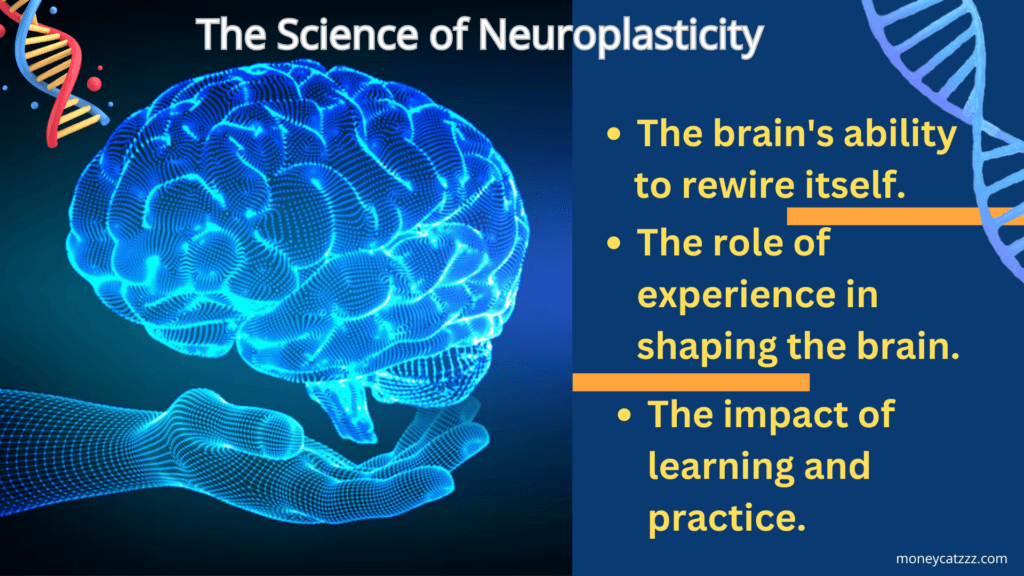
[“The Science of Neuroplasticity” – moneycatzzz.com]
The Lifelong Potential of a Plastic Brain
Neuroplasticity isn’t just a childhood superpower. It lasts a lifetime. That’s one of modern neuroscience’s most exciting—and empowering—realizations. In The Brain’s Way of Healing, Doidge showcases incredible stories of people overcoming chronic pain, Parkinson’s, and cognitive decline using neuroplastic techniques.
From stroke survivors regaining speech to seniors learning new languages in their 80s, neuroplasticity offers living proof that you’re never too old, too stuck, or too broken to change.
Even in the face of brain trauma, neuroplasticity allows the brain to “reroute traffic”—building alternative pathways to bypass damaged areas. With consistent effort and targeted strategies—it is possible to restore function, regain abilities, and even exceed previous limitations.
Practical Ways to Harness Neuroplasticity
How can you tap into this innate power? While every brain is different—the foundational strategies are surprisingly accessible. Let’s walk through practical, science-backed ways to invite neuroplastic change into your life.
1. Be a Lifelong Learner
Learning isn’t just for students or the young—it’s essential fuel for a healthy, adaptive brain. When you challenge yourself to pick up a new skill—your brain begins building new neural pathways—strengthening its capacity for growth and change. Whether learning an instrument, speaking another language, or exploring a new hobby like woodworking or painting, each unfamiliar experience stimulates brain plasticity.
In Spark by John Ratey, we see how physical and cognitive challenges—especially when combined—can spark neurogenesis, the growth of new brain cells. In other words, novelty is nourishment for the brain.
Even just fifteen minutes a day of stretching outside your comfort zone—like trying something you’ve never done before—can enhance your memory, improve cognitive flexibility, and keep your mind sharp well into older age.
2. Practice Deep Focused Repetition
Not all practice is created equal. Neuroplastic change responds best to deliberate, focused repetition—what Daniel Coyle calls “deep practice” in The Talent Code. This means slowing down, paying attention, making errors, and correcting them. Whether you’re learning to play piano or trying to reframe negative thoughts, slow, mindful repetition builds stronger neural circuitry than rushed or distracted effort.
Instead of constantly multitasking—carve out specific windows of undistracted time for focused practice—whether journaling, learning, or skill-building. Consistency and intention are everything when it comes to rewiring the brain.
3. Engage Multiple Senses
The brain thrives on multisensory learning. Combining visuals, movement, sound, and touch activates more brain areas and creates richer, more lasting connections. The Cambridge Handbook of the Neuroscience of Creativity highlights how multisensory learning deepens memory and boosts innovation.
Try pairing reading withdrawing, or teach someone else what you’ve learned by speaking it aloud. Add music or gentle movement to the process: the more senses involved, the more deeply the learning sticks.
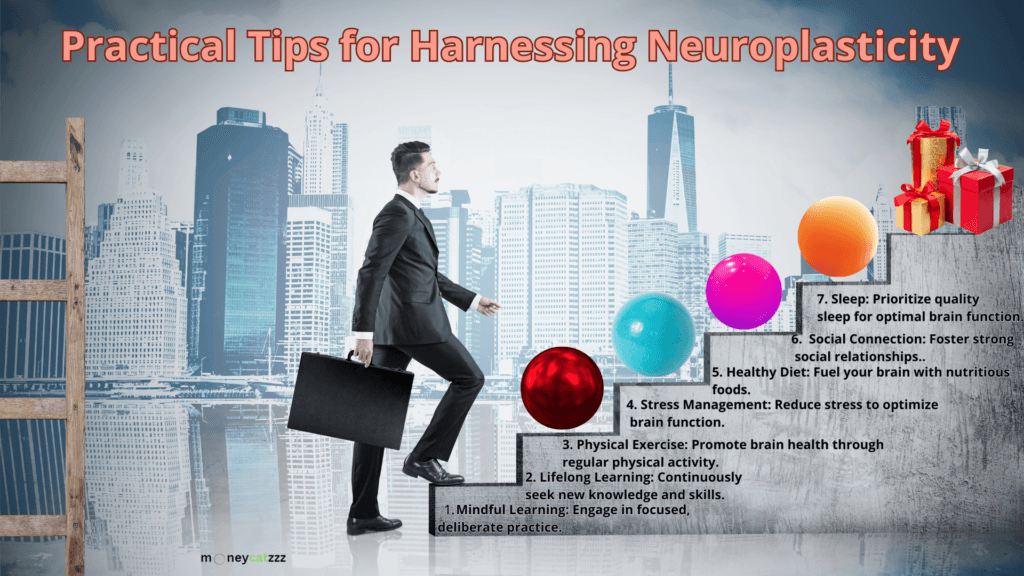
[“Practical Tips for Harnessing Neuroplasticity” – moneycatzzz.com]
4. Adopt a Growth-Oriented Mindset
Your mindset matters more than you might think. Carol Dweck’s research in Mindset shows how the belief that you can grow influences how your brain responds to challenges. A fixed mindset shuts down effort and rewiring. A growth mindset, on the other hand, keeps your neural circuits open to change.
Self-compassion plays a key role here. Harsh self-criticism activates the brain’s threat systems, making it harder to learn or adapt. But gentle encouragement does the opposite—it keeps your brain open, safe, and primed for change. So instead of saying, “I can’t,” shift your language to “I’m learning to…” and speak to yourself as you’d talk to a child trying something new. Encourage, don’t criticize.
5. Use Movement to Fuel Mental Change
Exercise isn’t just good for the body—it’s essential for the brain. Aerobic movement increases blood flow and stimulates the release of growth factors like BDNF (brain-derived neurotrophic factor), supporting the formation of new neural connections. Movement also has the power to “unstick” emotional or cognitive ruts, especially when paired with mental rehearsal or visualization.
Regular brisk walks can be especially powerful—before or after learning something new, use that time to mentally rehearse positive thoughts, new habits, or creative ideas. You’re not just moving your body—you’re reshaping your mind.
6. Reshape Emotional Patterns with Intention
Your emotions are not fixed traits—they’re patterns shaped by neuroplasticity. Repeated worry, frustration, or anger can form deep grooves in your brain’s wiring. But so can joy, compassion, and gratitude.
In The Upward Spiral, neuroscientist Alex Korb shows how small, consistent actions—like naming emotions, practicing gratitude, or mindful breathing—can gradually shift your emotional baseline toward calm and resilience.
Keeping a daily gratitude journal may seem simple, but it creates measurable changes in emotional wiring over time. And when anxiety arises, try breathing into the feeling rather than resisting it. These practices, repeated with intention, quietly reshape your emotional defaults.
The Limitations—and Possibilities—of Brain Change
It’s important to be realistic. Neuroplasticity is not a magic switch—it’s a process. Age, health conditions, and environment influence how quickly and deeply changes occur. Some damage may be too extensive to reverse entirely.
But here’s the key truth: there’s always some capacity for change. And even small improvements in focus, mood, or function can ripple outward into meaningful life upgrades.
Progress isn’t always linear. There will be plateaus, setbacks, and moments of doubt. That’s part of the journey. Much like the body, the brain adapts over time—not overnight.
You Are the Architect of Your Brain
The most empowering message of neuroplasticity is this: you are not at the mercy of your brain—you are its sculptor.
Each thought, each choice, and each moment of intentional effort becomes a chisel in your hand. Over time, those chisels carve new pathways, perceptions, and lives.
So wherever you are—recovering from injury, struggling with mental health, seeking to level up your life—know this: your brain is listening. It’s responding. It’s ready to change.
The future is unwritten. And you hold the pen.

Your brain was built for change—don’t let comfort rob you of that birthright. Lean into the awkwardness of learning, the stumbles, the rewiring. Let every small win remind you that you’re not stuck—you’re sculpting something new, one imperfect step at a time.
You don’t have to overhaul your life overnight. Just start moving in the direction of growth. Trust that transformation isn’t some distant dream. It’s already alive in you—etched into your biology, waiting to be awakened.
Disclosure: This post may contain affiliate links. We only recommend products we believe in, and We may receive a commission at no cost to you! Thank you for your support!
Acknowledgement: Cover Photo by The Local Bus
Disclaimer: The information is provided for general information only – moneycatzzz.com makes no representations or warranties in relation to the information, including but not limited to any representation or warranty as to the fitness for any particular purpose of the information to the fullest extent permitted by law. While every effort has been made to ensure that the information provided in this article is accurate, reliable, and complete as of the time of writing, the information provided in this article should not be relied upon to make any financial, investment, real estate or legal decisions. Additionally, the information should not substitute advice from a trained professional who can take into account your personal facts and circumstances, and we accept no liability if you use the information to form decisions.