
 Reading Time: 8 mins #
 This post may contain affiliate links.
Employee Disengagement: Boost Your Team
“Train people well enough so they can leave, treat them well enough so they don’t want to.” – Sir Richard Branson.
Talent is your most valuable asset in today’s hyper-competitive business environment. Yet 73% of employees worldwide are disengaged, according to a recent Gallup study. That’s more than a statistic—it’s a wake-up call. Every disengaged employee represents a missed opportunity—a silent threat to productivity, innovation, and morale.
The good news is that “disengagement” is preventable; the antidote lies in a culture anchored in open communication, growth, recognition—and purpose.
But before you can fix disengagement—you must understand what fuels it.
What Causes Disengagement? It’s Deeper Than You Think
Disengagement doesn’t usually show up with flashing lights. It creeps in quietly—maybe in the form of missed deadlines, a dip in energy, or work that feels just “good enough.” If ignored, it doesn’t just affect one person—it spreads, slowly chipping away at team spirit and performance.
That’s why it’s important to spot what’s fueling the disconnect early—before it quietly becomes the norm. When leaders can trace disengagement to its roots, they stand a better chance of reversing it.

[“Consequences of Disengagement” – Photo by Cup of Couple]
Below are three common (and often overlooked) drivers that tend to push employees toward disengagement:
1. Lack of Recognition
Most people don’t clock in just for a paycheck—they want to be seen, valued, and appreciated. When hard work goes unnoticed, it sends a subtle but powerful message—your contributions don’t matter—over time, that silence chips away at motivation, eroding people’s sense of connection and pride in their work.
A report by Gallup and Workhuman highlights that organizations with effective recognition programs experience significantly lower turnover rates and higher employee engagement.
Action Tip: Integrate recognition into daily routines. Simple, sincere acknowledgments can reignite motivation and foster a culture of appreciation.
2. No Path for Growth
Career stagnation is a silent disengager to employees who perceive limited opportunities for advancement or further skill development—they may become disheartened and disengaged, even if they remain in their roles.
According to McKinsey & Company, employees leave their jobs because they lack career development and advancement opportunities.
Action Tip: Provide clear pathways for career progression, including training programs, mentorship—and opportunities to take on new challenges.
3. Poor or Inconsistent Communication
Effective communication is the backbone of a cohesive and engaged workforce. When communication is lacking or inconsistent, it can lead to confusion, mistrust—a sense of isolation among employees.
A Harvard Business Review article discusses how poor communication can slow down teams and negatively impact overall performance.
Action Tip: Foster open and transparent communication channels—regular updates, clear expectations, and active listening can build trust and align employees with organizational goals.
4. Toxic Work Culture
In a hostile environment—where bullying, exclusion, or micro-aggressions are ignored—engagement gets destroyed—it creates fear instead of safety, leading to high turnover and low morale.
Leadership responsibility: Address toxic behavior early and enforce psychological safety across all levels.

5. Absence of Purpose
When employees don’t understand how their work contributes to something larger, they disengage. Without purpose, even high achievers lose their spark.
Bridge the gap: Connect day-to-day tasks with long-term mission and values.
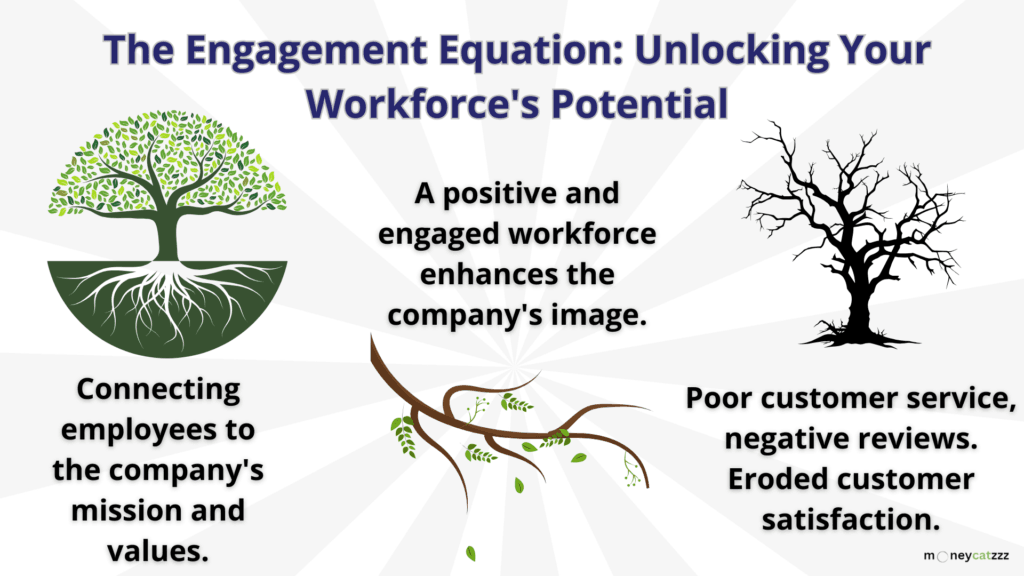
[“The Engagement Equation: Unlocking Your Workforce’s Potential” – moneycatzzz.com]
The High Cost of Disengagement
Disengagement isn’t just bad vibes—it’s bad business.
- Lower productivity: Disengaged employees do the bare minimum. Creativity and collaboration plummet.
- Higher turnover: Replacing talent is expensive. Losing institutional knowledge is even worse.
- Poor customer experiences: If your employees don’t care, your customers will notice.
- Stalled innovation: Disengaged teams stop asking, “What if?“—and that’s how businesses become obsolete.
Case in Point: How Gallup Practices What It Preaches
Gallup doesn’t just report on engagement—they live it. After identifying widespread disengagement in their data, Gallup focused inward, redesigning their workplace to prioritize:
- Continuous recognition
- Transparent, two-way communication
- Career growth and development
The result? Higher performance, lower attrition, and a strong, resilient culture that sets the bar globally.
Reversing Disengagement: 5 Proven Strategies
Disengagement can be reversed—but not with pizza parties or hollow promises. It takes strategic, sustained effort. Start with these five pillars that leading companies use to drive long-term engagement:
1. Make Recognition a Daily Habit
Recognition isn’t just feel-good fluff—it’s a performance catalyst. According to Gallup, employees who feel adequately recognized are 63% more likely to stay at their current job. Create rituals of appreciation. Celebrate wins—big or small. Personalized praise fosters a deep sense of motivation, visibility—and belonging.
2. Provide Clear Growth Paths
No one wants to feel stuck. The LinkedIn Workplace Learning Report shows that 94% of employees would stay at a company longer if it invested in their learning and development. Offer structured training, mentorship, and visible promotion tracks. People thrive when they see a future within your organization and disengage when that future is unclear.

3. Foster Open Communication
Transparency isn’t a buzzword—it’s a trust builder. According to a Salesforce report, employees who feel their voices are heard are 4.6x more likely to feel empowered to perform at their best. Share company goals, explain decisions openly, and actively listen to feedback. Honest two-way communication forms the foundation of high-performing teams.
4. Build a Positive, Safe Culture
Culture can’t be faked. A toxic workplace erodes performance and increases attrition. A Harvard Business School study found that toxic work environments cost U.S. companies $223 billion over five years due to employee turnover. Act quickly to root out disrespectful behavior and embed psychological safety and inclusion into leadership training, hiring, and daily interactions.
5. Connect Work to a Greater Purpose
Employees crave meaning. Research from McKinsey & Company found that 70% of employees define their sense of purpose through their work—yet only a fraction feel their organization helps them achieve it. Help teams understand how their work contributes to larger goals and societal impact. Employees who feel connected to something bigger than themselves bring passion and persistence.
Disengagement vs. Engagement: A Measurable Gap
| Metric | Engaged Employees | Disengaged Employees |
|---|---|---|
| Productivity | 21% higher | Up to 18% lower |
| Customer Satisfaction | Increased loyalty | Frequent complaints |
| Innovation | Idea generators | Status quo maintainers |
| Retention | 59% less likely to leave | Higher turnover & burnout |
| Profitability | Strong revenue growth | Long-term financial risk |
Source: Gallup, Harvard Business Review
Recommended Reading for Leaders Fighting Disengagement
- “Drive” by Daniel H. Pink: Learn how purpose, autonomy, and mastery impact motivation.
- “First, Break All the Rules” by Marcus Buckingham: Gallup-backed insights on top-performing managers.
- “The New One Minute Manager” by Ken Blanchard & Spencer Johnson: Timeless tools for recognition and feedback.
- “Quiet” by Susan Cain: Understand how valuing diverse personalities enhances workplace engagement.
The Bottom Line: Communication Is the Cure
You can’t fix disengagement with superficial perks. You fix it by building a culture of trust, meaning, and open communication.
What is your next step? Don’t just measure engagement—start meaningful conversations. Ask your employees how they feel. Then, act on what you hear.
Disengagement is not inevitable. But ignoring it is inexcusable.
Final Thoughts: Reconnect to Reignite
Engagement isn’t a checkbox—it’s a compass that directs your organization’s future. Invest in your people consistently—not reactively.
Foster open communication, recognize contributions, provide growth, and tie work to purpose. When you do, you unlock a competitive advantage that no competitor can copy.
🟢 Start today. Conduct a pulse survey. Host a team roundtable. Launch a recognition initiative.
Your people are ready to engage—are you prepared to lead?
Disclosure: This post may contain affiliate links. We only recommend products we believe in, and We may receive a commission at no cost to you! Thank you for your support!
Acknowledgement: Cover Photo by cottonbro studio:
Disclaimer: The information is provided for general information only – moneycatzzz.com makes no representations or warranties in relation to the information, including but not limited to any representation or warranty as to the fitness for any particular purpose of the information to the fullest extent permitted by law. While every effort has been made to ensure that the information provided in this article is accurate, reliable, and complete as of the time of writing, the information provided in this article should not be relied upon to make any financial, investment, real estate or legal decisions. Additionally, the information should not substitute advice from a trained professional who can take into account your personal facts and circumstances, and we accept no liability if you use the information to form decisions.