
 Reading Time: 8 mins #
 This post may contain affiliate links.
In today’s fast-paced, success-driven culture, self-awareness is often championed as the ultimate career advantage; the “holy grail” that unlocks fulfillment, sharper decision-making, and authentic leadership. Countless business gurus and leadership coaches emphasize clarity of self as the cornerstone of professional success and personal satisfaction.
But what if knowing yourself doesn’t just guide you forward; what if it disrupts your career path? What if profound clarity pulls you away from a trajectory you’ve invested years, even decade building?
For many, self-awareness catalyzes liberation and brings uncertainty, anxiety, and complex transitions. The hidden cost of clarity is this paradox: when you finally see yourself clearly, the identity that once tethered you to success may begin to unravel.
“The privilege of a lifetime is to become who you truly are.” – Carl Jung.
This article explores the under-acknowledged tension between crystal pure clarity and career continuity, how knowing yourself can liberate and unsettle and how professionals can navigate this space between recognition and reinvention.
The Modern Mandate for Self-Awareness: Blessing or Burden?
In executive coaching circles and corporate boardrooms, clarity is the gold standard. Harvard Business Review and Forbes routinely cite self-awareness as essential for high-performing leaders; it boosts engagement, improves communication, and fosters better decision-making.
But as Herminia Ibarra, author of Working Identity: Unconventional Strategies for Reinventing Your Career, argues, clarity doesn’t arrive in tidy epiphanies. It evolves through action, trial, and tension. Self-concept, she explains, is not something you uncover; it’s something you construct, and often reconstruct over time.
This means that the clarity you’re chasing may initially destabilize your current path. It might expose conflicts between your authentic self and your professional reality. Clarity can feel more like a disruption than a solution in that space.

Real-World Transitions: When Clarity Breaks the Mold
Some of the most striking career pivots happen not because of failure, but because of deepening clarity.
1. The Executive Turned Minimalist
Sarah, a Fortune 500 executive, was the picture of success: a six-figure salary, a corner office, and a global travel schedule. But over time, she felt a growing internal discomfort she couldn’t ignore.
Through coaching and inner work, Sarah gained clarity around her core values — creativity, simplicity, and human connection, all in tension with her fast-paced, high-stakes corporate role.
Eventually, that clarity led her to walk away. She left the corporate world to become a minimalist lifestyle coach and content creator. While the transition brought financial uncertainty and social skepticism, Sarah describes the shift as a return to her true self.

[“The Clarity Paradox: Shattered” – Image on Pexels.com]
2. The Doctor Turned Creative Entrepreneur
During meditation and journaling — Dr. Marcus, a respected surgeon, realized that his true passion wasn’t in clinical care but in storytelling and education.
The clarity he found led him to reduce his clinical hours and launch a podcast and blog on health literacy. Despite the initial career risks, Marcus feels aligned, energized, and creatively fulfilled.
Why Clarity Disrupts: The Psychology of Identity and Work
At the heart of this disruption is the psychology of identity. We don’t just perform roles, we become them. Titles, accolades, and routines form a coherent story we tell ourselves about who we are.
Ibarra’s research reveals a core tension: “who we are” vs. “who we want to become.” When new self-insights emerge, they often collide with our current professional persona, creating internal and external friction.
Clarity can ignite:
- Cognitive dissonance is uncomfortable when new self-understanding contradicts what we do daily.
- Social risk—fear of disappointing mentors, colleagues, or family.
- Financial anxiety—concern about leaving stability for uncharted, authentic paths.
Worse, clarity rarely arrives with a roadmap. It often shines light on what no longer fits, without revealing what comes next. This leaves many in a liminal, vulnerable space.
Read Related Articles:

Confronting Passive-Aggressive Behavior with Radical Candor
Research-Backed Tools for Navigating Career Clarity
In Working Identity, Ibarra emphasizes that career clarity is not the result of introspection alone, it requires experimentation and active engagement with new identities.
1. Try on “Provisional Selves”
Instead of leaping into change, try out aspects of your future self in low-risk settings; freelance projects, online courses, and weekend workshops. These small experiments let you refine clarity in motion.
2. Build Networks Around the Self You’re Becoming
Surround yourself with people who understand and reflect your evolving identity. Whether through mentorship, community, or coaching, this support helps you process and stay grounded during uncertain transitions.
3. Redefine Success
Shift your internal compass rather than external rewards to define success through alignment, meaning, and emotional resonance. This reframing allows clarity to become a bridge, not a threat to fulfillment.
4. Embrace the Mess
True clarity is not static. It’s a process. Allow space for ambiguity, reversals, and redefinition. Progress will rarely be linear, and that’s okay.
The Shadow Side: When Clarity Comes Too Soon
While the value of self-awareness is undeniable, premature clarity can backfire.
Some professionals fall into analysis paralysis, waiting to define their perfect “true self” before taking any action. Others anchor too heavily in one identity dimension, limiting exploration and growth.
The antidote? Balancing curiosity with clarity. Stay open to emerging parts of yourself—treat identity not as a final answer but as an evolving question.
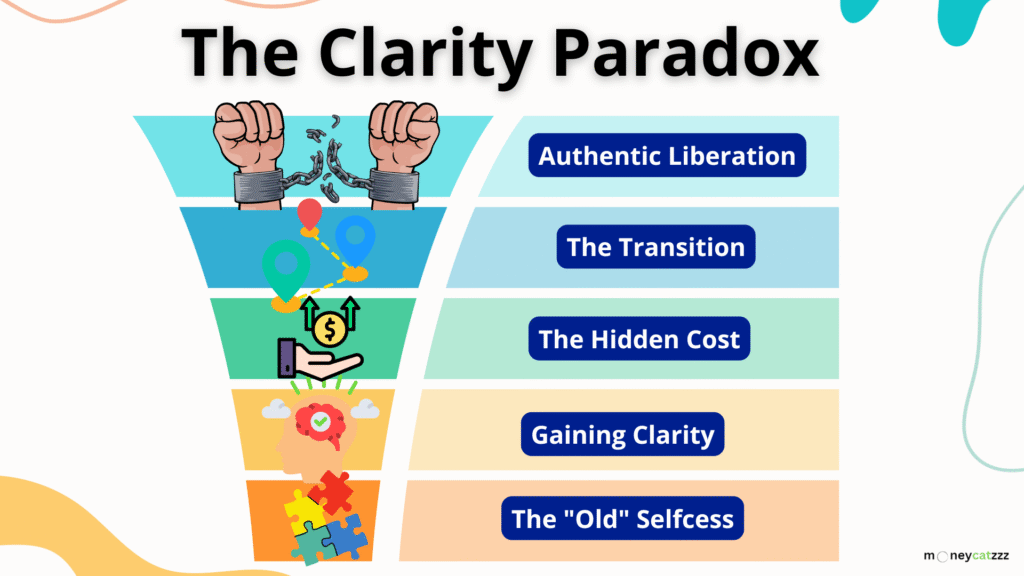
[“The Clarity Paradox” – Image by moneycatzzz.com]
Practical Steps for Those Torn Between Authenticity and Stability
If you find yourself caught between a successful life and a truthful one, try these:
- Conduct Identity Audits: Ask yourself regularly; what still excites me? What drains me? What’s changing?
- Take Safe Risks: Before making drastic changes, experiment with roles, hobbies, or paths that intrigue you.
- Learn From Transition Stories: Read or connect with people who’ve made authentic shifts. Their lessons can shorten your curve.
- Practice Self-Compassion: Career realignment is tender work. Treat your process with gentleness.
- Plan Financial Buffers: Give yourself breathing room. Financial preparation allows emotional freedom during pivots.

The Final Word: The Paradox and Power of Clarity
Self-awareness, and its clarity remains one of the most powerful tools for long-term career fulfillment. But it comes with a paradox: the more you understand yourself, the more you may challenge your previous definition of success.
This is not failure. It’s evolution.
The hidden cost of clarity is disruption, but its reward is liberation. A life and career that mirror your internal truth may not follow conventional paths, but they offer something deeper: resonance, sustainability, and self-respect.
If you’re a leader, professional, or high-achiever standing at this crossroads, know this: the discomfort you feel is not a sign of weakness, it’s the signal that you’re finally in alignment with your truth.
Clarity may unsettle, but ultimately, it sets you free.
Disclosure: This post may contain affiliate links. We only recommend products we believe in, and We may receive a commission at no cost to you! Thank you for your support!
Acknowledgement: Cover Photo by moneycatzzz.com on Canva
Disclaimer: The information is provided for general information only – moneycatzzz.com makes no representations or warranties in relation to the information, including but not limited to any representation or warranty as to the fitness for any particular purpose of the information to the fullest extent permitted by law. While every effort has been made to ensure that the information provided in this article is accurate, reliable, and complete as of the time of writing, the information provided in this article should not be relied upon to make any financial, investment, real estate or legal decisions. Additionally, the information should not substitute advice from a trained professional who can take into account your personal facts and circumstances, and we accept no liability if you use the information to form decisions.