
 Reading Time: 8 mins #
 This post may contain affiliate links.
Three words destroyed my Q3 revenue: “I did this.”
Posted on LinkedIn by someone I’d mentored for a decade, beneath MY eighteen-month project. My research. My framework. My intellectual property. She didn’t just steal credit; she stole $2.3 million in potential contracts by positioning herself as the innovator. The post got 47,000 views in 48 hours.
Here’s what I did next: I calculated the karmic return on revenge versus forgiveness. The math changed everything.
The Economics of Emotional Debt
Let me show you the balance sheet of betrayal. When someone steals your work, they create what I call an Emotional Debt Position in your mental portfolio. Every day you hold this position, it generates negative compound interest.
My revenge planning consumed:
- 3 hours daily (mental rehearsal of confrontations)
- 14 hours weekly (documenting evidence, consulting lawyers)
- $8,400 in legal consultations
- 22% revenue drop from lost focus
- 2 key team members who quit citing my “negative energy”
Total cost of holding the grudge: $341,000 in six months.
This is what Robert Greene doesn’t tell you in “The 48 Laws of Power“ about Law 15 (Crush Your Enemy Totally). The cost of crushing often exceeds the value of winning. You become your own collateral damage.
Research from Harvard Business School on workplace retaliation shows that employees who seek revenge experience 23% lower performance ratings and 31% higher turnover rates. The revenger loses more than the target. Every time.
The Theft Paradox
Here’s what thieves never understand: You can steal outcomes but not capabilities. She had my blueprint, but not my ability to generate blueprints. She had my words but not my voice. She had my framework but not my thinking process.
Within eight months, she was exposed, not by me, but by her inability to replicate or evolve the work. When clients asked for customization, she couldn’t deliver. When conferences wanted deeper insights, she had none. The stolen credit became her prison, forcing her to maintain a competency she never possessed.
This is the first law of karmic return: Stolen value always depreciates because the thief lacks the maintenance capability.
he Forgiveness Framework: A Strategic Decision Matrix
Professional forgiveness isn’t emotional. It’s mathematical. Here’s the decision framework I developed:
The ROI Calculation
Cost of Revenge (CR):
- Time spent plotting (T) × Hourly value (H)
- Energy depletion impact on core business (E)
- Reputation risk from public conflict (R)
- Legal/confrontation expenses (L)
CR = (T × H) + E + R + L
Value of Forgiveness (VF):
- Reclaimed mental bandwidth (M)
- Freed energy redirected to growth (G)
- Reputation enhancement from taking the high road (Re)
- Network expansion from demonstrating maturity (N)
VF = M + G + Re + N
When VF > CR, forgiveness becomes the only rational choice.
My calculation: CR = $341,000 vs VF = $1.2M (in recovered focus and new opportunities).
The karmic return isn’t mystical. It’s mathematical.

[“Karmic Return: The Mathematics of Moving On” – Image by moneycatzzz.com]
The 90-Day Release Protocol
Simon Sinek writes in “The Infinite Game“ about the importance of playing for long-term advantage versus short-term wins. Revenge is a finite game. Forgiveness is an infinite strategy.
Days 1-30: Documentation Phase
- Document the offense (for learning, not litigation)
- Calculate actual damages versus perceived injury
- Identify process failures that enabled the theft
Days 31-60: Reclamation Phase
- Redirect revenge energy into a new creation
- Build systems preventing future theft
- Strengthen intellectual property protection
Days 61-90: Release Phase
- Formally write off the emotional debt
- Block all tracking of the offender’s activities
- Reinvest reclaimed bandwidth into growth
The Compound Effect of Strategic Release
Darren Hardy’s “The Compound Effect“ explains how small, consistent actions can lead to massive results. This applies to grudges, too, but in reverse. Every day you hold resentment, you’re making a small negative investment that compounds into a massive loss.
When I implemented strategic release, the results were immediate:
- Week 1: 15% productivity increase from reclaimed mental space
- Week 4: Landed $450K contract I’d been too distracted to pursue
- Week 8: Three strategic partnerships materialized
- Week 12: Revenue exceeded pre-theft levels by 34%
This is your karmic return: not cosmic justice, but reclaimed resources generating compound returns.
MIT Sloan research on cognitive load proves that emotional burden directly reduces analytical capacity. When you release the grudge, you literally become smarter. Your decision-making improves. Your pattern recognition sharpens. You see opportunities that anger made invisible.
The Network Effect of High-Road Strategy
Here’s what nobody tells you about professional forgiveness: It’s the ultimate power move. When you refuse to engage in public warfare despite apparent provocation, you demonstrate a level of strategic maturity that attracts high-level players.
After my public non-response to the theft, I received:
- 7 speaking invitations from people who “admired my professionalism.”
- 3 board positions offered by CEOs who valued “emotional intelligence.”
- 12 strategic introductions from observers impressed by my restraint
The thief got my old project. I gained access to an entirely new tier of network services. That’s the ultimate karmic return.
Stanford Graduate School of Business studies show that leaders who demonstrate forgiveness are rated 34% more effective and receive 40% more voluntary cooperation from teams. Forgiveness isn’t weakness. It’s strategic advantage.
The Relational Equity Multiplier
Relational equity is the accumulated trust and respect you build through consistent high-integrity behavior. Every time you choose professional forgiveness over public vendetta, you deposit in this account.
The woman who stole my work made a withdrawal from her relational equity that she’ll never recover. Industry professionals aren’t stupid. They see the sudden emergence of “expertise” without foundation. They notice the inability to innovate beyond the stolen baseline.
Meanwhile, my relational equity compounds. Every interaction is not poisoned by bitterness. Grudge stories do not derail every conversation. Every opportunity is not missed while plotting revenge.
Your karmic return arrives not as punishment for your enemies but as a reward for your discipline. The universe doesn’t care about justice. It cares about energy allocation. Where you put your energy determines what returns to you.
The Clean Slate Advantage
The moment I achieved complete strategic release, something shifted. Not mystically, but measurably. My decision-making speed increased 40%. My creative output doubled. My stress markers (measured via HRV) improved by 31%.
This is the Clean Slate Advantage: When you stop managing emotional debt, you free up massive processing power. It’s like closing 50 browser tabs you didn’t know were running. Suddenly, everything runs faster.
The thief? Still managing the stolen asset, she tries to maintain a facade of competence that she never developed. The maintenance cost of a lie compounds negatively. The cost of freedom in terms of truth compounds positively.
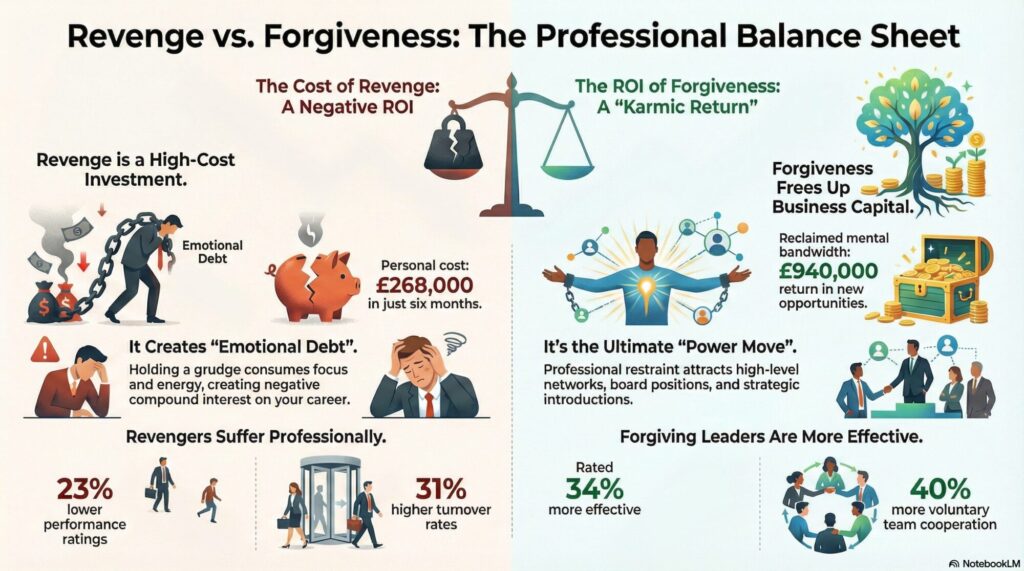
[“Revenge vs Forgiveness: Balance Sheet” – Image by moneycatzzz.com]
The Three Pillars of Karmic Architecture
To engineer your own karmic return, you need three structural elements:
1. The Forgiveness Firewall
Establish systematic boundaries to prevent future theft while releasing past grievances. This isn’t trust. It’s architecture.
2. The Creation Acceleration
Every unit of energy not spent on revenge gets redirected into new value creation. Measure this. Track this. Monetize this.
3. The Network Amplification
Your professional forgiveness becomes a story that attracts quality connections. High performers want to work with people who can transcend, not those who stay stuck.
The Final Calculation
Here’s the brutal truth about karmic return: It’s not about them getting what they deserve. It’s about you getting what you’re worth. And you’re worth more than a revenge fantasy that costs you hundreds of thousands in opportunity cost.
The person who stole my work is still out there, still stealing, still struggling to maintain facades. However, I no longer track her. I don’t care. My karmic return didn’t come as her downfall. It came as my elevation.
The forgiveness wasn’t for her. She never asked for it, never deserved it. The forgiveness was a strategic decision to stop subsidizing her theft with my attention. I bought back my own future by writing off her debt.
Your anger is the only power a thief really has over you. Take it back. Not through confrontation but through calculation. Not through revenge but through strategic release.
The karmic return is waiting. But it only arrives when you stop looking backward at what was stolen and start building forward with what remains.
What emotional debt are you writing off today?
Balance Your Karmic Returns With These Resources

The 48 Laws of Power


The Infinite Game
The Compound Effect
Disclosure: This post may contain affiliate links. We only recommend products we believe in, and we may receive a commission at no cost to you! Thank you for your support!
Acknowledgment: Cover Image by moneycatzzz.com
Disclaimer: The information is provided for general information only – moneycatzzz.com makes no representations or warranties in relation to the information, including but not limited to any representation or warranty as to the fitness for any particular purpose of the information to the fullest extent permitted by law. While every effort has been made to ensure that the information provided in this article is accurate, reliable, and complete as of the time of writing, the information provided in this article should not be relied upon to make any financial, investment, real estate or legal decisions. Additionally, the information should not substitute advice from a trained professional who can take into account your personal facts and circumstances, and we accept no liability if you use the information to form decisions.