 Reading Time: 12 mins #
 This post may contain affiliate links.
You’re scrolling through your phone on your morning commute, half awake and barely caffeinated. Suddenly, an ad catches your eye: “This coffee will turn you into a productivity god!” You chuckle and roll your eyes, but curiosity gets the better of you. Before you know it, you’re walking into a café, ordering this supposedly divine brew.
Welcome to the world of hyperbole, where every product is revolutionary, every service is life-changing, and every experience is unforgettable. In a world where the average person encounters up to 10,000 ads daily (yes, you read that right – 10,000!), standing out isn’t just an advantage—it’s a thrilling challenge.
“People love stories. They love to hear about other people’s experiences. They love to be entertained.” – Seth Godin.
The Anatomy of Hyperbole: More Than Just Big Words
Before you dismiss hyperbole as mere exaggeration, let’s dive a little deeper. Hyperbole, derived from the Greek word “hyperbolē” meaning “excess,” is more than just pumping steroids into your words—it’s a cognitive magic trick that makes our brains sit up and take notice.
Imagine you’re at a party, someone tells you they waited “a million years” in line at the DMV. Your logical brain knows that’s impossible, but on an emotional level—you’re right there with them—feeling their pain and frustration. That’s the power of hyperbole—it bypasses our logical defenses and speaks directly to our emotions.
Dr. Raymond W. Gibbs Jr., in his book “The Poetics of Mind,” explains it as “a cognitive process that involves conceptualizing one thing in terms of something else that is impossible or highly unlikely.” In other words, it’s like describing your boss’s monotonous meeting as “watching paint dry in slow motion” – it’s impossible, but boy, does it capture the feeling!
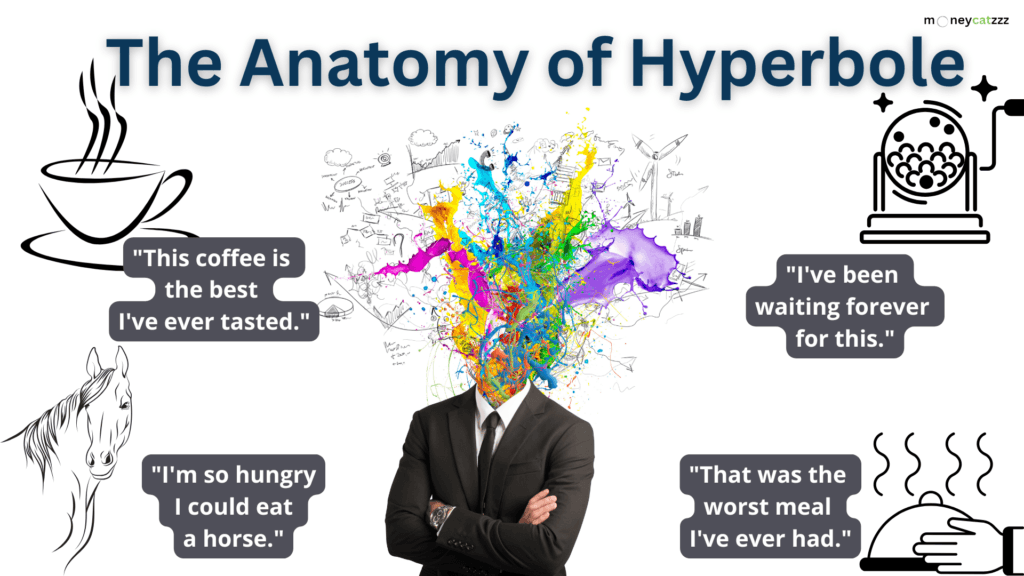
[“The Power of Exaggeration” – moneycatzzz.com]
Case Studies in Hyperbolic Success: When Exaggeration Pays Off
Red Bull Gives You Wings (But Not Really)
Let’s talk about Red Bull. Their slogan, “Red Bull gives you wings,” is probably one of the most famous examples of hyperbole in advertising. I don’t know about you, but I’ve consumed my fair share of Red Bull (hello, college all-nighters!)—I can confidently say—I’ve never sprouted a single feather, let alone wings.
But here’s the kicker – it doesn’t matter! The slogan works because it taps into something we all desire: the ability to soar above our limitations. And boy, has it worked for Red Bull. In 2021, they held a whopping 43% market share in the energy drink sector, with global sales reaching 7.9 billion cans. That’s a lot of metaphorical wings!
Apple’s “1000 Songs in Your Pocket” (AKA The Day Music Got Weightless)
Cast your mind back to 2001. Britney Spears was topping the charts—flip phones were all the rage, and carrying your music collection meant lugging around a bulky CD player and a case full of CDs. Then, Steve Jobs stepped onto a stage and uttered those magical words: “1000 songs in your pocket.”
Boom! Just like that, the iPod wasn’t just a new gadget – it was a revolution you could slip into your jeans. This hyperbole effectively communicated the revolutionary storage capacity of the device in a way that resonated with consumers. The result? Apple sold over 400 million iPods before discontinuing the product line in 2022. Not bad for a little exaggeration, eh?
The Psychology Behind Hyperbole: Why Our Brains Love Exaggeration
Why does that clickbait headline “You’ll NEVER believe what happened next!” work so well? It’s not (just) because we’re gullible. It’s because our brains are wired to respond to hyperbole.
Dr. Herbert L. Colston, a leading researcher in figurative language, puts it this way: “Hyperbole serves important cognitive and communicative functions. It allows us to express the intensity of emotion and create vivid mental images that stick in the listener’s mind.”
Think about it – which is more likely to stick in your mind: “Our new vacuum cleaner is effective at removing dust” or “Our new vacuum cleaner will make your floors so clean you could eat off them”? (Though I wouldn’t recommend eating off your floors, no matter how good your vacuum is!)
The Dark Side of Hyperbole: When Exaggeration Backfires
But before stuffing your marketing materials with more exaggerations than a fisherman’s tale, let’s talk about the risks. Hyperbole can backfire spectacularly because, like that friend who always oversells the “amazing” party, that turns out to be three people eating stale chips.
The Fyre Festival Fiasco: A Cautionary Tale
Remember the Fyre Festival? Promoted as “the cultural experience of the decade,” it promised luxury villa accommodations, gourmet meals, and performances by top musicians on a private Bahamian island. Instead, attendees got more like a post-apocalyptic camping trip – complete with disaster relief tents, sad cheese sandwiches, and zero luxury amenities or star performances.
The result? It was a PR nightmare of biblical proportions, multiple lawsuits, and a prison sentence for the organizer. According to court documents, investors lost over $26 million in the failed venture. Ouch.
The lesson here? You’re in trouble when the gap between your hyperbole and reality becomes wider than the Grand Canyon.

Hyperbole in the Digital Age: The Rise of Clickbait
Let’s talk about the elephant in the room – or should I say, the “MOST SHOCKING ANIMAL YOU’LL EVER SEE (You won’t BELIEVE number 7!)”. Yes, I’m talking about clickbait, the digital age’s contribution to the art of hyperbole.
We’ve all been there. You’re minding your own business, scrolling through your feed, when suddenly you see a headline like “This One Trick Will Change Your Life Forever!“ Your rational brain says, “Yeah, right,” but your finger… your traitorous finger… it clicks anyway.
A study by the Pew Research Center found that 55% of U.S. adults often or sometimes actively try to include news with exaggerated headlines in their media intake. It’s like we know it’s probably exaggerated, but we just can’t help ourselves. It’s the informational equivalent of knowing there are no more cookies in the jar but checking anyway – just in case a cookie fairy paid a visit.
Measuring the Impact: The ROI of Hyperbole (Or: How Much Is That Exaggeration In The Window?)
Now, I know what you’re thinking. “This all sounds great, but show me the money!“ Well, buckle up because we’re about to dive into the fascinating world of hyperbole ROI.
A 2018 study published in the Journal of Advertising Research examined the effect of hyperbolic claims in product reviews. They found that moderately exaggerated reviews led to a 15% increase in purchase intent compared to non-hyperbolic reviews. Ka-ching!
But hold your horses before you start claiming your product will “revolutionize the entire universe and all parallel dimensions.” The same study found that highly exaggerated reviews had a negative effect, decreasing purchase intent by 10%.
It’s like Goldilocks and the three bears of hyperbole – you don’t want too little, you don’t want too much. You want it just right.
The Future of Hyperbole: Navigating the Post-Truth Era (Without Getting Lost)
So, where do we go from here? How do we use hyperbole effectively and ethically in an age where “fake news” is thrown around more often than a frisbee at a college campus?
Dr. Jonah Berger, author of “Contagious: Why Things Catch On,” suggests a shift towards “authentic exaggeration.“ It’s about pushing the boundaries of language without crossing the line into deception. Think of it as the linguistic equivalent of a yoga master – flexible but not to the point of breaking.
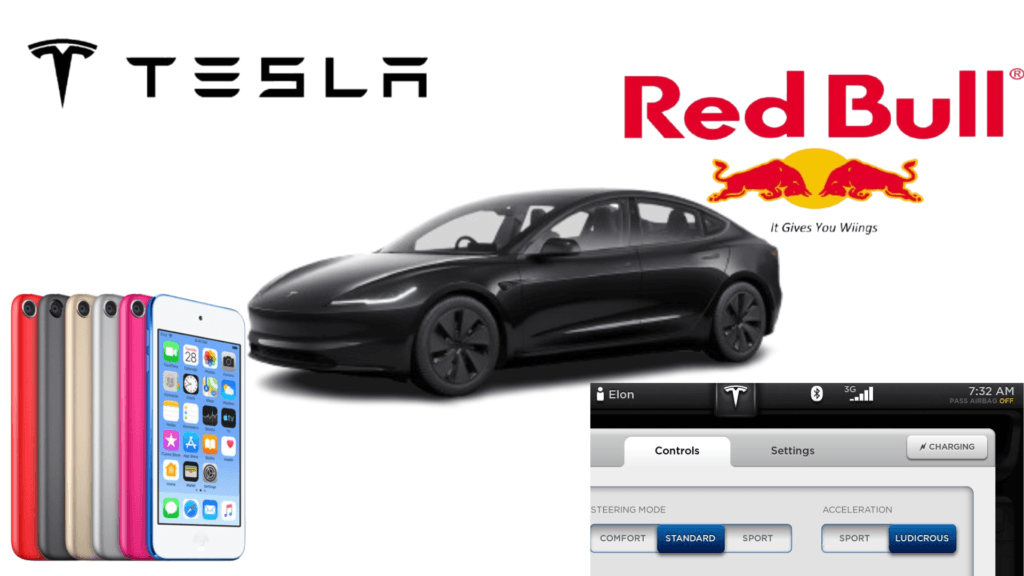
[“Hyperboles that worked” – moneycatzzz.com]
Case Study: Tesla’s “Insane Mode” (Because “Fast Mode” Was Just Too Boring)
When they introduced acceleration modes called “Insane Mode” and “Ludicrous Mode,” it was hyperbole. Unless your car is actively trying to escape an asylum or starring in a Mel Brooks movie, it’s not “insane” or “ludicrous.“
But here’s the kicker – these names, while exaggerated, accurately reflect the car’s exceptional performance capabilities. It’s hyperbole, yes, but it’s hyperbole grounded in reality. And it’s worked wonders for Tesla. Their revenue grew from $31.5 billion in 2020 to $53.8 billion in 2021, a 71% increase. It’s not too shabby for a company to name car features like a hyperactive teenager, right?
The Hyperbolic Balancing Act (Or: How To Exaggerate Without Falling Flat On Your Face)
As we’ve seen, hyperbole in business is like a high-wire act. When done well, it’s breathtaking, captivating audiences and driving consumer behavior. When done poorly, let’s say the fall isn’t pretty.
The key lies in striking a balance. You want to be bold enough to grab attention but not so over-the-top that you strain credibility. It’s about finding that sweet spot where your audience raises an eyebrow in interest rather than skepticism.
Remember, in a world where everyone is shouting to be heard, sometimes the most revolutionary hyperbole is the one that whispers the truth so loudly it cannot be ignored. It’s about making your audience feel something, whether it’s the excitement of potentially growing wings from an energy drink or the awe of holding 1000 songs in their pocket.
So, go forth and exaggerate responsibly, my friends. May your metaphors be mighty, your similes stupendous, and your hyperboles... well, maybe just a little hyper.

Disclosure: This post may contain affiliate links. We only recommend products we believe in, and We may receive a commission at no cost to you! Thank you for your support!
Acknowledgement: Cover Image by moneycatzzz.com on Canva
Disclaimer: The information is provided for general information only – moneycatzzz.com makes no representations or warranties in relation to the information, including but not limited to any representation or warranty as to the fitness for any particular purpose of the information to the fullest extent permitted by law. While every effort has been made to ensure that the information provided in this article is accurate, reliable, and complete as of the time of writing, the information provided in this article should not be relied upon to make any financial, investment, real estate or legal decisions. Additionally, the information should not substitute advice from a trained professional who can take into account your personal facts and circumstances, and we accept no liability if you use the information to form decisions.