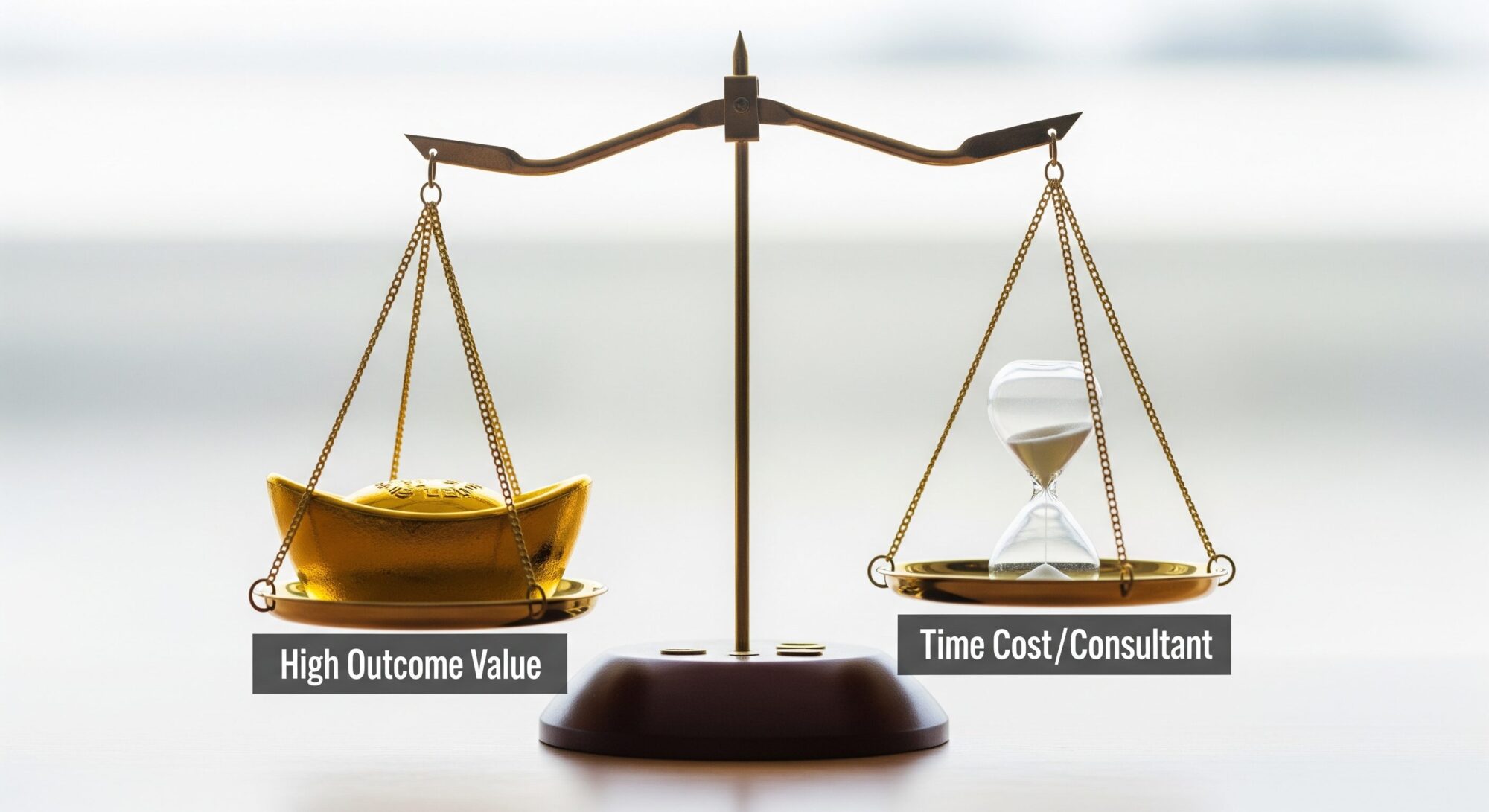
 Reading Time: 8 mins #
 This post may contain affiliate links.
Stealing five dollars and stealing five million are both theft. But if you think they’re the same thing, you’ve lost your damn mind.
Yet this is precisely how we’ve been trained to think. Every conflict has “two sides.” Every argument deserves “equal weight.” Every position merits “balanced consideration.” We’ve become so obsessed with appearing fair that we’ve forgotten how to think.
This is false equivalence, the intellectual plague that’s turned every discussion into a meaningless soup where nothing matters because everything’s supposedly the same.
Last month, I witnessed a manager destroy a team’s morale with a single sentence: “Well, you were both wrong.” One employee had missed a deadline by two hours. The other had been sabotaging projects for six months. But in the name of “fairness,” both infractions were treated identically. The room went silent. Everyone knew this was insane, but nobody could articulate why.
The Coward’s Mathematics
Here’s what false equivalence really is: intellectual cowardice dressed up as wisdom.
It’s the lazy person’s escape from having to make actual judgments. Because if everything’s equal, nothing requires real thought. If all sins are the same size, you never have to weigh them. If every opinion holds identical merit, you never have to choose.
But life doesn’t work in perfect symmetries. A paper cut and a severed artery both draw blood, but that doesn’t make them medically equivalent. A white lie about liking someone’s haircut and a decade-long affair both involve deception, but that doesn’t make them morally equivalent. This should be obvious, yet we’ve built an entire culture on pretending these distinctions don’t exist.
The ancient Buddhists had a concept called “right discrimination,” viveka in Sanskrit. It meant the wisdom to see differences clearly, to understand that not all suffering is equal, not all actions carry the same weight, not all paths lead to the same place. They understood what we’ve forgotten: False equivalence isn’t fairness. It’s blindness.
Think about the last time someone responded to your legitimate complaint with “Well, nobody’s perfect” or “Everyone makes mistakes.” They weren’t seeking the truth. They were erasing it. They were taking your specific, weighted, contextual issue and dissolving it in the acid bath of false equality.
Three Flavors of Intellectual Dishonesty
After years of watching false equivalence poison everything from relationships to board meetings, I’ve identified three toxic varieties that are probably destroying your life right now.
The Magnitude Collapse
This is when vastly different scales get flattened into the same category. “Violence is violence,” someone says, equating a shove with a shooting. “Lying is lying,” they claim, putting forgotten anniversaries on par with hidden debt.
I knew a couple where she had an emotional affair that lasted three years. He once looked at porn. During counseling, these were treated as “equivalent betrayals” because both involved “sexual attention outside the marriage.” The false equivalence was so absurd that it prevented any real healing. How can you address problems when you can’t even acknowledge their relative weight?
In workplaces, this manifests as an “All feedback is valid” culture, where an intern’s uninformed opinion is given equal weight to twenty years of expertise. Or “All mistakes are learning opportunities,” where typos and million-dollar errors receive the same response. This isn’t egalitarian. It’s insane.
The Context Amnesia
Context changes everything, but false equivalence pretends it doesn’t exist. A parent spanking a child and a stranger hitting that same child are both “hitting children,” but treating them identically erases crucial context about relationship, intent, and social framework.
Observe how this unfolds in professional settings. Employee A misses a deadline because their parent has passed away. Employee B misses the same deadline because they were gaming all night. HR treats both identically because “policy is policy.” The false equivalence here isn’t just unfair, it’s actively destructive to morale and human decency.
Or consider financial debates. “Both parties waste money,” people say, as if a million spent on healthcare and a million spent on yacht subsidies are morally identical because the dollar amount matches. The context: what the money does, who it helps, what problems it solves — gets erased in the service of a false balance.

[“The Context Breaker” – Image by moneycatzzz.com]
The Historical Flattening
This is false equivalence across time: judging past actions by present standards or present actions by past precedents, without accounting for evolution, learning, or changed circumstances.
“The founding fathers owned slaves, so we can’t trust anything they wrote.” This erases the ability to hold complexity, to recognize both brilliance and moral failures, and to understand historical context while maintaining moral clarity. It’s false equivalence between then and now, flattening time into a single, judgment-free plane.
Or the reverse: “We’ve always done it this way” as justification for current bad behavior. Your grandfather’s generation’s casual racism doesn’t make yours acceptable. Past wrongs don’t justify present ones. But false equivalence pretends time doesn’t matter, that all moments are morally identical.
Why Your Brain Falls for This Trap
The human brain loves false equivalence for three disturbing reasons:
Cognitive Efficiency: Making distinctions requires mental energy. Lumping things together is easier. Your brain is fundamentally lazy, and false equivalence allows it to remain that way.
Social Safety: Taking a position means risking conflict. Saying “both sides have a point” keeps you safely in the middle, offending no one, standing for nothing.
Moral Comfort: If everything’s equally bad, then nothing’s particularly bad. Your own failings become less significant when everyone’s guilty of something. False equivalence becomes a universal absolution.
But here’s the price: When you can’t distinguish between five dollars and five million, you lose the ability to make any meaningful judgments at all. You become morally colorblind in a world that desperately needs people who can see.
The Discernment Protocol: Reclaiming Your Judgment
I’m going to teach you how to destroy false equivalence wherever you find it: in others’ arguments and, more importantly, in your own thinking.
Step 1: The Proportion Test
When someone claims equivalence, immediately examine proportion. Are these things actually the same size, scope, and scale? Or is someone trying to make a mountain out of a molehill (or vice versa)?
Ask directly: “Are you saying these two things caused equal harm?” Watch them squirm. Most false equivalences crumble under the simple question of proportion. Nobody actually believes a slap and a stabbing are equivalent; they just hope you won’t call them on it.
Step 2: The Context Restoration
False equivalence depends on stripping context. Your job is to restore it relentlessly.
“Yes, both people were late, but one was in a car accident and one overslept. Are you really saying these are identical?”
“Both candidates have flaws, but one has a parking ticket and one has a fraud conviction. Surely these aren’t equivalent?”
Keep adding context back until the false equivalence becomes impossible to maintain. Force the specific details that reveal the absurdity of the comparison.
Step 3: The Consequence Check
Follow both things to their logical outcomes.
“If these truly were equivalent, what would that mean for how we handle them?”
“If all lies are equally bad, should we jail people for saying ‘fine’ when they’re not fine?”
“If all violence is the same, should playground pushes carry the same sentence as assault?”
This technique reveals false equivalence by showing its absurd implications. When someone realizes their logic would lead to insanity, they’re forced to acknowledge the distinctions they were denying.
Step 4: The Weight Assignment
Force actual quantification. Make people assign relative weights to their comparisons.
“On a scale of 1-10, how bad was each action?”
“What percentage of responsibility does each party bear?”
“If you had to choose one to happen to you, which would it be?”
False equivalence cannot survive actual measurement. The moment you demand specific weights, the pretense of equality collapses.

[“The Moral Colorblindness” – Image by moneycatzzz.com]
The Real-World Body Count
Let me show you how false equivalence destroys real lives and real organizations:
The Startup Implosion: A tech startup treated all user complaints as equally valid. A colorblind user’s accessibility issue was given the same priority as someone who didn’t like the logo color. Resources scattered, core problems unsolved, company dead in eighteen months. False equivalence in prioritization killed them.
The Marriage That Couldn’t Math: Sarah forgot their anniversary twice. Jim had a two-year affair. Their counselor treated these as “equivalent relationship violations.” Sarah internalized guilt she didn’t deserve. Jim avoided the accountability he absolutely deserved. They divorced, not because of the affair, but because false equivalence made honest reckoning impossible.
The School That Lost Its Mind: A high school implemented “zero tolerance” policies where all infractions received equal punishment. A kid with aspirin got the same suspension as a kid with cocaine. The policy lasted exactly one semester before parents revolted. False equivalence in discipline created more injustice than it solved.
Frequently Asked Questions
Q: Isn't it essential to see both sides of every issue?
Seeing both sides doesn't mean weighing them equally; it means considering them fairly and objectively. I can see the perspective of both the arsonist and the firefighter, but that doesn't make their actions morally equivalent. Understanding different viewpoints is wisdom. Pretending they're all equal is false equivalence.
Q: How is this different from whataboutism?
Whataboutism deflects by bringing up unrelated wrongs ("What about when you..."). False equivalence admits both wrongs but pretends they're identical in magnitude. One changes the subject, the other destroys proportion. Both are intellectually dishonest, but in different ways.
Q: Aren't you justifying bias by allowing unequal treatment?
No, I'm justifying judgment. Equal treatment for equal actions is justice. Equal treatment for unequal actions is injustice. The person who steals bread to feed their family and the one who steals for thrills aren't morally equivalent, just because both involve theft, context and proportion matter.
Q: What if I genuinely can't tell which is worse?
Then you need more information, not false equivalence. "I don't know enough to judge" is an intellectually honest response. "Both are equally bad" when you don't actually know is intellectual cowardice. Uncertainty doesn't justify false certainty about equality.
Q: How do I respond when someone accuses me of being unfair for noting differences?
"Fairness isn't treating everything identically; it's treating things according to their actual weight and context. Is it 'fair' to give the same sentence for jaywalking and murder? No. Neither is it fair to treat all mistakes, all harms, or all positions as equivalent."
The Return of Discernment
We live in an age that’s allergic to judgment. We’ve been taught that discernment is discrimination, that noting differences is dangerous, that the safest position is perfect neutrality.
This is ridiculous.
The ability to distinguish between $5 and $5 million, between small mistakes and large betrayals, between minor flaws and significant failings isn’t just intellectual clarity. It’s a moral necessity. Without it, we can’t allocate resources properly, assign responsibility accurately, or solve problems effectively.
False equivalence isn’t sophisticated thinking. It’s the absence of thinking. It’s the intellectual equivalent of painting everything gray because colors are too complicated to sort out.
But here’s the thing: The world isn’t gray. It’s a million different shades of a million different colors, each with its own weight, meaning, and consequence. Pretending otherwise doesn’t make you wise. It makes you blind.
Your assignment? Start noticing false equivalence everywhere: in the news, in arguments, in your own thinking. Challenge it — demand proportion. Restore context. Assign actual weights.
Because in a world drowning in false equivalencies, the person who can still distinguish between five dollars and five million isn’t just competent.
They’re revolutionary.
What false equivalence will you demolish today?
Part of The Cat Speaks series on philosophy, discernment, and the lost art of proportional thinking. Marco Ban writes about false equivalence, moral clarity, and why your need to appear balanced is making you fail. More exercises in intellectual courage at moneycatzzz.com
False Equivalence Resources and Knowledgebase

Radical Acceptance

The Gifts of Imperfection
Atomic Habits
Disclosure: This post may contain affiliate links. We only recommend products we believe in, and we may receive a commission at no cost to you! Thank you for your support!
Acknowledgment: Cover Image by moneycatzzz.com
Disclaimer: The information is provided for general information only – moneycatzzz.com makes no representations or warranties in relation to the information, including but not limited to any representation or warranty as to the fitness for any particular purpose of the information to the fullest extent permitted by law. While every effort has been made to ensure that the information provided in this article is accurate, reliable, and complete as of the time of writing, the information provided in this article should not be relied upon to make any financial, investment, real estate or legal decisions. Additionally, the information should not substitute advice from a trained professional who can take into account your personal facts and circumstances, and we accept no liability if you use the information to form decisions.