Note: This post was last refined and updated on January 13, 2026, to reflect current best practices in emotional clarity and decision-making.
Emotional Clarity: The Invisible Force Behind Our Best Decisions
Ever notice how one bad morning can unravel an entire day? How can a single sharp word, a misread text, or a restless night spiral you into a pattern of stress, withdrawal, or overreaction?
That’s not just mood, it’s emotional momentum.
In physics, momentum is the product of mass and velocity. In emotional terms, it’s the weight of accumulated feeling and the speed at which it carries us forward. And unless we consciously interrupt that movement, we get swept along by it, often right into decisions we regret.
Understanding how to break emotional momentum is crucial to regaining emotional clarity, making informed choices, and living from intention rather than reaction.
Recognizing Emotional Momentum in Action
Before we can change it, we must see it.
Emotional momentum often begins with a small trigger: a disappointment, a confrontation, a shame spiral. From there, our nervous system responds quickly: tight shoulders, a flood of cortisol, racing thoughts. If left unchecked, these states begin to shape how we present ourselves: how we speak, eat, move, and interact.
You might notice:
Snapping at someone who didn’t deserve it
Making impulse decisions to “get it over with”
Numbing out with screens or snacks
Ruminating on conversations that haven’t even happened yet
It’s like a storm that starts with a single gust of wind. But without interruption, it gathers.
[“The Power of Pattern Interruption” – Picture on Canva]
The Power of Pattern Interruption
Pattern interruption is the practice of breaking the cycle in the moment. It’s not about suppressing emotion but pausing the chain reaction.
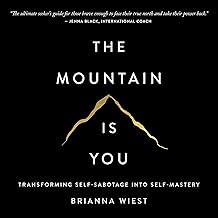
In her powerful book The Mountain Is Youby Brianna Wiest, she describes self-sabotage as “a coping mechanism, not a character flaw.”
The key, she argues, is catching ourselves before we spiral. That means identifying early emotional cues and deploying an interrupt before the emotion becomes identity.
Common pattern interrupters:
Name it out loud: “I’m starting to spiral. Pause.”
Cold water on wrists (or splash your face)
Shake out the body: movement discharges emotion
Box breathing: inhale 4, hold 4, exhale 4, hold 4
Apps like Pause or Breathwrk guide you through quick nervous system resets. They take just a few minutes, but the effect can be profound, like switching tracks before a train derails.
Interrupting emotional momentum is easier when we prepare for it before we need it. Here’s how:
1. Track your trigger patterns.
Notice what times of day, situations, or people consistently drain or inflame you; keep a small journal (digital or analog) of emotional peaks and patterns for two weeks.
2. Design a reset ritual.
Anchor your day with touchpoints that ground you, a short walk between Zoom calls. A morning coffee made slowly. Music that centers you. Use these as emotional palate cleansers.
3. Use sensory anchors.
A small object in your pocket. A scent that calms you. Even a mantra you whisper under your breath (“I return to myself.”) Sensory cues help interrupt runaway thoughts and bring you back.
According to Harvard Health, controlled breathing has downregulated the stress response almost instantly. These micro-tools can act as brakes when the emotional train starts rolling.
Emotional Clarity: What Lives Underneath
Here’s the deeper truth: Emotional momentum often protects something fragile underneath. Anger guards grief. Anxiety covers powerlessness. Distraction masks longing.
Breaking emotional momentum isn’t just about stopping; it’s about listening.
When we pause, breathe, and name the experience, we meet the emotion at its root. We say: “I see you. You’re here for a reason. But I choose what comes next.”
That’s what emotional clarity is, it’s not the absence of emotion, but awareness within emotion.
[“The Still Point That Changes Everything” – Image by moneycatzzz.com on Canva]
From Reaction to Resilience
Resilience doesn’t mean we never wobble. It means we don’t let the wobble define the whole dance.
Every time we interrupt emotional momentum, we rewire something fundamental. We affirm that we are not the storm, we are the sky it moves through.
You don’t need to fix everything today. But you can:
Pause when you’d usually scroll
Take a breath when you’d normally lash out
Choose a walk over a wallow
Small moves. Big shifts.
The Still Point That Changes Everything
In T.S. Eliot’s Four Quartets, he writes: “At the still point of the turning world, there the dance is.”
That still point, the moment we say, “Wait. I choose differently now,” is the moment the pattern breaks. It’s also the moment we reclaim our lives.
Emotional momentum is real. But so is your power to slow it.
You are not at your worst. You are not your last mistake. You are not the thought-loop that tells you it’s all too much. You are the awareness that notices it and decides to rise anyway.
Disclosure: This post may contain affiliate links. We only recommend products we believe in, and we may receive a commission at no cost to you! Thank you for your support!
Disclaimer: The information is provided for general information only – moneycatzzz.com makes no representations or warranties in relation to the information, including but not limited to any representation or warranty as to the fitness for any particular purpose of the information to the fullest extent permitted by law. While every effort has been made to ensure that the information provided in this article is accurate, reliable, and complete as of the time of writing, the information provided in this article should not be relied upon to make any financial, investment, real estate or legal decisions. Additionally, the information should not substitute advice from a trained professional who can take into account your personal facts and circumstances, and we accept no liability if you use the information to form decisions.
 Reading Time: 8 mins #
 This post may contain affiliate links.