
 Reading Time: 8 mins #
 This post may contain affiliate links.
Jeff Bezos was sitting in a 31st-floor office in Manhattan when he ran the calculation that would build the most valuable company on earth. It wasn’t a market analysis or a business plan. It was a regretful calculation. He called it the “regret minimization framework,” and the entire exercise took about three minutes. He projected himself to age eighty and asked one question: which version of himself could he tolerate looking back at?
The version that tried and failed? Tolerable.
The version that never tried? Terminal.
That’s the diagnosis. There was no vision board or a purposeful statement. A cold, structural assessment of which regret would be survivable and which would be corrosive. He didn’t build Amazon because he loved books. He built it because the eighty-year-old version of himself couldn’t stomach the alternative.
The Scorecard Nobody Reads Until It’s Too Late
We have become experts at polishing ephemeral ghosts. We obsess over a scorecard that vanishes the moment we walk out the door for the last time. We treat hitting a revenue target or a follower count with a level of devotion that should be reserved for something permanent.
We have spent so long staring at the urgent, next deadline, next review—that we’ve forgotten it is all just noise. We treat the quarterly goal as if it’s etched in stone, when in reality it’s just a temporary rule for a game that doesn’t matter once the lights go out.
Nobody remembers the person who never missed a meeting; they remember the person who actually stood for something. Nobody eulogizes a quarterly target.
Bronnie Ware doesn’t see this as cynicism after years of sitting with people in their final weeks as a palliative care nurse. Ware documented what surfaced when the performance was permanently over—when there was nothing left to optimize, no meeting to prepare for, no metric to chase. She compiled the results, and the number one entry is a structural indictment of how most of us spend our professional lives.
“I wish I’d had the courage to live a life true to myself, not the life others expected of me.” – from The Top Five Regrets of the Dying (Brommie Ware)
When the simulation ends, the metrics fail to provide comfort.

In the final accounting, no one looks back and wishes they’d hit more targets. No one laments a missed KPI or a forgotten performance review.
The regret is always simpler, and much heavier:
- The unlived life.
- The performance that never happened.
- The version of themselves that existed as potential, but never as evidence.
We spend decades building a resume of achievements that won’t be read at our funeral. At the same time, the parts of us that actually matter: the curiosity, the connection, the raw human evidence of being alive—are left to gather dust in the “potential” column.
The scorecard that matters is the one nobody tracks.
The Mortality Salience Effect
There’s a well-documented phenomenon in psychology called mortality salience: a measurable shift in behavior, values, and decision-making that occurs when someone becomes acutely aware of their own demise. Stanford’s research on the subject found something that should alarm every professional running on autopilot: when people are forced to confront their finitude, they almost universally reprioritize away from achievement and toward meaning.
Not gradually. Immediately.
The subjects didn’t need coaching. They didn’t need a framework, a podcast, or a seven-step protocol. They needed to confront the fact that the scorecard has an expiration date. Mortality salience acts as a cognitive reset—it strips the performance layer and reveals what’s actually underneath.

[The Forensic Mirror | moneycatzzz.com]
Most people wait for a catastrophe to permit them to be honest. They postpone the life audit until the choice is made for them: until a sudden diagnosis, a jagged accident, or a crisis of identity shatters the glass of their routine. They spend decades avoiding the mirror, only to be forced into it when the room is already on fire.
By the time the reset arrives, they aren’t choosing a new path—they are simply mourning the one they never took.
Atul Gawande documented this with surgical precision in Being Mortal. His research revealed that even physicians—people who deal with death professionally, daily, structurally—avoid the personal confrontation with their own mortality until it becomes unavoidable. The people most familiar with death’s mechanics are often the least prepared for its personal implications. If doctors can’t run this audit proactively, the odds that you’re doing it voluntarily are close to zero.
The Bezos Diagnostic
The regret minimization framework works because it bypasses the performance layer entirely.
It doesn’t ask, “What should I do?” That question triggers the achievement scorecard: the titles, the targets, the external validation system.
It doesn’t ask, “What do I want?” That question triggers the desire engine—the hedonic treadmill that my Low Expectations piece already diagnosed as structurally unreliable.
It asks: What will I regret not doing?
The question operates in negative space. Instead of constructing an ideal future and working backward, it identifies the specific absences that would be intolerable in retrospect. This is why it took Bezos three minutes. He didn’t need a strategic plan—he needed to identify which regret would corrode him from the inside and then structure his life to avoid it.
The trace-back utility of the regret minimization framework is that it clarifies by elimination. Most decisions become simple—not easy, but simple—when evaluated against the question of what you’d regret at eighty. The difficult conversation you’ve been avoiding? Run it through the framework.
The creative project sitting in a drawer? Run it through. Is the relationship you’re maintaining out of obligation rather than a genuine connection?
Run it through. The framework doesn’t care about your comfort. It cares about your legacy.
The Evidence File
Viktor Frankl survived Auschwitz. He lost his wife, his parents, and his brother. Every external marker of his life was systematically destroyed. What remained, what no external force could reach, was the decision about who he would be inside the experience.
Frankl identified the structural core of human resilience; it isn’t the avoidance of suffering but the attachment of meaning to suffering. The people who survived the camps psychologically weren’t the physically strongest. They were the ones who maintained a purpose that extended beyond the immediate horror: a manuscript to complete, a child to reunite with, a future self that required their survival.
Frankl’s data point is extreme, and deliberately so. If meaning can be constructed inside a concentration camp, then the excuse that your circumstances prevent you from living with intentionality is demonstrably bankrupt.
The obituary test asks what Frankl’s work implies: When the external structure is removed, the title, the revenue, the follower count, the carefully maintained performance—what remains? What have you actually built that exists independently of the professional machinery?
For most people, the honest answer produces the specific discomfort that mortality salience research predicts—the discomfort is diagnostic. It tells you exactly where the gap lives between the life you’re performing and the legacy you’re actually constructing.
Executing the Scan
The Obituary Test isn’t a journaling exercise or a vision board afternoon. It is a structural examination—an internal scan of your current reality using three specific diagnostic filters.
The Subtraction Test: Strip away the title, the salary, and the network. What is left? If the answer is nothing, you don’t have an identity—you have a lease. You are renting your sense of self from an employer or an audience who can evict you on a whim.
The Honest Eulogy: Write yours today, no aspirations, just the current evidence. If your honest draft is: “He hit his quarterly targets and managed his inbox,” and that sentence makes you sick—the revulsion is data. It is the exact measurement of how much of yourself you have traded for a scorecard that won’t exist in ten years.
The Silence Inventory: What have you stopped mentioning? Look at the gap between the ambitions of your twenty-five-year-old self and the “practicality” of today. These silences are not maturity; they are larval regret. They require no maintenance and demand no attention until the final audit, where they become the only things you can hear.
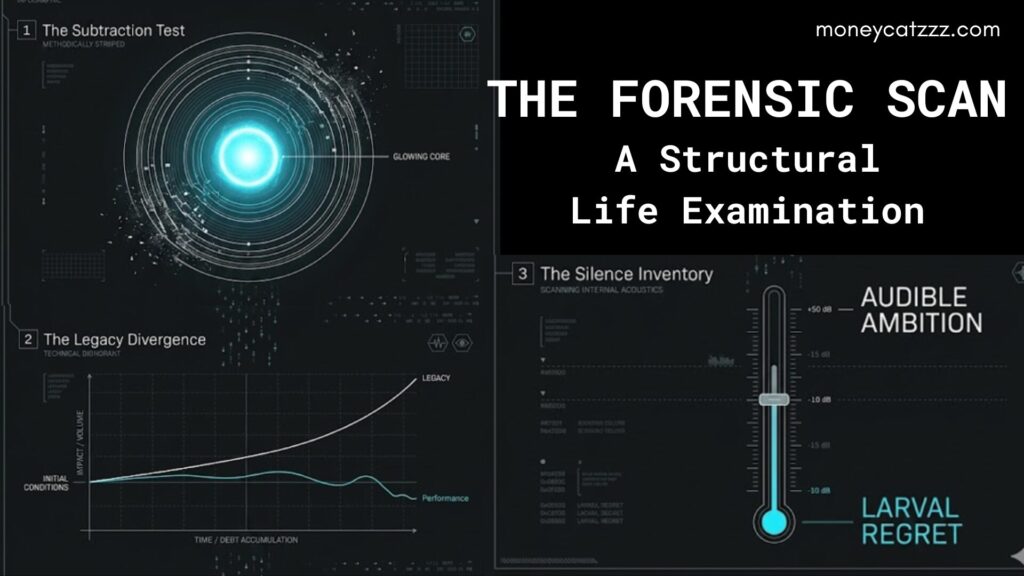
[THE FORENSIC SCAN: A Structural Life Examination | moneycatzzz.com]
The Legacy Framework
Legacy is not a retirement project. It is a daily output.
Most people accidentally delegate their legacy to their professional performance. They assume the personal scaffolding will build itself while they are busy hitting targets. It won’t. If you don’t intentionally design the structure of your life, you are simply a passenger in a system designed by someone else’s objectives.
Legacy is built in the exact moments when the professional scorecard and the personal reality diverge; it is the decision to prioritize human evidence over a digital performance.
These aren’t soft choices; they are structural investments in the only portfolio that survives the end of the simulation. The Obituary Test reveals the truth: are you actually making these trades, or are you merely thinking about them while optimizing for a scorecard that won’t be read at your funeral?

The Terminal Finding
The life examination produces one of two findings. Either you’re building something that will matter after the performance ends, or you’re perfecting a performance that will be forgotten before the flowers on the casket have wilted.
Regret is not built in the dramatic moments of failure. It is built on the quiet accumulation of days when the urgent consumed the important; when the performance consumed the person, when the scorecard consumed the life.
Bezos ran the calculation in 1994. Three minutes. One question. Thirty years of evidence that the framework works. No Manhattan office or a billion-dollar outcome required
Regret minimization isn’t a strategy for entrepreneurs. It’s a litmus test for anyone operating on a scorecard they’ve never examined against the only non-negotiable deadline.
The curtain is moving. The obituary is being drafted in real time by the choices you’re making today. Not the choices you’re planning. The ones you’re making.
The eighty-year-old version of you is already watching.
What does the current evidence show?
The Evidence Stack: Tools for the Unlived Life.
Top Five Regrets of the Dying

Being Mortal

Man’s Search for Meaning
Disclosure: This post may contain affiliate links. We only recommend products we believe in, and we may receive a commission at no cost to you! Thank you for your support!
Acknowledgment: Cover Image by moneycatzzz.com
Disclaimer: The information is provided for general information only – moneycatzzz.com makes no representations or warranties in relation to the information, including but not limited to any representation or warranty as to the fitness for any particular purpose of the information to the fullest extent permitted by law. While every effort has been made to ensure that the information provided in this article is accurate, reliable, and complete as of the time of writing, the information provided in this article should not be relied upon to make any financial, investment, real estate or legal decisions. Additionally, the information should not substitute advice from a trained professional who can take into account your personal facts and circumstances, and we accept no liability if you use the information to form decisions.