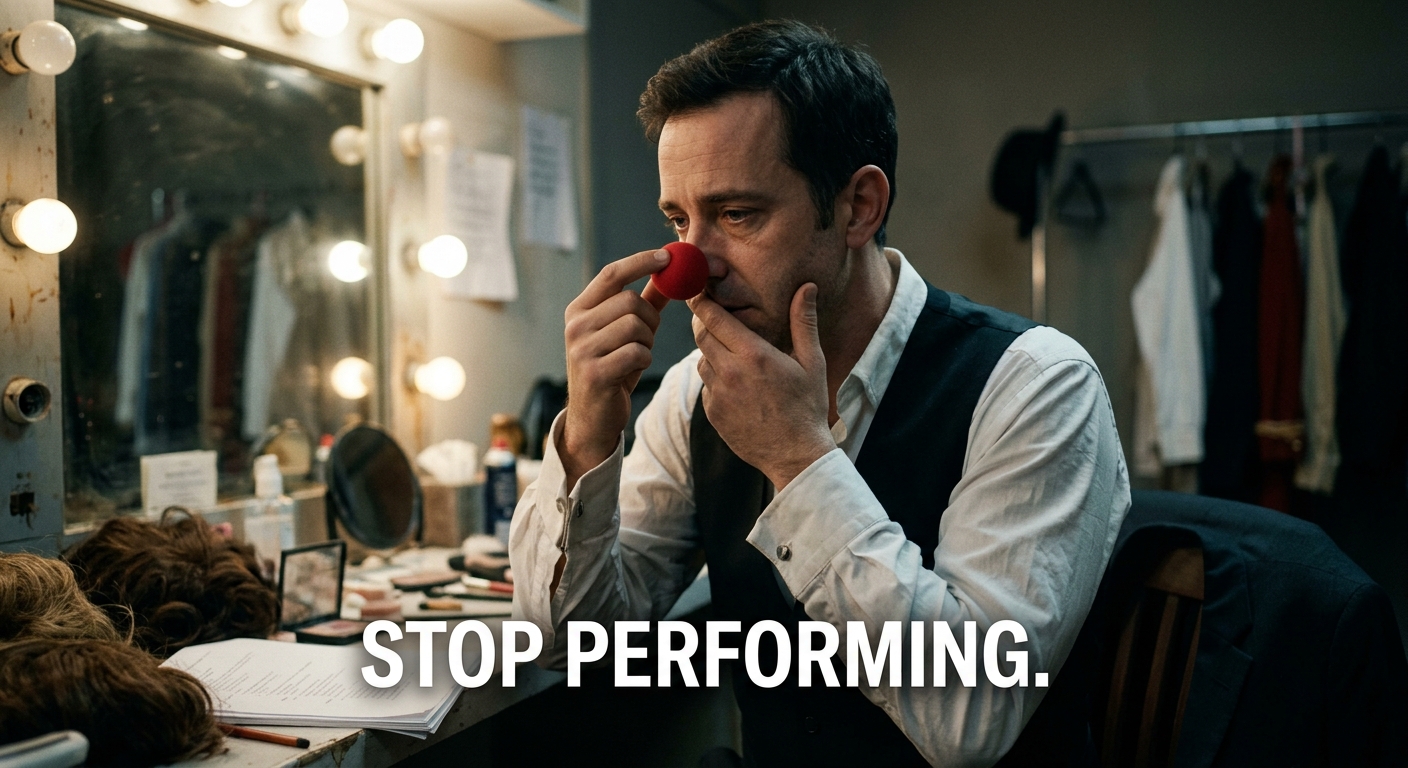

stop performing cover

Red Nose: The Performance of Okay – Who Remains When the Room Empties?

imagesReading Time: 8 mins #

disclosure line icon vector This post may contain affiliate links.

The boardroom laughed. I delivered the line with a genuinely self-deprecating, sharp enough tone that felt real without offending anyone. The regional director slapped the table while the junior associate looked relieved. Everyone was comfortable. I walked to the bathroom at the Midtown office on the 19th floor, stared into the mirror, and realized I didn’t know how to stop performing.


What I had delivered was my typical performance. What was worse was that I didn’t have to lie. I just used a routine I learned so early that I forgot it was a tool.


The red nose isn’t a joke. It’s a survival strategy. And when you wear it long enough, you start to believe it’s your actual face.

Optionality Over Authenticity

The act isn’t the issue. The mask itself isn’t the problem. The problem is forgetting you can take it off.


You don’t need to stop performing in your career or daily life. You need to stop believing the act is your actual identity.


You don’t need to abandon your public persona to be real. You need to realize you are the person holding the script, not the script itself. Realizing you can stop performing at any moment gives you your choice back.

Screenshot 2026 07 28 154437

Here is how to see the mask for what it is, and separate the tool from who you are.


The First Face: The Clown

You put it on for a reason.


Maybe you were the kid who made everyone laugh. You learned early that a well-timed joke bought you safety. The bullies left you alone, and the teachers liked having you around.


Maybe you were the adult who realized that competence plus charm equals promotion; you learned to calibrate your tone and energy. You became the person who could manage a crisis while keeping team morale high in the same meeting.


Maybe you were the partner who discovered that keeping the peace was easier than telling the truth. You learned to nod and absorb the friction. You decided your comfort was less important than everyone else’s.


The performance is a strategy. Strategies aren’t immoral. They’re solutions to problems you didn’t choose.

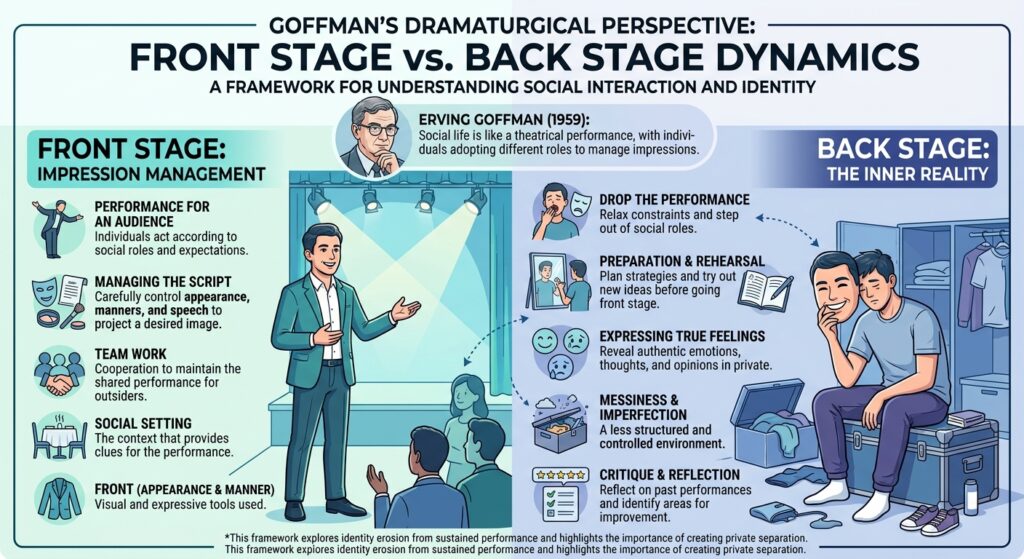
Goffman’s Front Stage and Back Stage

In his foundational sociological work, The Presentation of Self in Everyday Life, Erving Goffman detailed the dramaturgical framework of human interaction. Goffman called the public arena the front stage, the place where you perform for the audience according to established social scripts. The backstage is the private space where you step out of character and drop the performance.


The modern trap occurs when the front stage colonizes the backstage. You perform so thoroughly that you forget a private space ever existed. The front stage consumes your solitude until you no longer know how to stop performing when the audience leaves the room.


The clown becomes the only face you know how to wear.

stop performing: Goffman's dramaturgical framework
[Goffman’s Dramaturgical Framework | moneycatzzz.com]

The Glue: How Reinforcement Anchors the Mask

The nose doesn’t stay on by itself. It requires glue.


The glue is reinforcement. You get a promotion, or a partner says, “I love how easy you are to be around.”


Each reward applies another layer of adhesive. The nose becomes harder to remove, not because you’re attached to it, but because the alternative feels impossible.


What would happen if you decided to drop the act? Who would be left when the lights go down?

Hence the trap. The mask becomes the face. And when your personality feels fake, it’s because you’ve forgotten where the mask ends, and you begin.


I remember the first time I noticed the glue. October 2019. I was driving home from a work dinner at a steakhouse in Midtown. Windows down. No music. The silence was loud.


I spent four hours keeping the table engaged. The second the car door shut, my energy flatlined. I wasn’t exhausted; I was vacant. That blankness wasn’t burnout from a long dinner. It was the realization that after years of running the script, I had forgotten who existed when the act stopped.

The Second Face: The Mask.

The shift rarely begins with a grand revelation. It starts as a micro-glitch in execution.


You forget a name mid-sentence or answer “I’m good” just half a second too fast. For a fraction of a second, the mask slips. You see the subtle flicker in their eyes, and you realize they caught it too. They know something is off. You recover, and the performance resumes.


My crack came from a video, a recording of a keynote I’d given six months earlier on remote team management. The client had asked for a copy. I watched it alone, late at night.


The man on screen was polished, practiced, and completely hollow. He wasn’t me. I couldn’t unsee that man, and I couldn’t pretend he was someone else.

Hochschild’s Emotional Labor and Identity Erosion

In The Managed Heart: Commercialization of Human Feeling, sociologist Arlie Russell Hochschild established the framework for emotional labor.


She distinguished between two primary modes of self-presentation:

  • Surface Acting: Faking external expressions, smiles, and body language to manage the feelings of others without altering your internal state.
  • Deep Acting: Actively deceiving yourself to force your inner feelings into alignment with your professional role.

Hochschild’s research proves that persistent surface acting causes acute psychological distress and identity erosion, while deep acting gradually destroys self-awareness.

Neither approach gives you freedom. One leaves you exhausted, and the other leaves you lost. True relief comes only from separation: keeping a clear line between the tool you use and the person holding it.


When you forget that the work is contextual, you lose access to choice. You become trapped as the clown because you can’t remember how to stop performing when the curtain falls.

The Myth of Radical Authenticity

Conventional advice demands that you burn the mask, drop the persona, and expose your raw self in every environment.


This assumes the performance is the enemy. It frames performance vs. authenticity as a war in which one side must win. It assumes you need to burn the nose and find your real face underneath.


The real shift is far more practical: you don’t need to destroy the tool. You need to stop confusing the instrument with the person holding it. You don’t have to stop performing entirely; you need to stop mistaking the act for your identity.


The relief isn’t in permanently taking off the nose. It is in seeing that the nose was never your face.


You can wear it. You can take it off. But you can’t do either if you think the mask is your actual skin.


You need to cut the gap between the tool and the self, between the front stage and the backstage.

stop performing the clown
[Some People Only Liked the Clown | moneycatzzz.com]

The Third Face: The Face Underneath

The relief wasn’t in becoming a different person. It was in realizing that the performance was never mandatory.


I started small: a question instead of a joke, a silence instead of a laugh. A moment where I didn’t fill the room with comfort.


It was terrifying at first. The silence felt like a vacuum, but it was also honest.


I could choose when to wear the nose. I could choose when to take it off.


I now know I have options.

Practical Steps to Build Separation

You don’t need a revelation. You need practice.

  • Notice the glue. Pay attention to the moments when you get rewarded, whether it’s for performing the promotion or the quiet approval. Each one applies another layer. Just notice it.
  • Find the crack. Watch for the moment when the mask slips, when you say “fine“ too quickly. That microsecond is your moment of separation.
  • Practice the silence. Don’t fill every gap with comfort. Let the silence sit. You’ll feel the difference between the performance and the space underneath.
  • Surrender the need to be liked. The performance exists to make people comfortable. When you stop performing solely to keep others comfortable, some people will get uneasy. That’s just the cost of clarity.
Mindvalley promo

What Happens When You Stop Being Likable

You don’t become unlikable. You become optional.


Some people only liked the clown. The moment you stop managing their comfort, they will notice the shift and tell you that you’ve grown distant or quiet.


Let them think whatever they want.


Others will prefer the face underneath. They notice the drop in noise, ask better questions, and treat you like a person rather than an entertainer.


You won’t know which group someone belongs to until you stop performing.


Authenticity without separation is just another role in which you act out vulnerability rather than charm; that’s the real risk. The goal isn’t to force yourself to be raw in every room; it’s to recognize that the performance is removable, so you can choose when to use it.

Holding the Mask

I haven’t thrown the persona away. In plenty of rooms, I still reach for it. The charm works, and sometimes smoothing over friction is a good strategy.


The difference is that I no longer think the mask is glued to my face.


Once you see the boundary between the tool and yourself, the performance stops being a trap. You use it when you choose to, and put it back down when you’re done.


Luigi Pirandello captured the warning decades ago:

“You will learn at your expense that on the long journey of life you will meet many masks and few faces.”

_______________________________________________

Required Reading: Books on Emotional Labor and Social Performance

81Lzohf6CYL. AC UY218


Presentation of Self in Everyday Life

by Erving Goffman

Amazon Button

514qHzS7OL. AC UY218


 The Managed Heart

by Arlie Russell Hochschild

Amazon Button

61keL3dNSwL. AC UY218


Stories for the Years

by Luigi Pirandello

Amazon Button

Disclosure: This post may contain affiliate links. We only recommend products we believe in, and we may receive a commission at no cost to you! Thank you for your support!
Acknowledgment: Cover Image by moneycatzzz.com

Disclaimer: The information is provided for general information only – moneycatzzz.com makes no representations or warranties in relation to the information, including but not limited to any representation or warranty as to the fitness for any particular purpose of the information to the fullest extent permitted by law. While every effort has been made to ensure that the information provided in this article is accurate, reliable, and complete as of the time of writing, the information provided in this article should not be relied upon to make any financial, investment, real estate or legal decisions. Additionally, the information should not substitute advice from a trained professional who can take into account your personal facts and circumstances, and we accept no liability if you use the information to form decisions.

Signup to our Newsletter for regular updates:

Marco Ban

Marco Ban is a 42-year-old, from sunny Spain bringing 7 years of experience crafting clear and engaging content in finance and digital marketing. A digital entrepreneur by trade, he brings vast experience in digital product reviews, financial blogging, and tutorials. A silky writer with a touch of a European flare, his postings are always engaging and informative.