 Reading Time: 8 mins #
 This post may contain affiliate links.
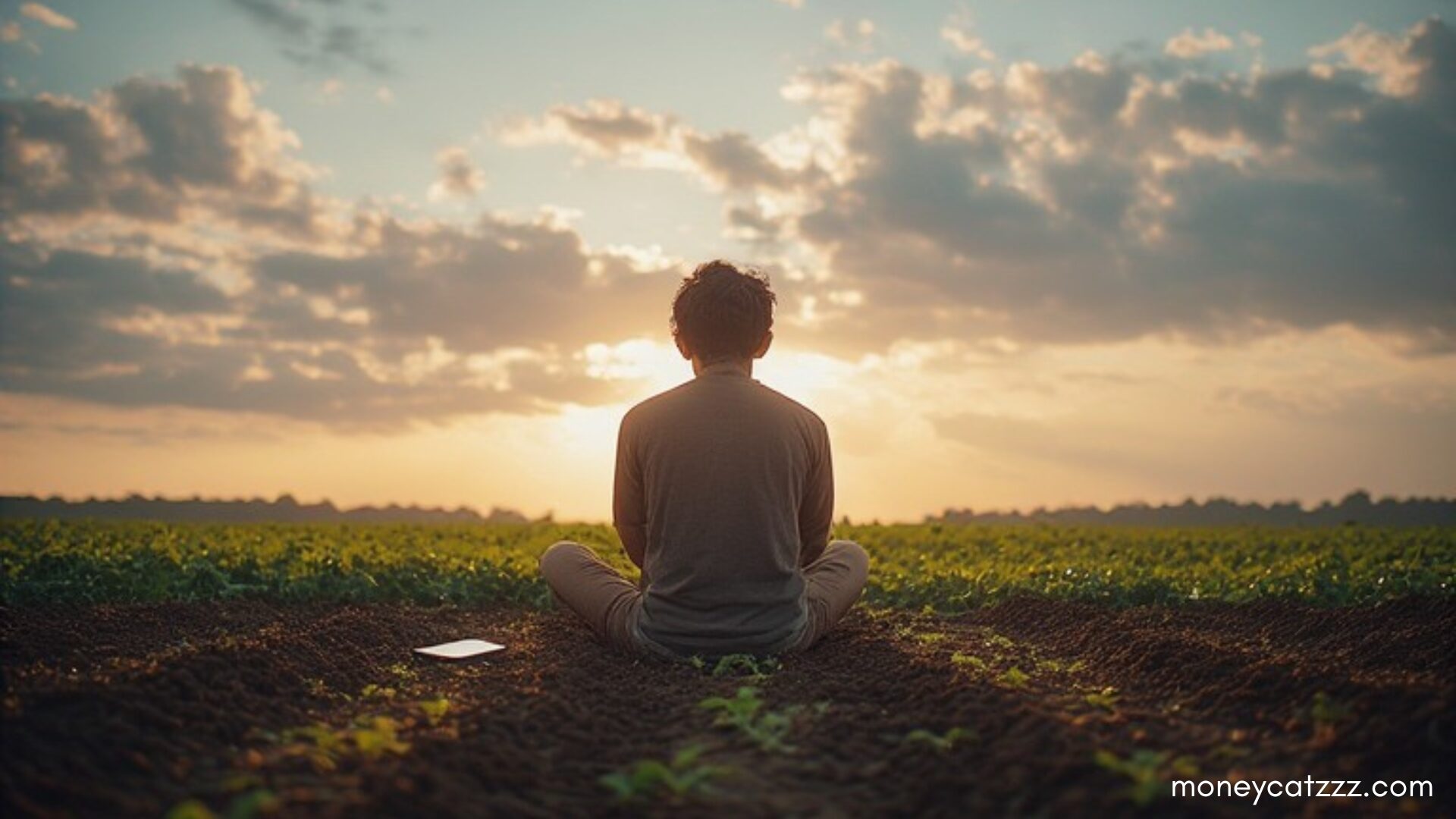
There is a farmer in Portugal I spend time with who is special. To his neighbors, he’s an enigma: he leaves a massive third of his acreage entirely unplanted, season after season. It’s not a resource issue; he has the seeds and the irrigation. It’s that João respects the dirt. He understands a truth we’ve forgotten about our own cognitive profiles: soil that is never left fallow eventually turns to dust—continuous cultivation is actually a form of depletion. In his eyes, that empty, weed-strewn patch isn’t a loss—it’s the only way the rest of the farm stays alive.
I find myself thinking about João every time my hand “ghosts“ toward my phone during a three-second gap in life. It happens at red lights. It happens while the espresso machine is hissing. It happens before I’ve even processed that I’m bored. I’m not actually searching for information. I’m fleeing from the silence—I’ve been treating boredom like a biological glitch to be patched, rather than the most nutrient-dense psychological state I possess.
What We’ve Done to Silence
There’s a monastery in the south of France where monks maintain what they call “the great silence” from evening prayer until morning. Not because silence is comfortable; most of them will tell you it isn’t, especially at first. They maintain it because they’ve discovered that that’s where the interior life actually happens. Strip away the noise, and something essential surfaces, something you couldn’t have if it weren’t for the instant stimulation of ordinary life.
Amid our modern advancement, we’ve built the opposite monastery. The modern environment is an anti-silence machine, specifically engineered to ensure that boredom never takes hold. Every waiting room has a screen. Every commute has a podcast. At every meal, a phone is propped against the salt shaker. We’ve collectively, and mostly unconsciously, decided that an unoccupied moment is a problem requiring an immediate solution.
Johann Hari documented that the attention we have isn’t just a matter of our focus; it’s systematically dismantling our capacity for it. The business model of every major platform depends on our attention span never stabilizing long enough to turn inward. Boredom isn’t for quarterly earnings. So they’ve made sure they’ve experienced it.
The Neuroscience of Nothing
Here’s what actually happens when you sit with boredom instead of fleeing from it.
Your brain should be able to do what neuroscientists call the default mode network, or DMN. This is the neural system that activates during rest, during undirected thought, during exactly the kind of unstructured mental wandering that boredom provides. It sounds like downtime. It’s actually your brain’s most sophisticated processing mode.
The DMN is where you consolidate memories, have a narrative sense of your experiences, generate creative connections, and access the deeper self-knowledge that gets buried under constant stimulation.

Research from the University of California shows that DMN activity correlates strongly with creative insight, empathy, and the capacity for complex ethical reasoning. The insights you have in the shower, the solutions that appear during walks, the sudden clarity about their vision that’s been confusing you: all DMN activity, all require this kind of unoccupied mental space that boredom uniquely provides.
We’ve been treating our most powerful cognitive tool like a bug to be patched.

[The Great Silence vs. The Anti-Silence Machine | moneycatzzz.com]
The Fallow Ground Principle
Agriculture discovered thousands of years ago what we’re only beginning to remember about minds: you cannot extract continuously from any living system without eventually destroying it. The fallow field isn’t empty; it’s regenerating. Nitrogen returns to the soil. Root systems decompose into nutrients—the microbiome recovers. What looks like nothing happening is actually everything necessary for future productivity occurring below the surface.
Boredom is your psychological fallow period. The mind left unoccupied isn’t idle—it’s performing maintenance that constant stimulation makes impossible. It’s integrating experience, processing emotion, making connections between apparently unrelated things, and asking questions that busy minds never get to formulate.
Manoush Zomorodi points this out beautifully in Bored and Brilliant, tracking what happens when people deliberately embrace boredom for even short periods. Creative output increases. Problem-solving improves. People report understanding themselves. The fallow ground, given just a little time, begins producing.
Digital Distraction as Avoidance
The uncomfortable question beneath all this isn’t that exact thing we’re avoiding?
Digital distraction is remarkably effective at preventing a specific kind of encounter: the encounter with yourself. With your actual thoughts, unmediated and unperformed. With the emotions you’ve been too busy to feel, with the questions about your life that you’ve been managing, it’s not enough to stay in perpetual motion.
American spiritual teacher, author, and former software programmer, Michael Singer, describes how the mind generates constant noise, chatter, and commentary to avoid stillness. In his renowned book on releasing the ego and observing thoughts, he insisted that stillness is initially painful but, because it is revelatory, ultimately rewarding. In silence, you discover what you actually think, what you actually want, what you’re actually feeling. And sometimes those discoveries require changes that feel more threatening than digital distraction does.
I’ve noticed this in my own mindfulness practice. The first five minutes of sitting quietly are uncomfortable in a way that’s hard to explain. It’s not painful exactly. It’s more like a craving, an insistence from some part of my brain that this is wrong, that you’d be doing something—that stillness is a kind of death. The discomfort isn’t a sign to stop—it’s evidence of how thoroughly I’ve been conditioned against the very state that serves me most.
A 20-Minute Experiment
Here’s what I want you to try, and I want to be honest: it will feel strange.
Set a timer for 20 minutes. Sit somewhere comfortable. Bring nothing: no phone, no book, no music, no task. Just sit.
You’ll likely experience, in rough sequence:
- Initial restlessness (minutes 1-5)
- Active discomfort and strong urges to reach for something you’re used to (5-10)
- A beginning settling, curiosity arriving (minutes 10-15)
- Something that might be spaciousness (minutes 15-20)
What I’m experiencing in those first ten minutes is withdrawal. Actual withdrawal from constant stimulation is your brain’s test against the reality of its usual inputs. Its restlessness is a sign of how dependent you’ve become on external input to feel okay with yourself.
What comes after is what all the fuss is about. Enlightenment isn’t a particularly dramatic revelation. It is just the mild, profound pleasure of your own company: thoughts arriving without agenda, attention moving without burden, something loosening in the chest that you didn’t notice was tight.

[Subtraction as Optimization | moneycatzzz.com]
The Attention Span Repair
Research on attention span is genuinely alarming. Microsoft’s much-cited study suggesting that human attention now averages 8 seconds is criticized for its methodology, but any honest self-examination confirms the trend’s direction. We have habituated ourselves to such rapid input that sustained attention on anything, a book, a conversation, a problem, feels increasingly effortful.
Studies from the American Psychological Association show that even brief mindfulness practice, involving present-moment awareness without specific task demands, measurably increases attention and reduces the compulsive quality of digital distraction. We can rebuild what we’ve depleted, but it requires giving the ground time to recover.
Cal Newport argues that the solution to a depleted attention span isn’t optimization but subtraction. Not managing your phone use better, but avoiding the conditions that made the problem possible. The fallow field doesn’t improve with more care. Microsoft’s It improves by being left alone.

What the Monks Understood
Those monks in France aren’t maintaining the great silence because they’ve transcended the human need for stimulation. They are maintaining it because they have discovered, through centuries of collective experimentation, that silence produces something that noise cannot: depth.
Not depth as a personality trait or intellectual achievement. Depth as a quality of presence. The capacity to be genuinely here, fully occupying this moment rather than processing inputs about a hundred other moments simultaneously. The capacity that every form of wisdom tradition across human history has identified as both the beginning and the destination of a meaningful life.
Boredom is the inner gateway to this depth. You don’t need a monastery or a spiritual framework. You need 20 minutes, a comfortable seat, and the willingness not to follow every conditioned instinct to reach for the phone.
The Practice
Start small. Smaller than you think necessary.
Three minutes of doing nothing before you pick up your phone in vain. Two minutes sitting in your car before they’re into the next obligation, they’ve got minutes after dinner, before the screen, just sitting with the residue of the day.
Don’t try to meditate in the formal sense. Don’t try to think about anything, or don’t think about anything. Just notice what emerges in boredom, what floats up when you stop pushing things down with constant stimulation.
The farmer leaves his field fallow, not because he’s given up on it. He leaves it fallow because he loves what it produces, and he’s learned that production requires rest.
Your mind is the field. Boredom is the rest. What wants to grow there hasn’t been waiting patiently for you to stop filling the ground with noise long enough for it to surface.
It’s been waiting a while.
You might be surprised what’s ready.
The Fallow Mind: Why Boredom is the Engine of Insight
Bored and Brilliant

Deep Work

The Untethered Soul
Disclosure: This post may contain affiliate links. We only recommend products we believe in, and we may receive a commission at no cost to you! Thank you for your support!
Acknowledgment: Cover Image by moneycatzzz.com
Disclaimer: The information is provided for general information only – moneycatzzz.com makes no representations or warranties in relation to the information, including but not limited to any representation or warranty as to the fitness for any particular purpose of the information to the fullest extent permitted by law. While every effort has been made to ensure that the information provided in this article is accurate, reliable, and complete as of the time of writing, the information provided in this article should not be relied upon to make any financial, investment, real estate or legal decisions. Additionally, the information should not substitute advice from a trained professional who can take into account your personal facts and circumstances, and we accept no liability if you use the information to form decisions.