 Reading Time: 12 mins#
 This post may contain affiliate links.
Like intricate mazes, our minds are full of shortcuts and biases that help us navigate life’s complexities. While often helpful, these mental heuristics can lead to systematic errors in thinking, known as cognitive biases. However, by actively overcoming cognitive biases, we can sharpen our decision-making, enhance reasoning, and foster personal growth.
Like a labyrinth with twisting paths and dead ends, navigating our thoughts without awareness can lead us astray. Our brains are naturally wired to follow cognitive biases, making them difficult to escape. Yet, by recognizing and addressing these biases, we can equip ourselves with the tools to overcome cognitive biases and develop more precise, more rational thinking.
In this exploration, we will delve deep into the mechanisms of cognitive biases and provide actionable strategies to overcome cognitive biases effectively. By identifying these mental traps and applying critical thinking, we can take charge of our decisions, refine our judgment, and lead more fulfilling lives.
“The mind is a wonderful servant but a terrible master.” – William S. Burroughs
The Hidden Influences: Four Key Cognitive Biases
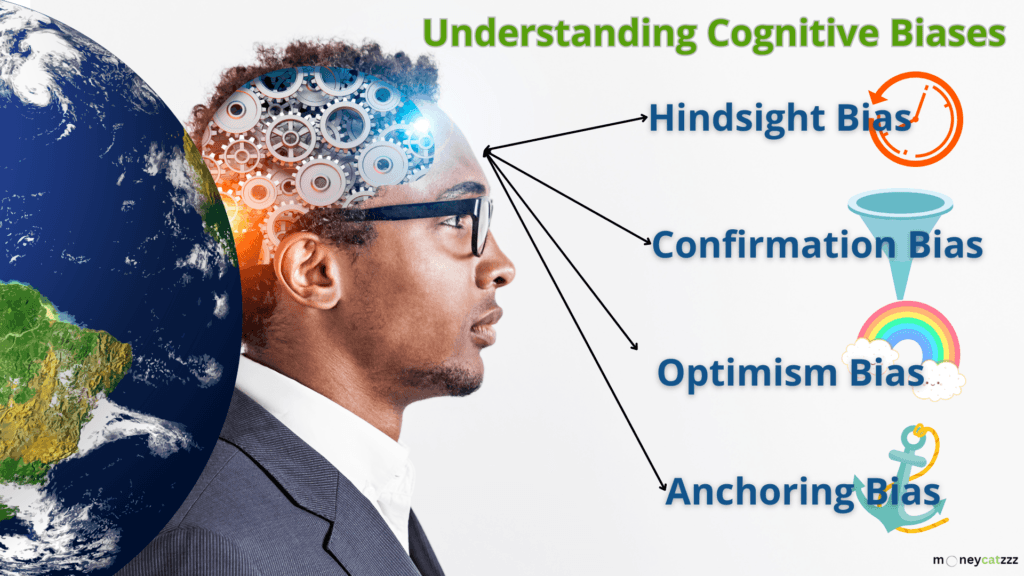
In this exploration of cognitive biases, we’ll focus on four particularly influential biases that shape our perceptions, decisions, and memories:
- Hindsight Bias: The tendency to overestimate our ability to predict events after they have occurred.
- Confirmation Bias: The tendency to seek information confirming our beliefs.
- Optimism Bias: The tendency to overestimate the likelihood of positive events happening to us.
- Anchoring Bias: The tendency to rely too heavily on the first information we encounter when making decisions.
These biases play a significant role in how we interpret the world and make choices. By examining them in detail, we can begin to recognize their influence, leading to greater awareness and understanding of our decision-making processes.
[Image by moneycatzzz.com on Canva]
Hindsight Bias: The Illusion of Predictability
“I knew it all along!” How many times have we said this after something has happened? Hindsight bias is the perception of past events as more predictable than they were, often known as the “I-knew-it-all-along” effect.
In his excellent book “Thinking, Fast and Slow,” Daniel Kahneman, the Nobel laureate, revealed one of the most intriguing mental mistakes. Kahneman points out that hindsight bias takes place because we retroactively reconstruct the past by making the actuality of the event seem more probable. Thus, this forms the inevitable singular vision, which, in turn, can cause us to be over-confident in predictions.
Consider the following scenarios:
- A company’s stock price plummets unexpectedly. In retrospect, analysts claim they saw warning signs all along.
- A political upset occurs in an election. Pundits assert they always knew the underdog had a chance.
In both cases, the reality is that these events were likely far less predictable than they appear in hindsight.
The consequences of hindsight bias can be significant:
- It can lead to an overestimation of our ability to forecast future events.
- It may result in unfair blame attribution, as past decisions are judged based on information that wasn’t available.
- It can hinder learning from past experiences, as we may believe we “knew it all along” and thus fail to recognize the true lessons of an event.
To combat hindsight bias, consider these strategies:
- Keep a decision journal: Document your thoughts and predictions before events unfold.
- Embrace uncertainty: Recognize that many outcomes are inherently unpredictable.
- Consider alternative outcomes: Actively think about how events could have unfolded differently.
- Seek diverse perspectives: Engage with viewpoints that challenge your recollections.

Confirmation Bias: A Cognitive Bias That Distorts Thinking
Confirmation bias is a cognitive bias that leads us to seek information supporting our existing beliefs while ignoring or minimizing contradictory evidence. This mental shortcut can influence our decision-making, shaping our perceptions and reinforcing preconceived notions.
In The Righteous Mind: Why Good People Are Divided by Politics and Religion, social psychologist Jonathan Haidt explores how cognitive bias—particularly confirmation bias—shapes our moral and political beliefs. He argues that people often form conclusions and look for evidence to justify them rather than objectively analyzing all available information.
Confirmation bias manifests in various ways:
- Selective exposure: We surround ourselves with like-minded individuals and information sources that align with our beliefs.
- Biased interpretation: We interpret ambiguous information to support our preexisting views.
- Selective recall: We’re more likely to remember information that confirms our beliefs than information that challenges them.
[“The Hidden Influences: Understanding Cognitive Biases” = moneycatzzz.com]
The impact of confirmation bias can be far-reaching:
- It can lead to polarization in politics and social issues.
- It may result in poor decision-making in business and personal life.
- It can hinder scientific progress by causing researchers to overlook contradictory evidence.
To mitigate confirmation bias:
- Actively seek out diverse perspectives and contradictory information.
- Practice the “steelman” argument: Formulate the best possible version of opposing viewpoints.
- Engage in collaborative decision-making to incorporate multiple perspectives.
- Regularly reassess your beliefs and be open to changing your mind when presented with new evidence.
Optimism Bias: The Rose-Tinted Future
Surprisingly, the human mind contains an inner-biased ability to believe in a bright future even when the contrary evidence is right in front of their eyes. This bias, now called optimism bias, leads people to overestimate the probability of positive events and underestimate the likelihood of adverse events.
Tali Sharot explains this phenomenon in detail in her book “The Optimism Bias: A Tour of the Irrationally Positive Brain.” As per Sharot, though the optimism bias has benefits, as it reduces stress levels and builds resiliency, over-optimism can also lead to bad decisions and taking risks when there is no need to.
Examples of optimism bias include:
- Underestimating the time and cost required to complete a project.
- Believing we’re less likely than others to experience negative events like illness or job loss.
- Overestimating our abilities or the success rate of our endeavors.
The consequences of optimism bias can be double-edged:
- On the positive side, it can foster hope, motivation, and persistence in facing challenges.
- However, it can also lead to inadequate preparation for potential setbacks and unrealistic expectations.
To harness the benefits of optimism while mitigating its risks:
- Use concrete planning strategies like implementation intentions (“if-then” plans) to prepare for potential obstacles.
- Seek out and seriously consider objective feedback from others.
- Use historical data and base rates when making predictions rather than relying solely on personal expectations.
- Practice “defensive pessimism” in high-stakes situations by considering and planning for worst-case scenarios.
Anchoring Bias: The Power of First Impressions
When making decisions or estimates, most of us give heavy weight to the first piece of information that happens to come to our attention. That initial “anchor” has a powerful influence on our subsequent judgments, even when the anchor is irrelevant to the actual decision. This effect is called anchoring bias.
Anchoring bias-how that skews and changes the way decisions are made-was a major focus of this behavioral economist. In “Predictably Irrational: The Hidden Forces That Shape Our Decisions,” Dan Ariely discusses how anchoring bias has come to influence our decision-making processes with respect to consumer behavior and pricing strategy.
Anchoring bias can manifest in various contexts:
- Negotiations: The first offer often serves as an anchor, influencing the final agreement.
- Pricing: Retailers often use high “original” prices to anchor consumers’ perceptions of value.
- Performance evaluations: Initial impressions can disproportionately influence overall assessments.
[“Strategies for Overcoming Cognitive Biases” – Image by creativeart]
The impact of anchoring bias can be significant:
- It can lead to suboptimal decisions in personal finance, such as overpaying for products or services.
- In business, it may result in missed opportunities due to an over-reliance on historical data or initial proposals.
- In legal settings, it can influence judgments and sentencing decisions.
To mitigate the effects of anchoring bias:
- Seek multiple reference points before making decisions.
- Delay your first impression and gather more information before forming judgments.
- Use objective criteria and predefined decision-making frameworks when possible.
- Be aware of potential anchors and consciously question their relevance and validity.
The Interplay of Cognitive Biases
While we’ve explored these four biases individually, it’s crucial to recognize that they often work in tandem, reinforcing each other and shaping our perceptions in complex ways.
For instance:
- Hindsight bias can strengthen confirmation bias by making us more confident in our beliefs.
- Optimism bias might lead us to seek confirmation information, further entrenching our positive expectations.
- Anchoring bias can provide a starting point that confirmation bias then works to reinforce.
Understanding these interactions can help us develop more comprehensive strategies for debiasing our thinking and decision-making processes
Practical Strategies to Overcome Cognitive Biases
While eliminating cognitive biases is likely impossible, we can develop strategies to mitigate their effects and improve our decision-making:
- Cultivate self-awareness: Regularly reflect on your thought processes and decision-making patterns.
- Embrace diverse perspectives: Actively seek out viewpoints that challenge your own.
- Use structured decision-making frameworks: Implement processes that force consideration of multiple factors and alternatives.
- Practice mindfulness: Developing present-moment awareness can help you recognize when biases influence your thoughts.
- Leverage technology: Use data analytics and AI tools to complement human judgment and provide objective insights.
- Encourage a culture of constructive dissent: In organizational settings, create an environment where challenging ideas are valued and encouraged.
- Continuous learning: Stay informed about cognitive biases and emerging behavioral economics and psychology research.
Case Studies: Cognitive Biases in Real Life
To illustrate the real-world impact of cognitive biases, let’s examine two contrasting case studies:
Case Study 1: The 2008 Financial Crisis
The 2008 financial crisis provides a stark example of how cognitive biases can contribute to systemic failures. Several biases played a role:
- Optimism bias led many to believe that housing prices would continue to rise indefinitely.
- Confirmation bias caused investors and regulators to overlook warning signs contradicting their positive outlook.
- Hindsight bias has since made the crisis seem more predictable than it was at the time.
The consequences of these biases were catastrophic, leading to a global economic downturn that affected millions of lives.
Case Study 2: Google’s Project Oxygen
By contrast, Google’s Project Oxygen is an example of when knowledge of cognitive biases leads to better results. It started by asking what makes a great manager at Google.
A strong anchoring bias was initially toward technical skills being the most critical factor. Employing various data-driven approaches and active efforts at discounting their assumptions, they realized that soft skills involving communication and empathy were more crucial to managerial success.
Having acknowledged and overcome these biases, Google could provide management training programs more effectively, with overall improved team performance.

Learning to Love Our Cognitive Quirks
A better understanding of cognitive biases helps us triumph over the perfect rationality of our minds as we fumble through the maze of our brains and make informed decisions accordingly.
Once we are aware of hindsight bias, confirmation bias, optimism bias, and anchoring bias, we can improve our decision-making skills in our personal and professional lives.
Improve our critical thinking skills and ability to evaluate information more objectively, communicate with others more effectively, and continue working collaboratively. Develop more empathy and understanding of diverse perspectives.
Let’s remember that cognitive biases are not flaws in our thinking but rather features of our mental architecture that have evolved. They often serve useful purposes, enabling us to navigate a complex world with limited cognitive resources. The key is to understand when these mental shortcuts are helpful and when they might lead us astray.
Go forward in your next steps, challenging yourself to question your assumptions, seek out diverse perspectives, and approach decisions with a curious, open mind. In so doing, you’ll be building better habits for yourself while enhancing the thoughtfulness and nuance of discourse in an increasingly complicated world.
Embracing our cognitive quirks and attempting to work around their effects unlocks the potential for more intelligent, balanced, and effective decision-making. Overcoming biases is a never-to-end process, but it is a process where awareness, effort, and the proper arsenal can better navigate the maze of our minds toward more optimal outcomes in all spheres of life.
Disclosure: This post may contain affiliate links. We only recommend products we believe in, and We may receive a commission at no cost to you! Thanks for your support!
Acknowledgement: Cover Image by moneycatzzz.com on Canva
Signup to our Newsletter for regular updates:
Disclaimer: The information is provided for general information only – moneycatzzz.com makes no representations or warranties in relation to the information, including but not limited to any representation or warranty as to the fitness for any particular purpose of the information to the fullest extent permitted by law. While every effort has been made to ensure that the information provided in this article is accurate, reliable, and complete as of the time of writing, the information provided in this article should not be relied upon to make any financial, investment, real estate or legal decisions. Additionally, the information should not substitute advice from a trained professional who can take into account your personal facts and circumstances, and we accept no liability if you use the information to form decisions.