
 Reading Time: 8 mins #
 This post may contain affiliate links.
You have probably seen the black-and-white clip. Pierre Berton interviewing Bruce Lee in Hong Kong. Berton asks the martial artist to describe his philosophy. Lee does not give a slogan. He gives a physics lesson.
“Empty your mind. Be formless, shapeless, like water. If you put water into a cup, it becomes the cup. You put water into a bottle, and it becomes the bottle. You put it into a teapot, and it becomes the teapot. Water can flow or crash. Be water, my friend.”
Most people hear poetry. I heard otherwise.
Lee was not talking about peace and harmony. He was talking about adaptive utility – the ability to adapt your shape to the container without losing your capacity to act. Fluidity is not softness. It is structural intelligence. Rigidity breaks under pressure. Fluidity absorbs and redirects.
I have watched countless companies spend millions on strategic plans that assume the container will not change. The container always changes. The question is not whether you predicted the shift, but whether your system can take on a new shape before it shatters.
The Cost of Rigidity
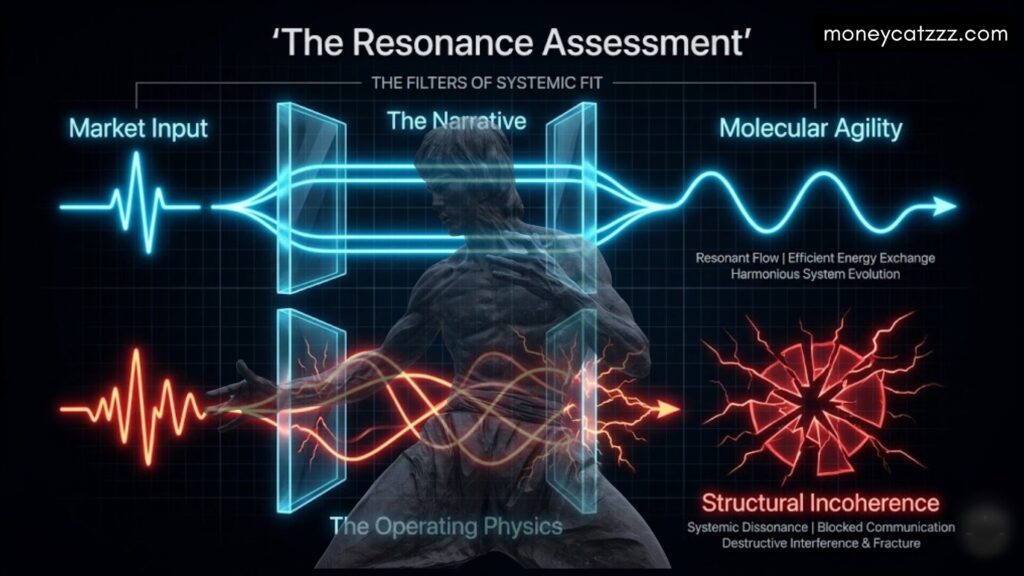
Fluidity is the natural state of a system without friction. But in the corporate world, friction is rarely a byproduct of movement; it is a byproduct of identity debt. When an organization claims one shape but operates in another, it loses its molecular agility. It becomes a “Brittle Giant”—impressive in scale, but incapable of the real-time reconfiguration required to survive a new container.
This debt functions as a structural toxin that triggers a Split-Screen Attention problem. The organization becomes so preoccupied with performing its legacy identity that it loses the capacity to process current market data.
- The Narrative: “We are agile and transparent”.
- The Operating Physics: High-friction approval chains and closed-door governance.
- The Terminal Finding: A total loss of fluidic efficiency; the system becomes too brittle to reshape itself around new containers.

The Default Protocol
To break the cycle of stagnation, you must move beyond performing resilience and conduct a resonance assessment—a cold, forensic examination of where your actual rewarded behaviors diverge from your stated values.
Jane called me for a consultation. Her company had engineered a dominant product for the enterprise market. When the market pivoted toward small businesses, she recognized the shift and announced a strategic realignment. Eight months later, the system remained locked in enterprise features, pricing, and sales protocols.
The small business segment didn’t just fail to convert; they bounced off the rigid planning. This wasn’t a vision issue. It was a failure of systemic alignment. The “Fire“ of the market shift was there, but Jane’s organization refused to enter the Fold. They were trying to cut new glass with an old, blunt edge.
“Why can’t we move?“ she asked.
I told her, “Your primary identity is still enterprise. You have not forgiven your own success. You are carrying identity debt from the old model—you are afraid to default on the very structure that once made you great.”
She went quiet. The stillness of the transition began to take hold. Then she said, “So what do I do?”
[The Resonance Diagnostic Loop |moneycatzzz.com]
The Resonance Assessment
Before you can become water, you need to know what shape you are in right now. That is the resonance assessment – a structural examination of whether your internal systems vibrate at the frequency you claim.
Here is how you run one.
Map your decision log for the past three months. Every significant choice. Next to each decision, write two things: the stated priority (what you said you valued) and the actual priority (what the decision rewarded). If the two do not match, you have found a dissonance.
Bruce Lee: The Lost Interview ‘ | Pierre Berton Show 1971 | BRUCE LEE ☯ MANIA
In a recent case study involving a logistics firm, the gap between ‘narrative’ and operating physics became a primary diagnostic finding. The organization’s stated priority was “customer satisfaction,“ yet a systemic alignment check revealed that its actual priority, as reflected in real-world decisions, was “on-time departure regardless of load.”
Information plasticity is the ability of a system to change its internal structure in response to new data. That logistics system had zero plasticity. The data (customers receiving partial shipments) was ignored because the bonus structure did not register it as relevant.
A resonance assessment reveals these blind spots. You cannot fix what you have not measured.
The Three States of Fluidity
Bruce Lee understood that water has phases. Calm flow. Crashing wave. Stillness. Each has its use.
Phase one: Flow. This is steady-state operations: the system runs smoothly because the container is appropriate, decisions happen at the right level, and information moves without friction—Fluidity here looks like competence.
Phase two: Crash. This is the pivot. The container changes abruptly. The system must summon force, not to resist, but to reshape. Fluidity here looks like controlled aggression. You do not hesitate, overthink. You become the wave.
Phase three: Stillness. This is a strategic pause. Sometimes, inaction is the best action. Water in a lake does not thrash. It waits for gravity to tell it where to go.
Most organizations overuse crash mode. They pivot constantly, exhausting their people. Or they freeze in flow mode, afraid to disrupt comfort. Fluidity requires knowing which phase serves the moment.
The Identity Debt Trap
Permit me to return to identity debt. It is the single biggest blocker to genuine fluidity. You accumulate this debt when you allow a structural incoherence to become your operating standard. It occurs the moment the internal frequency of your stated values stops matching the actual output of your rewarded behaviors.
Three mechanical failures to consider:
- The Midnight Partner: A firm that preaches balance while rewarding the midnight emailer creates friction that eventually warps the metal.
- The Gut-Driven Founder: Ignoring metrics that contradict a founder’s instinct is a refusal of structural intelligence; it is trying to forge without looking at the temperature gauge.
- The Safety Facade: Punishing the hard questioner ensures the system can never Fold. Without the fold, there is no purification—only the accumulation of slag.
The Breaking Point
This debt grows quietly, masked by a series of systemic rationalizations. When a market or internal pivot arrives, the system lacks the antifragility to reconfigure. Adapting would require a total decommissioning of the current model—a cost the “brittle giant“ cannot absorb without admitting the initial architecture was a simulation error. Consequently, rather than executing a fluid transition, the system undergoes a catastrophic failure.
I have seen this kill more transformations than bad strategy. Bad strategy fails fast. Identity debt builds slowly and expensively because the residue of its own lies weighs down the system.

The Information Plasticity Protocol
To engineer information plasticity into a rigid system, execute these three tactical moves:
- Decommission the Zombies: Every organization maintains legacy metrics that consume cognitive load without rewarding performance. Identify the three metrics driving 80% of operational behavior; if they do not align with your current vector, delete them immediately.
- Install Decision Tripwires: Implement pre-authorized triggers that bypass committee cycles. Tripwires force fluidic efficiency by making the systemic cost of inertia higher than the cost of the pivot.
- Execute Weekly Resonance Assessments: Conduct high-frequency, low-friction checks every Friday. Identify one point where stated priorities and actual decisions diverged, then implement a golden fix the following week.

[The Stillness of the Transition | moneycatzzz.com]
The Case of the Reconfigured System
Jane, previously locked in an enterprise identity, utilized this protocol to resolve her structural incoherence. Through a resonance assessment, she identified 17 points of friction where the system rewarded legacy enterprise behavior over the new-market target. By decommissioning five zombie metrics and installing three tripwires, she initiated a successful reforge.
Six months later, the system achieved antifragility. The small business segment integrated seamlessly, while the enterprise base remained stable—the new architecture supported their use cases more efficiently.
As she noted, “I thought becoming water meant losing what made us special. It did not. It meant losing what made us brittle“. That is information plasticity: not abandoning strengths, but shedding the residue that has become a weakness.
The Container Always Changes
Bruce Lee knew that the cup, the bottle, the teapot – those are not enemies. They are reality. You do not fight the container. You become the container. Then you become the next one.
Fluidity is not a philosophy. It is a discipline. It requires regular audits, honest accounting of identity debt, and the courage to let go of metrics that no longer serve you.
The container will change again next quarter. Are you still water? Or have you frozen into the shape of last year’s cup?
Run the audit. Find the dissonance. Forgive the old identity.
Be water, my friend.
The Fluidity Library: Required Reading for Adaptive Systems

Antifragile

Essentialism
Good to Great
Disclosure: This post may contain affiliate links. We only recommend products we believe in, and we may receive a commission at no cost to you! Thank you for your support!
Acknowledgment: Cover Image by moneycatzzz.com
Disclaimer: The information is provided for general information only – moneycatzzz.com makes no representations or warranties in relation to the information, including but not limited to any representation or warranty as to the fitness for any particular purpose of the information to the fullest extent permitted by law. While every effort has been made to ensure that the information provided in this article is accurate, reliable, and complete as of the time of writing, the information provided in this article should not be relied upon to make any financial, investment, real estate or legal decisions. Additionally, the information should not substitute advice from a trained professional who can take into account your personal facts and circumstances, and we accept no liability if you use the information to form decisions.