
 Reading Time: 8 mins #
 This post may contain affiliate links.
This post was last refined and updated on January 18, 2026, to reflect current best practices in Existentialism and decision-making.
In 1943, Jean-Paul Sartre sat in a Paris café, scribbling in a notebook. Outside, Nazi soldiers patrolled the streets. Inside, he wrote a line that would ignite a revolution of the soul: “Man is condemned to be free.”
No permission slips. There is no divine blueprint, just raw, terrifying freedom.
Existentialism isn’t just a philosophy; it’s a rebellion against the absurdity of existence. It’s the realization that life has no prewritten script, yet that very emptiness is where our power begins.
“Freedom is what you do with what’s been done to you” – Jean-Paul Sartre.

But here’s the twist: Existentialism isn’t about despair. It’s about defiance. It’s the refusal to be paralyzed by the void. It’s the art of carving meaning out of chaos.
Let’s joyfully wander through this labyrinth of meaning, where every dead end is an invitation to create your door and discover more about yourself.
The Sculptor’s Dilemma: Freedom vs. the Void (A Metaphor with Teeth)
Imagine a sculptor handed a block of clay and told:
“Create whatever you want. But there’s no mold, no instruction, and no ‘right’ answer. Oh, and the clay dissolves at midnight.”
Most would panic. The existentialist smiles and starts shaping.
This is the heart of existentialism: We are both the sculptor and the clay. Every choice, whether to create or destroy, is ours alone. The void isn’t a curse; it’s the blank canvas where we paint our humanity, a canvas that empowers us with the freedom of choice.
Much like the sculptor who faces limitless possibilities with no guide, we, too, are given the freedom to shape our lives as we wish. This freedom isn’t a gift; it’s a challenge that requires courage and determination. What will you create with your life’s clay? What will you leave behind?
Three Pillars of Existentialism (With Blood, Sweat, and Ink)
Now that we understand the sculptor’s dilemma, let’s explore the philosophical tenets that guide this art of self-creation.
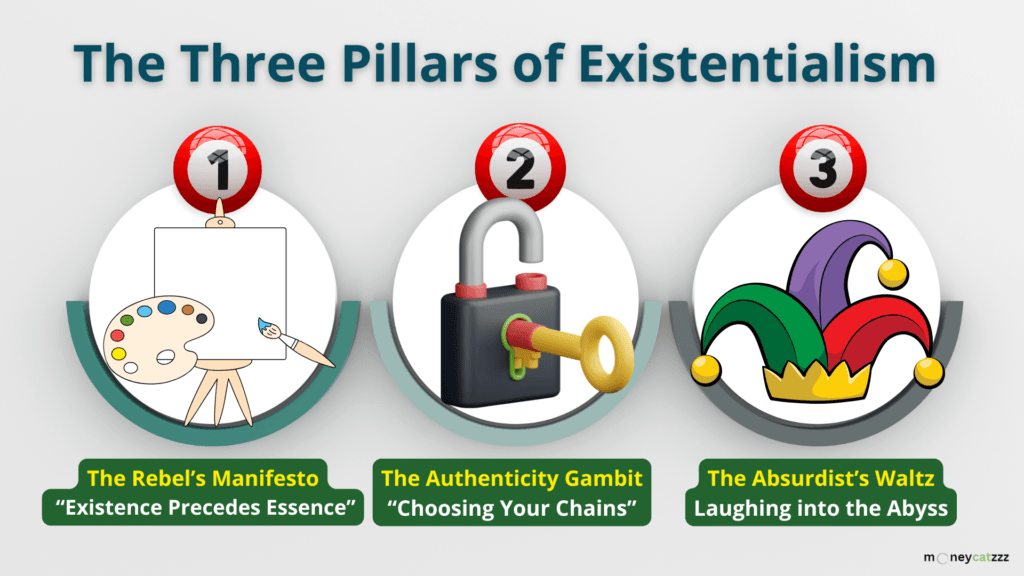
Three key pillars define existentialism: The Rebel’s Manifesto, The Authenticity Gambit, and The Absurdist’s Waltz.
These pillars represent a fundamental aspect of existential thought that guides us in our journey of self-creation.
1. The Rebel’s Manifesto: “Existence Precedes Essence”
In 1956, Albert Camus watched a play in Algiers where the actor forgot his lines, froze, then improvised wildly; the audience roared with laughter.
Camus scribbled in his notebook: “To be human is to forget your script – and dance anyway.”
What Camus meant was that you aren’t born with a purpose. You invent it. A nurse becomes a painter. A lawyer quits to farm olives. Essence isn’t destiny – it’s a verb. What you do with your freedom defines you, not the role society assigns.
Write a “manifesto” of what makes you feel alive (even if it’s absurd), as Camus’ love letter (as in The Myth of Sisyphus) to finding joy in pushing boulders uphill. Let go of the expectation that a script must live life. Burn the résumé. Find your lines.
[“The Three Pillars of Existentialism” – Image by moneycatzzz.com]
2. The Authenticity Gambit: Choosing Your Chains
In 19th-century Copenhagen, Søren Kierkegaard fell madly in love with Regine Olsen – then dumped her to write about God. Critics called him selfish. He called it “a leap of faith.”
Authenticity isn’t about being “true to yourself,” it’s about choosing which lies you’ll stop telling. The corporate ladder? The perfect Instagram life? Existentialism asks: “Whose voice is in your head when you make choices?”
Try saying “no” to anything that doesn’t align with your rawest self. Notice the chaos. Watch Fight Club (yes, really). Tyler Durden is Nietzsche with a soap bar. Authenticity demands that you confront and shatter the comfortable lies we tell ourselves.

3. The Absurdist’s Waltz: Laughing into the Abyss
A TikToker named Miriam posted a video of herself sobbing in her Tesla in 2022 with the caption: “I have everything I thought I wanted. Why do I feel empty?”
It went viral.
So what was the fuss all about? The “absurd” is the divorce between our hunger for meaning and the universe’s silence. Existentialism doesn’t solve this; it weaponizes it. The absurd is a canvas. We may never get answers, but we can choose to find meaning in the dance with the void.
People often create rituals with no clear purpose or meaning. Pour coffee into your favorite mug. Walk the same path daily. The meaning is in the making. Sartre (Nausea) deduces these as therapy, but with more cigarettes and wine. The absurd isn’t a problem to solve; it’s a space to create your meaning.
Case Studies That Bleed Truth
No doubt the theory is powerful, but the true test of these ideas lies in those who choose to live them. Let’s look at a few examples of individuals who sculpted their meaning from the clay of existence. These case studies, including those of Vincent van Gogh and Simone de Beauvoir, serve as powerful illustrations of how existentialism can be applied in real life to create meaning and defy the void.
Vincent van Gogh: The Madman Who Painted Stars
Van Gogh didn’t just paint sunflowers. He painted rage against the void. In an asylum, he wrote: “Normality is a paved road. It’s comfortable to walk, but no flowers grow.”
He sold one painting in his lifetime. Today, his work screams: “Existence is messy. So what?” The world will call your authenticity madness. Paint louder. Van Gogh didn’t wait for permission to live out his truth. His paintings are his defiance against an empty existence, embracing the messiness of the human condition.

[“Shattered Reflections: The Art of Creating Yourself” – Image from Canva.com]
Simone de Beauvoir: The Woman Who Built Her Own Table
In 1949, de Beauvoir wrote The Second Sex, and with that, a grenade was tossed into the patriarchy. Male philosophers scoffed. She shrugged and said, “One is not born a woman. One becomes one.”
Even gender is a sculpture. Chip away. Existentialism isn’t a solo act. A chorus of voices demanding: “I will not be defined.” De Beauvoir sculpted her own identity and, in doing so, redefined what it means to be a woman in a male-dominated world.
The Shadow Side: When Freedom Becomes a Cage
While existentialism opens up endless possibilities, it also carries the risk of veering into despair and nihilism, the belief that nothing matters. Some of history’s worst dictators used this void to justify horrors.
Kierkegaard’s mantra is a kind of antidote: “Life isn’t a problem to solve. It’s a reality to experience.”
Ask yourself:
- “Am I using freedom as an excuse or a responsibility?”
- “Does my ‘authenticity’ harm others?”
True freedom doesn’t just mean living without constraints – it means taking responsibility for your choices. Existentialism asks you to live with intention and awareness, not recklessness.
The Art of Embracing Your Freedom
Existentialism is not just a philosophy; it’s an invitation to take the reins of your life, to stand on the stage and create your script. The world may be chaotic, uncertain, and often cruel, but within that chaos lies an incredible freedom: the power to shape your meaning and define your essence.
You are not a passive observer. You are the sculptor. You are the artist. The clay of your life is ready for you to mold. And in this act of creation, you may find that the once intimidating void is not something to fear but to challenge. The absence of a predetermined meaning does not threaten your existence; it is the blank canvas where your authentic self can finally emerge.
Existentialism demands that you embrace uncertainty and defy the pressures to conform. It urges you to step into the unknown with courage, knowing that the freedom to create is yours alone and that every choice you make, no matter how small, can be an act of rebellion and self-creation.
So don’t wait for permission, don’t let the world’s noise drown out the voice that says, “I am the one who defines who I am.” You have the freedom to craft a uniquely yours life, a masterpiece in progress, full of flaws, beauty, and everything in between.
Now, go sculpt your existence. Embrace the absurd. Build a life that makes the universe lean in and ask:
“What will you create next?”
The clay is waiting.

Books That Taste Like Cigarettes and Red Wine (Not Lecture Halls)
If you’re ready to dive deeper into existentialism, the books here can guide you through the murky waters of meaning and freedom.
- “Thus Spoke Zarathustra” by Friedrich Nietzsche: A poetic fever dream. Nietzsche’s Übermensch isn’t a superhero – it’s you, choosing to dance on the edge of uncertainty.
- “The Stranger” by Albert Camus: A man attends his mother’s funeral and doesn’t cry. Society calls him a monster. Camus calls him free.
- “The Ethics of Ambiguity” by Simone de Beauvoir: Proof that existentialism isn’t navel-gazing – it’s a call to fight for others’ freedom too. To exist authentically is to embrace ambiguity and work toward the freedom of all.
Books That Taste Like Cigarettes and Red Wine (Not Lecture Halls)
If you’re ready to dive deeper into existentialism, the books here can guide you through the murky waters of meaning and freedom.
The Purpose Economy

Sustainable Investing ..
Somehow
Disclosure: This post may contain affiliate links. We only recommend products we believe in, and we may receive a commission at no cost to you! Thank you for your support!
Acknowledgment: Cover Image by Canva.com
Signup to our Newsletter for regular updates:
Disclaimer: The information is provided for general information only – moneycatzzz.com makes no representations or warranties in relation to the information, including but not limited to any representation or warranty as to the fitness for any particular purpose of the information to the fullest extent permitted by law. While every effort has been made to ensure that the information provided in this article is accurate, reliable, and complete as of the time of writing, the information provided in this article should not be relied upon to make any financial, investment, real estate or legal decisions. Additionally, the information should not substitute advice from a trained professional who can take into account your personal facts and circumstances, and we accept no liability if you use the information to form decisions.