
 Reading Time: 8 mins #
 This post may contain affiliate links.
I watched The Lord of the Rings again last night. There is a scene that never landed until now. The elf queen Galadriel stands before the mirror of water. She sees what she could become if she took the Ring. A dark queen. Beautiful and terrible. Then she refuses it. She says, “I passed the test. I will diminish, and go into the West, and remain Galadriel.”
However, that is not the scene that stopped me.
The scene that stopped me comes later. The sword Narsil, broken in battle, is brought to the elven smiths. They do not discard it. They do not pretend it is still whole. They take the shards, heat them, hammer them, reforge them into Andúril, the Flame of the West. The broken sword becomes the one that ends the war.
I thought about my own breaks: the business that failed when I was thirty-two, the marriage that ended when I was thirty-eight, and the morning I sat on my kitchen floor at forty-one, holding a coffee mug that had gone cold, wondering if I had any resilience left or if I had finally used it all up.
No one came to reforge me. No elven smiths. Just me, the cold floor, and the growing suspicion that I was not a broken sword waiting to be fixed. I was just broken.
That was five years ago. I was wrong about one thing. I was not broken. I was being folded.
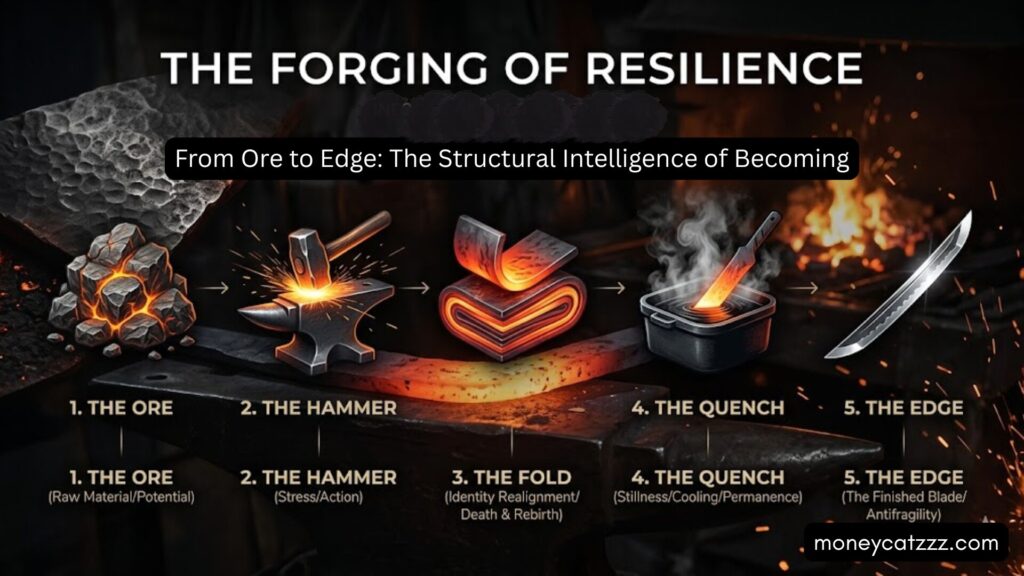
The Raw Ore
Before the fire, steel is not steel. It is ore. Rock. Full of impurities. Soft. Unformed. You cannot make a sword from ore. You have to destroy the ore to get to the metal inside.
I think about who I was before my first real adversity. Confident. Untested. Slightly arrogant. I advised friends about their problems because I had never had one that could not be solved in an afternoon. I was not strong. I was unmarked. There is a difference.
The ore does not know it is ore. It thinks it is already a sword. The fire shows the truth.

My first fire came at thirty-two. I had built a small marketing agency from nothing—five years of sixteen-hour days. Then my biggest client left. Then my second biggest. Then my business partner told me she was moving to another country. I spent six months pretending I could save it. I could not. I closed the doors on a Tuesday. I went home and slept for fourteen hours.
I told myself I had failed. That was not wrong. But it was not the whole truth. The fire had found me. The impurities were burning away. I could not see it yet.
The First Heat
Adversity is not gentle. It does not ask permission. It does not arrive at a convenient time. It throws you into a fire and expects you to survive.
The morning after I closed the agency, I did not feel strong. I felt hollow. My friend Sarah came over. She sat on my couch and said little—then she said something I have never forgotten.
“You are not starting over. You are being stripped down to what actually works.”
I hated her for saying it. I wanted sympathy, not perspective. But she was right.
Nassim Taleb says some things gain from disorder in his brilliant book, Antifragile. I agree to a certain extent, but not everything gains; some get lost in the chaos, and some stay broken. Wind extinguishes a candle but energizes a fire. The same stress that destroys one system makes another stronger. The difference is not the stress. It is the system.
I was learning that my pre-fire self had been a candle. I looked bright, but a strong breath could finish me. The fire was not killing me. It was teaching me what I was made of.
People who endure hardship together form stronger bonds than those who have never suffered. But I was not in a tribe, I was alone. Sebastian Junger’s principle held. The fire was not random. It was revealing my material limits. What I had thought was a weakness was just an untested edge.
[The Physics of Resilience: A Forging Protocol | moneycatzzz.com]
The Hammer
Forging is not one heat; it is hundreds. The smith heats the blade, then hammers. The process is repeated, again and again—each strike changes the shape, transforming the blade closer to what it will become.
I spent three years in the hammering phase. I took a corporate job I did not want because I needed funds, dated people who were wrong for me because I was lonely, and built a safety so secure that nothing could hurt me—nothing could reach me either.
The hammer was not the fire. The hammer was the daily, grinding repetition of showing up when I did not want to, making decisions when I was tired, or choosing integrity when no one was watching.
Each strike felt like a failure at the time. Now I see them differently. They were not failures. They were folds.
Japanese ‘katana‘ sword-makers fold the steel thousands of times. They do it to evenly distribute the impurities. A sword that is not folded will break at the weakest point. A sword that is folded can bend and return.
Every hard day was a fold. Every disappointment was a fold. Every moment I chose to keep going instead of giving up was another layer of steel, another distribution of my own impurities.
The Fold
Angela Duckworth’s Grit is a beautiful book. She argues that passion and persistence predict success better than talent. I agree with her, mostly. But she misses something. Grit is not enough. You also need direction.
A hammer that falls randomly will destroy the blade. A hammer that falls with intention creates edge.
I spent years being persistent in the wrong direction. I kept trying to rebuild the agency exactly as it was—that was not forging but stubbornness. Real strength through struggle requires letting go of the shape you thought you wanted so you can become the shape you actually need.
My friend Sarah once asked me, “What if you stopped trying to rebuild the old thing and started building something new?”
The question terrified me. She questions my identity. Letting it go felt like dying. But the ore had to die for the steel to emerge. The broken sword had to be melted down before it could be reforged.
I let go. I stopped applying for agency contracts. I started writing. Did some coaching. I started showing up as the person I actually was—not the person I had pretended to be for fifteen years.
The fold felt like a death and a rebirth happening all at once.
The Quench
This is where many people break.
After the hammering comes the quench; the smith plunges the blade into water or oil. The temperature drops instantly. The metal screams. If the quench is too fast, the blade cracks. If it is too slow, the blade never hardens.
The quench is recovery. It is the moment after the crisis, when the danger has passed, and you have to decide what to do with your new shape.
I nearly failed the quench. After I let go of the old identity, I did not know who I was. I felt weightless and terrified. I had spent so long pretending to be one person that becoming another felt like disappearing.
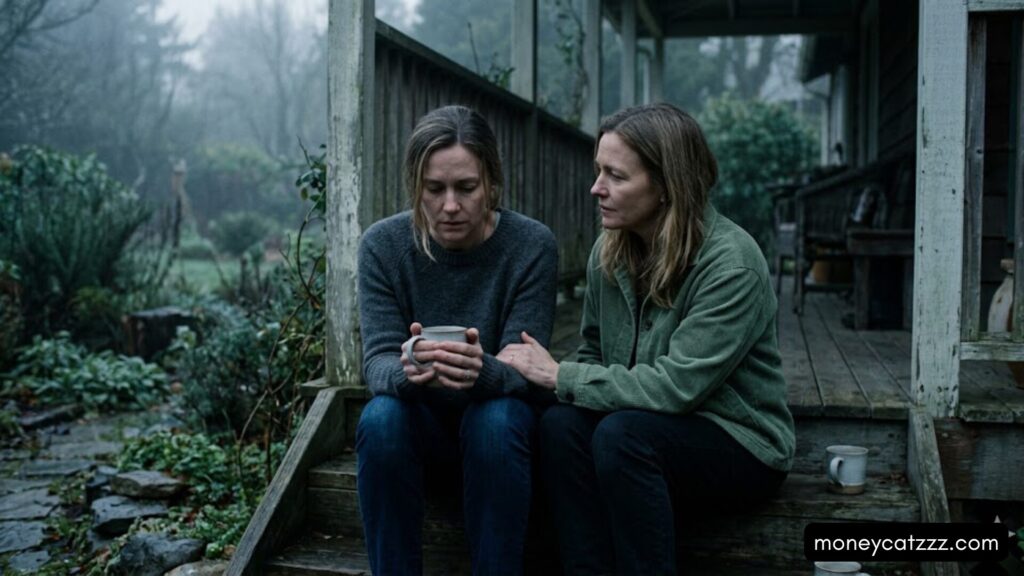
Sarah said, “You are not disappearing. You are cooling. Stay still. Let the shape hold.”
I stayed still, stopped trying to figure everything out at once. I let myself be unfinished, be uncertain, and I let the new shape harden around me.
We celebrate the fire and the hammer, but the quench requires staying still, unspoken. The quench is the part no one talks about, yet it is the silent anchor of antifragility. We forget that the cooling is where the shape finally holds.
[The Stillness of the Quench | moneycatzzz.com]
The Edge
The sword is finished. You can see the hammer marks if you look closely. The smith does not polish them away. They are proof.
I look at my own scars differently now. Failed agency. Marriage. Kitchen floor—those are no longer shameful. They are forging.
I am not unbreakable. I do not want to be. Unbreakable things are brittle. When they break, they shatter. I want to be hard but flexible. Sharp but able to bend.
The sword does not remember the fire. It remembers the edge.
What adversity taught me was not how to avoid pain. It taught me that I could survive it, that my material limits were not walls—they were maps. They showed me where I still needed to grow.
The Caution
Honestly, not everyone who goes through the fire becomes a sword. Some emerge like a phoenix; others remain broken.
The difference is not willpower—it is not magic—it is support.
I had Sarah. I had a friend who let me sleep on her couch for two weeks. I had people who held me steady during the quench. Without them, I might have cracked.
If you are in the fire right now, you need a quench partner. Someone who will not try to fix you. Someone who will sit on the couch and say, “You are not starting over. You are being stripped down to what actually works.”
If you do not have that person, find one. Therapy. A support group. A mentor. The sword is not forged alone.

The Mentor in the Forge
We all need a quench partner, someone who understands the strength that comes from struggle because they have stood in the heat themselves.
Sarah was my mentor—the one who taught me that resilience isn’t about bouncing back to your old shape, but having the courage to be hammered into a new one. She is the reason I stopped trying to be more and started learning to be a blade.
What the Blade Knows
Galadriel. She passed the test. She refused the Ring. She chose to diminish and go into the West. That is wisdom, not a failure. She knew her material limits.
Narsil. Broken. Reforged and named again. The broken sword became the one that ended the war.
All is not lost.
You are not broken. You are being folded. The fire is not punishment. The hammer is not cruel. They are the only path to the edge.
What fire are you in right now? What hammer is falling? What edge is being made?
Stay still during the quench. Let the shape hold.
The Forging Repository: Master Resources on Resilience and Structural Growth.
Tribe

Antifragile
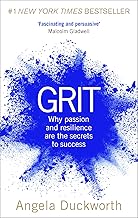
Grit
Disclosure: This post may contain affiliate links. We only recommend products we believe in, and we may receive a commission at no cost to you! Thank you for your support!
Acknowledgment: Cover Image by moneycatzzz.com
Disclaimer: The information is provided for general information only – moneycatzzz.com makes no representations or warranties in relation to the information, including but not limited to any representation or warranty as to the fitness for any particular purpose of the information to the fullest extent permitted by law. While every effort has been made to ensure that the information provided in this article is accurate, reliable, and complete as of the time of writing, the information provided in this article should not be relied upon to make any financial, investment, real estate or legal decisions. Additionally, the information should not substitute advice from a trained professional who can take into account your personal facts and circumstances, and we accept no liability if you use the information to form decisions.