
 Reading Time: 8 mins #
 This post may contain affiliate links.
The Executive's Explosion
The CEO prided himself on “radical candor” until the day his entire leadership team resigned en masse. “I was just being honest,” he told me, as if honesty was a hall pass for emotional incompetence. I’ve spent twenty years watching executives confuse cruelty with courage; hiding their communication failures behind the shield of authenticity. Here’s the truth they can’t handle: their honesty isn’t brave, it’s lazy, and their integrity trap is entirely self-constructed.
His name was Richard, though he preferred people call him “Direct Dick,” a nickname he wore like a medal of honor. He’d built a hundred-million-dollar company on what he called “truthful leadership.” What he’d actually built was a culture of fear dressed as transparency.
“I don’t sugarcoat,” he said during our first consultation, after his mass resignation. “People always know where they stand with me.”
They did. They stood in the exit line.
Understanding the Integrity Trap
The integrity trap operates on a seductive premise: if honesty is good, then more honesty must be better. If filtered communication is inauthentic, then unfiltered must be authentic. This logic appeals especially to analytical minds, executives who mistake emotional intelligence for emotional manipulation.
Richard showed me emails he’d sent to his team. Subject lines like “Your presentation was amateur” and “Disappointed again.” The body text was worse: streams of consciousness criticism, lacking structure and solutions, just raw reactions packaged as leadership.
“I’m giving them the gift of truth,” he insisted.
No. He was giving them the burden of his unprocessed emotions. There’s a word for this: self-serving honesty.
When Truth Becomes a Weapon
A Harvard Business School paper showing that leaders who claim to value “radical honesty” often have the highest turnover rates. Not because people can’t handle the truth, but because these leaders use the truth as a weapon rather than a tool.
Richard’s favorite phrase was “Let me be honest with you,” which his team learned meant “Let me hurt you without consequence.” He’d confused the integrity trap with actual integrity. Actual integrity requires discipline, processing, and consideration of impact without sacrificing truth. Richard’s version required only an open mouth and a closed mind.
The Narcissism of Unfiltered Thoughts
Here’s what defenders of brutal honesty won’t admit: self-serving honesty is narcissism disguised as virtue. It assumes that your first thought is your best thought, your immediate reaction is the truth, and your emotions are facts.
I asked Richard to try an experiment. For one week, write down every “honest” thing he wanted to say, then rewrite it an hour later with the same truth but different delivery.
His first attempt:
“This report is garbage. Did you even try?”
His rewrite:
“This report misses key metrics. Let’s review the requirements and identify where the gap happened.”
“But the second one isn’t honest,” he protested.
Both statements acknowledged the report’s failure. But only the second one could actually improve future reports. The first was emotional laziness, communication, and dumping frustration without purpose.
The First Thought Fallacy
Neuroscience research from Harvard suggests that our first thoughts are often driven by amygdala-based fear responses, rather than profound truths. The prefrontal cortex, which is responsible for reasoning and empathy, requires time to engage. When someone claims they’re “just being honest,” they’re usually just being fast.
Richard’s “honesty” was a reaction, not a reflection. His integrity trap was mistaking speed for courage, impulse for authenticity.
Self-Serving Honesty vs. Actual Integrity
The difference between self-serving honesty and actual integrity isn’t the truth being told; it’s the work being done. Actual integrity requires:
Emotional Processing: Understanding your own triggers before speaking.
Audience Awareness: Considering how truth will land without diluting it.
Outcome Orientation: Focusing on what you want to achieve, not just release.
Skill Development: Learning how to deliver brutal truths effectively.
Richard did none of this. His honesty required zero effort beyond opening his mouth.
The Effort Differential
I mapped Richard’s communication process:
- Feel something
- Say it
- Claim honesty
Compare this to skillful communication:
- Feel something
- Examine the feeling
- Identify the actual issue
- Consider the outcome needed
- Craft the message
- Deliver with precision
- Follow up for understanding
The first takes seconds. The second takes minutes or hours. Guess which one Richard called “authentic”?

[“Self-Serving Honesty vs. Actual Integrity” – Image by moneycatzzz.com]
Emotional Laziness Communication
Emotionally lazy communication is the refuge of the intellectually proud but emotionally incompetent. It’s easier to vomit your feelings than to digest them first. It’s simpler to claim honesty than to develop skill.
Richard’s former CFO told me about a budget meeting where Richard said, “Your projections are fiction. You’re either lying or incompetent.”
The truth? The projections were indeed wrong. But Richard’s delivery ensured the CFO spent the next week updating his resume instead of his models. The unfiltered honesty cost was an excellent CFO who could have been coached, but chose to leave instead.
Processing Before Speaking
The book “Nonviolent Communication” by Marshall Rosenberg outlines what Richard never learned: the discipline of separating observation from evaluation, feeling from judgment, and need from strategy.
Richard’s “honest” statement mixed all four:
- Observation: Projections were inaccurate
- Evaluation: CFO is dishonest or incompetent
- Feeling: Frustration and disappointment
- Judgment: Personal attack
A processed version:
“The projections are off by 30%. I’m concerned about the accuracy of our planning. What information or support do you need to improve the forecasting?”
Same truth. Different skill level.
The Unfiltered Honesty Cost
The unfiltered honesty cost at Richard’s company was quantifiable:
- 400% annual turnover in leadership positions
- $3 million in recruitment fees
- 18-month delay in product launch due to team instability
- Two lawsuits for a hostile work environment
But Richard saw these as badges of honor, proof that he was “too honest” for weak people.
Relationship Casualties
Beyond business metrics, Richard’s integrity trap destroyed relationships. His wife had left him because he was “cruelly honest” about her appearance, career, and parenting. His children avoided him. His only friends were people he paid.
“At least I’m authentic,” he said.
No. He was alone. There’s a difference.
Professional Seppuku
Research from the Harvard Business Review on executive communication reveals that leaders who pride themselves on “brutal honesty” tend to have careers that plateau earlier and decline more significantly. They’re seen as liabilities, not assets. Their emotional laziness in communication becomes their professional ceiling.
Richard’s board eventually forced him out. The resignation letter cited “leadership style incompatible with company culture.” Translation: his honesty had become too expensive.
Developing Skillful Communication
Skillful communication isn’t about being less honest. It’s about being more effective. It requires what Richard lacked: discipline, empathy, and the humility to recognize that your first thought isn’t sacred.
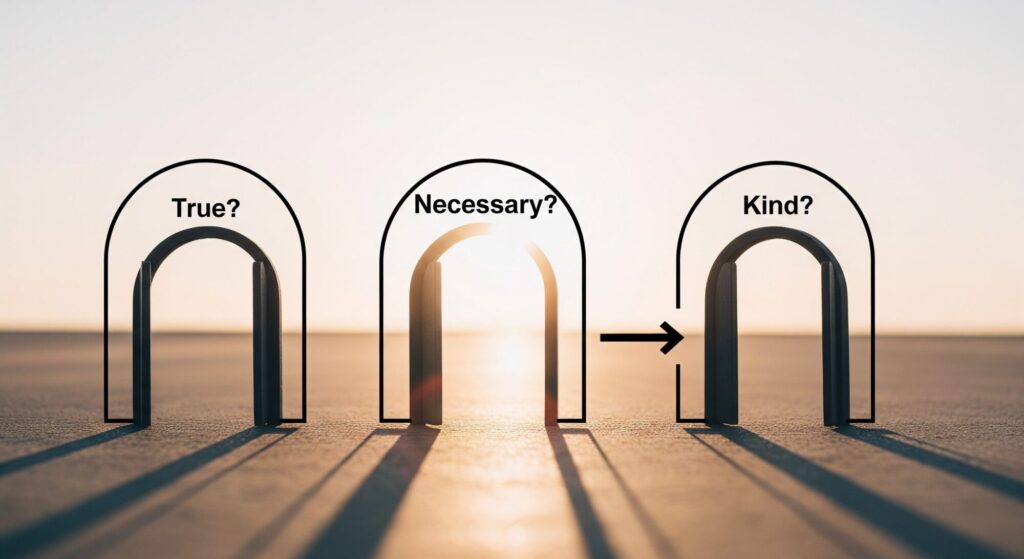
The Three-Gate Test
Ancient Sufi wisdom offers a framework Richard never learned. Before speaking, ask:
- Is it true?
- Is it necessary?
- Is it kind?
Not “nice,” but kind, meaning delivered with the intention to help, not hurt.
Richard consistently failed Gates two and three. His truths were often unnecessary, his delivery never kind. He mistook cruelty for courage, self-serving honesty for service.
Strategic Truth-Telling
The book Radical Candor by Kim Scott shows what Richard misunderstood. Radical candor requires caring personally while challenging directly. Richard challenged without caring, making his honesty radiation, not radiance.
Strategic truth-telling means:
- Choosing the timing for maximum reception
- Selecting words for clarity, not impact
- Following up to ensure understanding
- Taking responsibility for delivery, not just content
Breaking the Integrity Trap
Breaking free from the integrity trap requires admitting something Richard couldn’t: that his honesty was performance, not principle. He was acting out the role of truth-teller without doing the work of truth-crafting.
The protocol I gave him, which he initially refused:
The 24-Hour Rule: Write your honest response. Wait 24 hours. Rewrite with the same truth, better skill.
The Outcome Audit: Before speaking, ask “What do I want from this?” If the answer is simply an emotional release, that’s emotional laziness in communication.
The Mirror Test: Record yourself delivering “honest” feedback. Listen back. Would you want to receive this?
Richard tried the protocol for one month after his board removal. His first recorded feedback session was brutal to watch, seventeen minutes of unstructured criticism. His revised version, delivered the next day, was five minutes of specific, actionable feedback.
“It felt less honest,” he admitted.
It was more honest. It included the truth he’d been avoiding: that he cared about improvement, not just criticism.
[“The Three-Gate Test” – Image by moneycatzzz.com]
The Book That Changed Everything
I gave Richard a copy of The Courage to Be Disliked by Kishimi and Koga, the book’s core message: separating your tasks from others’ tasks. Richard’s task was to communicate truth. The recipient’s task was to receive it. But Richard had been making both tasks his, forcing his truth into others without consent or skill.
The book argues that real courage isn’t saying whatever you think. It’s taking responsibility for how you say it.
The Harder Truth
Six months after his company’s exit, Richard sent me an email. Subject line: “The harder truth.”
He wrote: “The integrity trap wasn’t that I was too honest. It was that I was too lazy to be skillfully honest. I hid my communication incompetence behind a virtue signal. I wasn’t brave. I was just emotionally unintelligent and proud of it.“
This was the first actually honest thing Richard had ever said to me.
The unfiltered honesty cost him his company, marriage, and relationships. But the real cost was decades of justifying cruelty as courage, laziness as authenticity.
The Distance Between Thought and Speech
Skillful communication creates space between thought and speech. Not to censor but to craft. Not to manipulate but to maximize impact. The integrity trap collapses this space, mistaking immediacy for authenticity.
Your first thought is often your worst thought, contaminated by ego, fear, and old patterns. Your second thought, processed through wisdom and empathy, is usually your truth.
The executives who survive and thrive understand this. They know that self-serving honesty serves no one, that emotional laziness in communication is just incompetence with a philosophy degree.
Richard now runs a small consulting firm, helping other executives escape the integrity trap he fell into. His new motto: “The truth doesn’t need your emotions attached.”
He’s learning what authentic integrity actually requires: the discipline to process, the skill to deliver, the humility to recognize that honesty without craft is just noise.
The space between your thought and your speech should be measured in wisdom, not seconds. That‘s not suppression. That’s skill. And skill, unlike brutal honesty, actually makes a difference.
Dig Deeper: Books on Integrity and Communications
Nonviolent Communication

The Courage to Be Disliked
by Ichiro Kishimi/Fumitake Koga
Radical Candor
Disclosure: This post may contain affiliate links. We only recommend products we believe in, and we may receive a commission at no cost to you! Thank you for your support!
Acknowledgment: Cover Image by moneycatzzz.com
Disclaimer: The information is provided for general information only – moneycatzzz.com makes no representations or warranties in relation to the information, including but not limited to any representation or warranty as to the fitness for any particular purpose of the information to the fullest extent permitted by law. While every effort has been made to ensure that the information provided in this article is accurate, reliable, and complete as of the time of writing, the information provided in this article should not be relied upon to make any financial, investment, real estate or legal decisions. Additionally, the information should not substitute advice from a trained professional who can take into account your personal facts and circumstances, and we accept no liability if you use the information to form decisions.