
 Reading Time: 8 mins #
 This post may contain affiliate links.
Are You Trapped? How to Harness the Soft Power of a Strategic Departure
There’s a rare kind of strength in leaving quietly.
In a world that worships visibility, where leadership often equates to louder, longer, and more, those who exit without fireworks seem invisible but aren’t. Their absence becomes a presence. Their silence speaks louder than their staying ever could.
This is the paradox of soft power.
Most leadership discourse revolves around strategy, innovation, and resilience. But rarely do we talk about endings. Even less about leaving well. And rarely about the quiet dignity required to step away without ceremony, ego, or collapse.
Yet in times of upheaval, graceful exits are often the most strategic moves a leader can make.
Why We Struggle to Leave
Leaders aren’t trained to leave. They’re trained to persist. Promotions are milestones. Staying power is proof of grit. The longer you endure, the stronger your legacy, or so the myth goes.
But what happens when that legacy starts to rust? What if staying becomes more about reputation maintenance than meaningful contribution?
The struggle isn’t logistical, it’s psychological. What looks like emotional withdrawal on the outside is often internal negotiation. Identity is tightly bound to output. We ask: If I leave this role, who will I be? If I walk away from this title, do I lose my value?
These aren’t trivial questions; they’re the core of leadership transition anxiety.
And yet, staying past the point of value doesn’t preserve power. It erodes it. The most respected leaders aren’t those who held on the longest. They’re the ones who knew when to let go.
The Dignity of the Quiet Exit
Soft power doesn’t need an audience. It doesn’t require applause. It works in subtleties: tone, timing, and discernment.
A graceful exit isn’t an act of surrender. It’s a conscious act of influence.
Jacinda Ardern’s resignation as Prime Minister of New Zealand is a good example.. No scandal. No sabotage. She stepped down, citing burnout, yes, but also transparency, responsibility, and love. Her departure became a masterclass in emotional intelligence and humility. She exited with clarity, not chaos. That is soft power in action.
Graceful exits reframe the narrative. Instead of reacting to a crisis, you leave as a response to alignment. You recognize when your leadership has served its season, and you make space for others to rise.

[“The Psychology of Letting Go” – Image by moneycatzzz.com on Gemini 2.5]
Emotional Withdrawal as Wisdom
We often misunderstand emotional withdrawal as apathy. In truth, it can be a sign of inner recalibration.
It’s not always burnout when leaders begin to pull back, by declining invitations, delegating more, disengaging from status games. Sometimes it’s evolution.
This internal shift is subtle but profound, it signals that the leader is starting to separate their sense of self from the structure they once animated. That detachment isn’t failure. It’s maturity.
Emotional withdrawal can also be an early warning system. A quiet way of asking, Is it time to go? And if answered honestly, it’s a gift. It prompts reflection before collapse; transition before toxicity.
In this sense, withdrawal isn’t weakness. It’s wisdom.
Leadership Transition as Legacy Work
Leaving well isn’t just about style. It’s about stewardship.
A leadership transition handled with grace ensures continuity. It protects morale. It shows emerging leaders what it looks like to move on without meltdown.
But most of all, it leaves behind a culture of dignity.
When leaders exit with care, they permit others to do the same, normalize endings, and model that strength isn’t about holding the center forever. It’s about knowing when to pass the torch.
This mindset shift is critical in a world of rapid change. Organizations evolve. Roles evolve. So must their stewards.
The best leaders design their own obsolescence. Not because they’re indispensable, but because they understand that leadership is not ownership. It’s stewardship. And stewardship always has an arc.
You may also like:

The Whisper That Roars: Discover Your Subtle Power of Change
The Strategic Value of Leaving
There are tactical reasons for graceful exits, too.
Leaders who leave well often preserve their reputations long after they’ve gone. They become trusted advisors, not tarnished relics. Their network remains intact. Their influence often increases, not diminishes.
This is how soft power works. It doesn’t assert. It invites. It lingers long after visibility fades.
There’s also an economic case. Executives who cling too long to a declining chapter often incur unspoken costs: team morale drops, innovation stalls, and future opportunities slip away, by contrast, those who exit strategically usually step into their next chapter with more clarity, more options, and more support.
The best part? You don’t need a new job lined up. The exit itself can be the move.

Redefining Power
We need to redefine what it means to be powerful.
True power isn’t about how loudly you lead. It’s about the wake you leave behind.
Leaders who understand soft power know how to influence without force. They listen more than they speak. They signal rather than demand and go when it’s time to go.
There’s no viral memo. No bridge burning. No slow, passive sabotage. Just a clear, clean, confident goodbye.
This form of departure doesn’t just serve the individual. It elevates the ecosystem. It clears space. It leaves things better.
That is leadership.
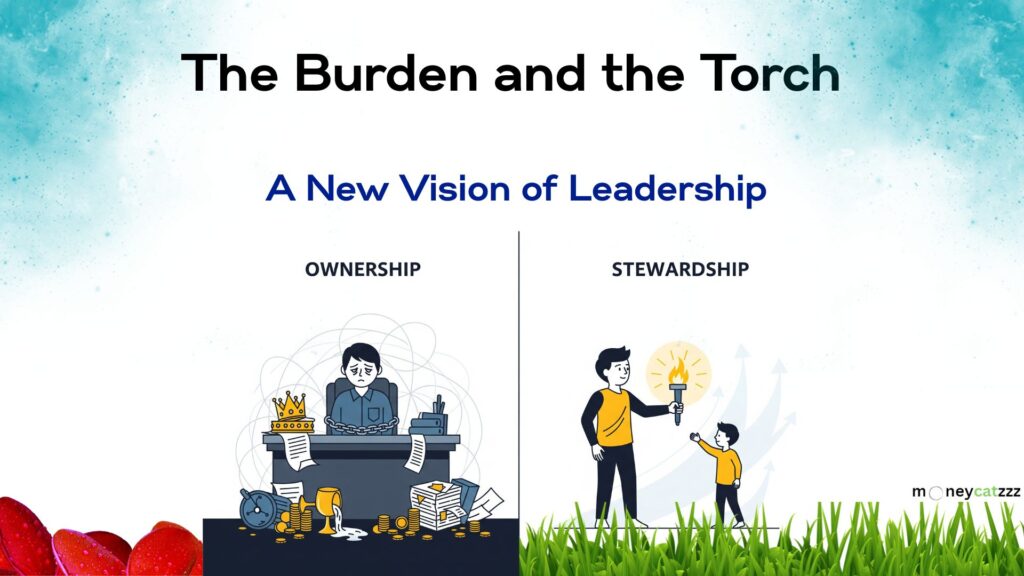
[“Are You Leading as an Owner or a Steward?” – Image by moneycatzzz.com]
Bob Iger’s First Departure from Disney
When Bob Iger stepped down as Disney CEO in 2020 (before his return), his exit was widely seen as a strategic success. He announced the transition, endorsed his successor, and shifted into a role where he could still mentor without dominating.
While his eventual return sparked debate, his original exit was a rare example of a leadership transition handled with clarity and minimal disruption. It preserved institutional stability, avoided shareholder panic, and earned him public respect.
His approach showed how a well-timed exit can amplify rather than diminish authority. That’s the calculus of graceful exits. They protect the leader’s arc and the organization’s momentum.
Tucked inside these stories are real-world tools. Thrive Global offers resources to prevent burnout and support values-based decision-making, helping leaders recognize the right time to step back. Chief.com provides a private space for executive women to reimagine their next chapter in power, purpose, and position.
As the research shows, learning to leave well isn’t an afterthought. According to Psychology Today, letting go at the right moment is part of the emotional intelligence toolkit. Harvard Business Review underscores the importance of leaving your job gracefully, not just for your legacy but for organizational continuity.
Final Thoughts: The Quiet Exit Is the Smartest Power Move
Not all exits are created equal. Some are reactive, others are strategic.
The quiet exit is rarely impulsive; it results from deep listening to the self and the system. It’s less about quitting and more about completion.
You leave because the chapter is over, not because the room told you to go. You leave not to prove anything but to protect everything that matters. Your integrity. Your energy. Your evolution.
In a culture that equates staying with strength, choosing to leave can feel countercultural, but the truth is, it takes far more courage to walk away with grace than to cling with fear.
So when the time comes, step out with clarity.
Lead with stillness.
And let the quiet speak for itself.

A Deeper Dive: Books on Leadership, Letting Go, and Legacy
For leaders seeking to master the soft power of leaving well, these four books offer profound insights into the psychology of ambition and the art of graceful exits.
1. The Gifted Adult by Mary-Elaine Jacobsen
This book helps you understand how early praise and “potential” can lead to performance pressure and chronic over-functioning. It’s a compassionate guide to reclaiming your own definition of success.
2. Laziness Does Not Exist by Devon Price
A crucial read for high achievers to challenge the myth of laziness and explains how over-performing can be a trauma response – offers a framework for breaking free from the hustle culture that fuels ambition fatigue.
3. The Mountain Is You by Brianna Wiest
This book explores the self-sabotage that keeps us from moving forward. It’s a powerful guide to confronting the fear of letting go and offers a clear path to the emotional maturity needed for a successful leadership transition.
4. Essentialism by Greg McKeown
McKeown argues for a more intentional approach to life. This book gives you the tools to identify what truly matters and to say “no” to the non-essential, a foundational skill for anyone considering a strategic exit and a more focused life.
Disclosure: This post may contain affiliate links. We only recommend products we believe in, and We may receive a commission at no cost to you! Thank you for your support!
Acknowledgement: Cover Image by moneycatzzz.com
Disclaimer: The information is provided for general information only – moneycatzzz.com makes no representations or warranties in relation to the information, including but not limited to any representation or warranty as to the fitness for any particular purpose of the information to the fullest extent permitted by law. While every effort has been made to ensure that the information provided in this article is accurate, reliable, and complete as of the time of writing, the information provided in this article should not be relied upon to make any financial, investment, real estate or legal decisions. Additionally, the information should not substitute advice from a trained professional who can take into account your personal facts and circumstances, and we accept no liability if you use the information to form decisions.