
 Reading Time: 8 mins #
 This post may contain affiliate links.
I sat in my car outside the personal development seminar I’d paid $3,000 to attend, my seventh that year. Total investment in “finding myself”: $80,000. Coaches, courses, retreats, certifications. As I reached for the door handle, the radio played that old Buffalo Springfield song, “Stop, children, what’s that sound…” and I froze. What was I actually looking for that I didn’t already have... I mean, already have?
That grammatical stumble stopped me cold. “Already are.” Not “already have” but “already are.” The broken English revealed something my proper grammar had been hiding: I’d been searching for myself as if I was lost, when maybe I was already here, already complete, already found.
I didn’t go to the seminar. Instead, I drove home and called my therapist, who’d been watching my expensive spiral for months. “I think I just realized something,” I told her. “What if I already am everything I’m paying to become?”
She laughed, not unkindly. “Bodhidharma said it best: ‘It’s not about where you want to go but where you already are.’ You just discovered what Buddhism has taught for centuries. You’ve been living in what I call the yet trap, and it’s time to understand why.”
The Yet Trap: The $80,000 Prison I Built Myself
The yet trap is insidious because it sounds like growth. “I’m not successful yet.” “I haven’t found my purpose yet.” “I’m not healed yet.” That little word transforms the present into a waiting room for a future that never arrives.
My yet trap inventory was extensive:
- Not a “real” entrepreneur yet (despite running a business for five years)
- Not financially free yet (despite earning six figures)
- Not emotionally healed yet (despite three years of therapy)
- Not spiritually awakened yet (despite meditation practice since college)
Each “yet” justified another course, another coach, another attempt to become what I apparently wasn’t. The rabbit-hole thinking went like this: If I’m not there “yet,” I must need more information, more healing, more transformation. Down the hole I went, credit card in hand.
Pema Chödrön addresses this in When Things Fall Apart, explaining how we use the future as an escape from the present. The yet trap is the ultimate escape because it makes our current self perpetually insufficient.
The Rabbit-Hole Thinking That Nearly Bankrupted Me
Rabbit-hole thinking starts with a simple question: “What’s wrong with me?” Then it spirals:
- What’s wrong becomes “What’s missing?”
- What’s missing becomes “What course will fix it?”
- What course becomes “What else do I need?”
- What else becomes “Why isn’t this working?”
- Back to “What’s wrong with me?”
I had a spreadsheet tracking my “transformation investments.” Looking at it now makes me nauseous:
- Leadership training: $12,000
- Executive coaching: $15,000
- Healing retreats: $8,000
- Online certifications: $20,000
- Mastermind groups: $25,000
Each purchase promised to fill the gap between who I was and who I should be “by now.” But here’s what rabbit-hole thinking never tells you: the hole has no bottom because you’re digging it yourself.
A Simply Psychology post on consumer psychology reveals that the anticipation of transformation can actually prevent it. We become addicted to the seeking, not the finding.
The Mental Architecture of Never Enough
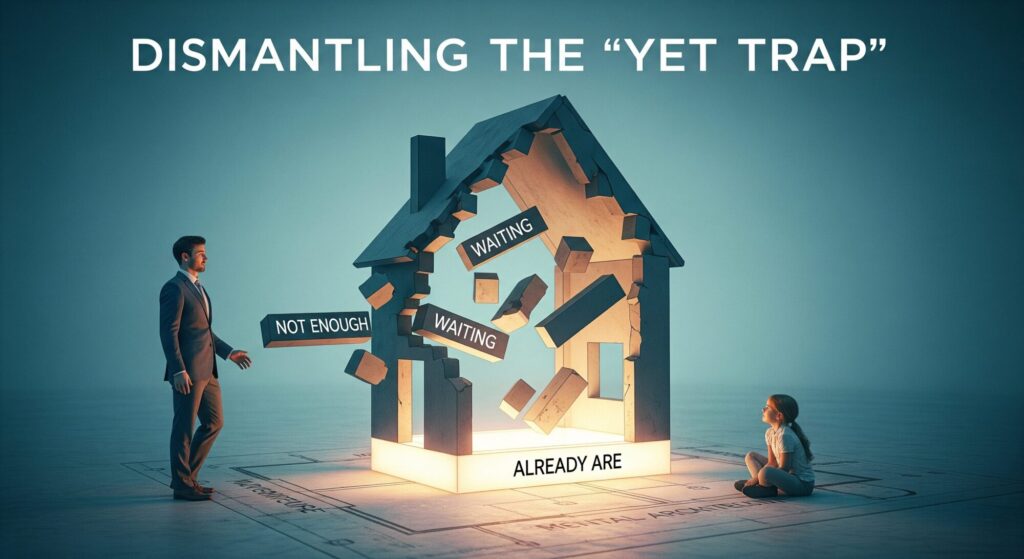
My therapist introduced me to the concept of mental architecture: the unconscious blueprints that structure our thoughts. My mental architecture was built entirely on lack:
Foundation: “I am incomplete.”
Walls: “Others have figured it out.”
Roof: “One more thing will fix me.”
Doors: “Entry requires external validation.”
This architecture meant that no matter what I achieved, I was living in a house built on “not enough.” Every success was just a temporary repair to a fundamentally flawed structure. The mental architecture of insufficiency can’t be fixed with achievement because achievement doesn’t address the blueprint.
Byron Katie’s Loving What Is helped me see that my mental architecture was built on unquestioned thoughts. The thought “I need to be more” was never thoroughly investigated, but instead accepted as truth and built upon.

[“The $80,000 Mirror” – Image by moneycatzzz.com]
The Day I Discovered I’m Just Here
Three weeks after skipping that seminar, I was journaling when I wrote: “Where am I trying to get to?” Then I looked around my home office. Sunlight through the window. Coffee cooling on my desk. Cat sleeping on the printer. I wrote: “I’m just here.“
Just here felt like a failure at first. No grand revelation, no transformational moment. Just here in my ordinary life with my ordinary problems and my ordinary joy. But then something shifted.
If I’m just here, then this must be where I’m supposed to be. Not because it’s perfect, but because it’s real. The yet trap deals in fantasies. Just here deals in facts.
Alan Watts explored this in The Wisdom of Insecurity, arguing that our suffering comes from trying to escape the present moment. Being just here isn’t giving up on growth; it’s growing from where you actually are instead of where you imagine you should be.
Already Are: The Grammar Error That Set Me Free
That morning in the car, when I said “already are” instead of “already have,” I accidentally discovered something profound. We don’t have traits, achievements, or wisdom as external possessions. We already are them.
I started experimenting with this grammatically incorrect but spiritually accurate phrase:
- “I already are successful” (I’m running a business)
- “I already are healing” (I’m in therapy)
- “I already are enough” (I’m here, aren’t I?)
The traditional “I already have” implies possession of something separate from the self. But “I already are“ collapses the distinction. You don’t have wisdom; you are wisdom accumulated. You don’t have experience; you are experience embodied.
A Linguistic post from Science Direct shows that grammatical structures shape thought patterns. My broken grammar broke my broken thinking.
The Cost of Rejecting What You Already Are
The real cost of the yet trap wasn’t the $80,000, though that hurt. The real cost was five years of rejecting my actual life in favor of an imaginary future. While I was chasing transformation, I missed:
- My business’s organic growth
- Relationships with people who accepted me as-is
- The wisdom I was accumulating through ordinary experience
- The peace available in accepting Tuesday afternoon as enough
Studies from Harvard Medical School have shown that presence-based practices outperform future-focused interventions for both mental health and performance. Being just here beats trying to get “there.”
Dismantling the Mental Architecture of Lack
Rebuilding my mental architecture required conscious deconstruction:
Old Foundation: “I am incomplete.”
New Foundation: “I already am whole, experiencing growth.”
Old Walls: “Others have figured it out.”
New Walls: “Everyone is just here in their own way.“
Old Roof: “One more thing will fix me.”
New Roof: “This moment contains everything needed.”
Old Doors: “Entry requires external validation.”
New Doors: “I already are inside my own life.”
The rebuild wasn’t instant. Old mental architecture has momentum. But each time I caught myself in the yet trap, I’d ask: “What if I already are what I’m seeking?”
[Dismantling the “Yet Trap” – Image by moneycatzzz.com]
Your Rabbit-Hole Audit
This Friday, instead of planning your next transformation, try this:
Spot the Yet Trap: List all instances where you use “yet.” Notice how each one pushes satisfaction into the future.
Practice Just Here: Set a timer for five minutes. Don’t be anything except just here: no roles, no goals, just presence.
Grammar Break Freedom: Try saying “I already are” about something you’re chasing. Feel how it changes from seeking to being.
Architecture Assessment: What’s your mental architecture built on? Lack or presence? Future or now?
The Morning After the Search
It’s been two years since I stopped searching for myself. My business grew 40% once I stopped trying to “level up” and started serving from my current position. My relationships deepened when I stopped trying to be “healed” and started being human. My creativity exploded when I stopped waiting for inspiration and started creating from just here.
The $80,000 I spent wasn’t wasted, but it wasn’t necessary. Everything I was seeking was sitting in that car with me at 6:23 AM, has been with me since birth, and will be with me until death. I am already are the person I was paying to become.
Research on self-concept from Stanford shows that recognizing existing capability outperforms building new capability for achieving goals.
The End of the Rabbit-Hole
There’s a paradox in realizing you already are complete: it’s the beginning of genuine growth. When you stop running from yourself, you can finally move forward. When you stop the rabbit-hole thinking of perpetual insufficiency, you can build on the sufficiency you already possess.
The yet trap keeps you running on a treadmill, sweating and exhausted, but never arriving. Being just here gets you off the treadmill and onto actual ground. And that ground? You already are standing on it.
Stop chasing. Start being. You are already home.
Resources to Find Yourself

The Wisdom of Insecurity

Loving What Is
When Things Fall Apart
Disclosure: This post may contain affiliate links. We only recommend products we believe in, and we may receive a commission at no cost to you! Thank you for your support!
Acknowledgment: Cover Image by moneycatzzz.com
Disclaimer: The information is provided for general information only – moneycatzzz.com makes no representations or warranties in relation to the information, including but not limited to any representation or warranty as to the fitness for any particular purpose of the information to the fullest extent permitted by law. While every effort has been made to ensure that the information provided in this article is accurate, reliable, and complete as of the time of writing, the information provided in this article should not be relied upon to make any financial, investment, real estate or legal decisions. Additionally, the information should not substitute advice from a trained professional who can take into account your personal facts and circumstances, and we accept no liability if you use the information to form decisions.