
 Reading Time: 10 mins #
 This post may contain affiliate links.
“The ship of fools sails on the sea of change.” – George R.R. Martin, author of “Game of Thrones“
Change doesn’t knock—it walks right in. Sometimes, it whispers through a career pivot or a shifting market. Other times, it crashes through the front door in the form of a layoff, a lost client, or an unexpected life detour. And while many of us instinctively reach for stability, clinging to what’s known, nothing stays the same.
But what if that wasn’t something to fear? What if impermanence—far from being a threat—was a powerful ally?
Whether you’re launching a startup, navigating leadership roles, or simply trying to stay grounded as life throws its curveballs, change is more than a disruption—it’s an invitation. It is an invitation to evolve, to rethink what success means, and to realign with what truly matters. Resisting change often feels safer, but it rarely leads to growth. The fundamental transformation happens when we stop bracing against the storm and instead learn to move with it—not just surviving the turbulence but learning to dance in the rain with presence and intention.
And that dance begins within. We need to look inward before we can respond effectively to changes in our careers, finances, or relationships. How do we react when the ground shifts beneath us? What stories are we still holding onto? Personal growth doesn’t always come from pushing harder—it often starts with letting go of the roles we’ve outgrown, the expectations that no longer serve us, and the attachments that keep us stuck. Embracing impermanence isn’t about giving up; it’s about making space—for clarity, creativity, and the kind of growth that lasts.
Letting Go: The First Step Toward Personal Growth
The roots of suffering often lie in attachment—to people, outcomes, habits, and identities. Personal transformation begins when we recognize that everything is transient—this realization is not meant to evoke fear but can empower a sense of clarity and freedom.
Typical forms of attachment:
- Holding onto past pain or failure
- Identifying with job titles or external success
- Fear of losing control over relationships or career paths
- Obsession with material possessions
Michael A. Singer’s The Untethered Soul explores this internal resistance. He argues that our peace lies beyond the limits we create. Letting go doesn’t mean indifference—it means flowing with life’s evolving nature instead of swimming against it.
Mindfulness can assist this practice. Eckhart Tolle’s The Power of Now highlights the strength of present-moment awareness. Through journaling, meditation, and stillness, we loosen the grip of the past and future and become better equipped to embrace life’s transitions.
Mindful living = noticing change without judgment and responding rather than reacting.
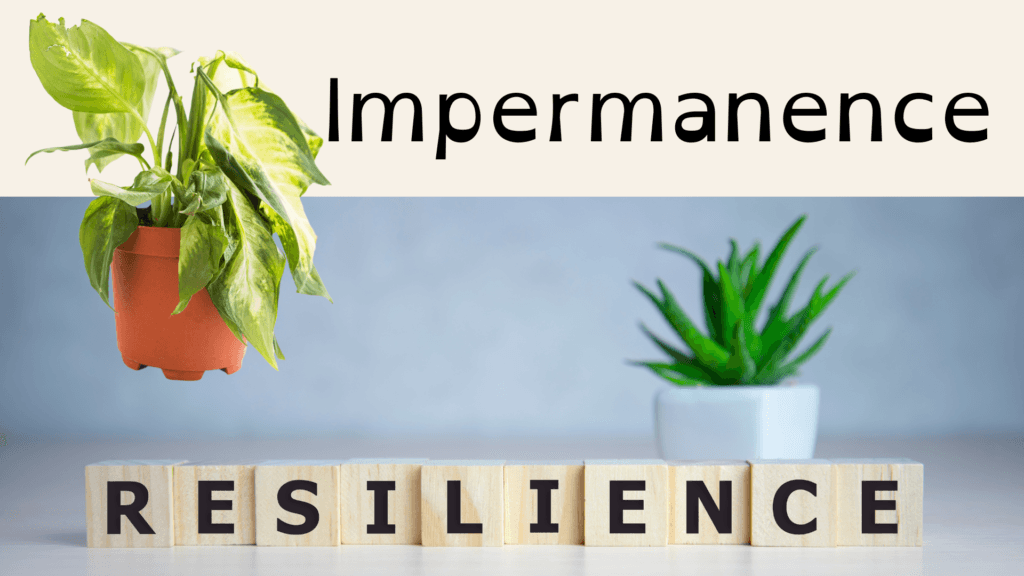
[“Impermanence & Resilience” – Image by moneycatzzz.com]
Professional Resilience: Navigating the New Normal
Impermanence is a given in today’s professional world. Job roles evolve. Industries disrupt. Entire career paths can become obsolete. But with the right mindset—change becomes an engine for reinvention.
Angela Duckworth’s Grit emphasizes perseverance in the face of challenge—success isn’t about avoiding failure but remaining engaged long enough to evolve through it.

Embracing change professionally means:
- Staying open to lateral career moves
- Viewing feedback and setbacks as learning opportunities
- Updating your skills regularly
A growth mindset is essential; as Stanford psychologist Carol Dweck explained, intelligence and talent are not fixed traits—but qualities that evolve through effort, curiosity, and resilience. When you no longer see change as disruption, you see it as direction.
For leaders and professionals, Harvard Business Review outlines that true resilience isn’t about bouncing back—it’s about bouncing forward, learning, and adapting through every setback.
Financial Mindfulness: Wealth Is Not Permanent
Money is one of the clearest illustrations of impermanence. Markets fluctuate. Incomes shift. Economic landscapes evolve. Accepting the transience of wealth is essential to building true financial resilience.
In The Psychology of Money, Morgan Housel reminds us: “Doing well with money has little to do with how smart you are and a lot to do with how you behave.”
Key takeaways for financial resilience:
- Diversify your portfolio to reduce dependency on a single-stream
- Build an emergency fund to weather unexpected life changes
- Focus on long-term planning, not short-term gain
Financial mindfulness means aligning your money habits with your values rather than just spreadsheets and budgets. It means making decisions from awareness rather than fear or ego. It’s learning to live with enough, even as you work toward more.
Forbes personal finance guides consistently stress this duality: sustainable financial growth requires strategy and emotional discipline.
Financial growth is about sustainability, not speed.
Real-World Proof: Two Case Studies of Transformation
Case Study 1: Howard Schultz and Starbucks
When Starbucks faced a downturn in 2008, Howard Schultz returned as CEO. Instead of resisting the economic dip, he recognized that change was necessary—he closed underperforming stores, revamped training programs, and leaned into digital transformation with innovations like the Starbucks app.
Schultz embraced market impermanence and reinvented Starbucks as a modern global brand. Today, the company is a case study in adaptive leadership.
Case Study 2: J.K. Rowling’s Resilient Rebirth
Before the world of Harry Potter, J.K. Rowling was a single mother facing poverty and depression. Multiple publishers rejected her manuscript. But she understood one thing: hardship is not permanent—her persistence through uncertainty turned her into one of the most successful authors in history.
In both stories, success came not despite change but because of it. Their stories prove that embracing impermanence isn’t just philosophy—it’s a competitive edge.
The Role of Continuous Learning in an Impermanent World
If you want to thrive professionally and personally, there is one non-negotiable: keep learning.
The world changes fast. The skills that made you valuable yesterday may be obsolete tomorrow—continuous learning becomes your greatest investment.
Ways to engage:
- Take online courses and certifications
- Read widely across disciplines
- Attend seminars and workshops
- Seek mentorship and coaching
Learning isn’t just about adding credentials. It’s about staying nimble, relevant, and energized by curiosity. As a lifelong learner, you can always handle what’s changing.
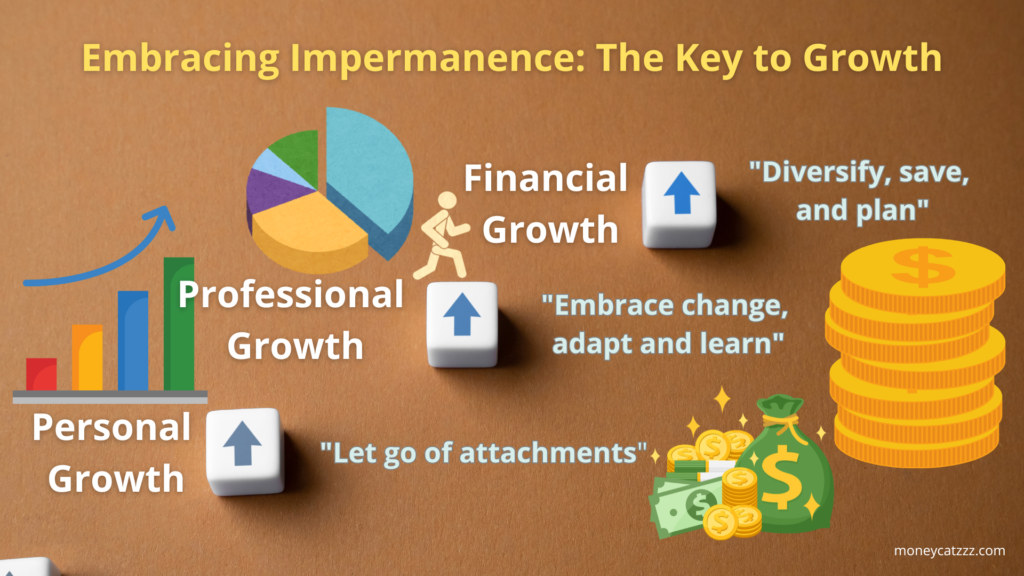
[“Embracing Impermanence: The Key to Growth” – Image by moneycatzzz.com]
Applying Impermanence: A Daily Practice
Want to start small? Integrate the principle of impermanence into your daily habits. Here’s how:
- Practice gratitude: Acknowledge what you have today—it won’t always be there.
- Stay flexible: Set goals, but detach from rigid outcomes.
- Reflect regularly: Journaling helps process emotions around change.
- Build mental resilience: Reframe challenges as opportunities.
“Growth doesn’t come from what stays the same. It comes from what forces you to evolve.“
Thriving Through Change
Impermanence is not the enemy. It’s your most excellent teacher.
When you stop resisting life’s natural ebb and flow, you gain access to the profound, steady clarity that comes from acceptance.
Change sharpens your vision. It tests your values. It invites you to let go of what’s outdated to make room for what’s next.
In your career, this might mean leaving a role that no longer fits. In your finances, it might mean simplifying and securing your future. It might mean healing, forgiving—or starting over in your personal life.
The only constant is change. But that doesn’t have to be a threat—it can be a compass.

Key Takeaways:
- Impermanence is inevitable; resistance is optional.
- Resilience grows through change, not comfort.
- Mindfulness and detachment lead to clarity and peace.
- Success today demands adaptability more than perfection.
Start small:
- Reflect for 10 minutes today on something you need to release.
- Reframe a current challenge as an opportunity to grow.
- Invest in one new learning opportunity this week.
In a world of uncertainty, the ability to flow with change is your greatest edge.
Disclosure: This post may contain affiliate links. We only recommend products we believe in, and We may receive a commission at no cost to you! Thank you for your support!
Acknowledgement: Cover Image by moneycatzzz.com on Canva
Disclaimer: The information is provided for general information only – moneycatzzz.com makes no representations or warranties in relation to the information, including but not limited to any representation or warranty as to the fitness for any particular purpose of the information to the fullest extent permitted by law. While every effort has been made to ensure that the information provided in this article is accurate, reliable, and complete as of the time of writing, the information provided in this article should not be relied upon to make any financial, investment, real estate or legal decisions. Additionally, the information should not substitute advice from a trained professional who can take into account your personal facts and circumstances, and we accept no liability if you use the information to form decisions.