 Reading Time: 8 mins #
 This post may contain affiliate links.
Mind Mapping: Unlock Your Brain's Full Potential
Imagine vibrant brainstorming sessions, crystal-clear planning, and actionable roadmaps. Yet, many still approach thinking in two dimensions. To unlock our true mental potential, we need to think differently. Enter mind mapping.
Research from ResearchGate found that mind mapping, compared to traditional note-taking, boosts information retention by 23% and significantly enhances creative thinking. Unlike rigid linear lists, mind maps reflect how our brains work—through association and visual processing, making them ideal for organizing ideas, problem-solving, and strategy development.
Whether you’re a founder, executive, or someone looking to supercharge your productivity, this in-depth guide will show how mind-mapping techniques can transform thinking and leading.
“The mind is not a vessel to be filled, but a fire to be kindled.” – Plutarch.
Plutarch’s words perfectly capture the spirit of mind mapping: not passive intake but active engagement and visual thinking.
Let’s explore how to master this powerful tool.

1. Strategic Use of Color
Color does more than brighten up your mind map—it helps your brain understand what it’s seeing. It is a visual shortcut—green might highlight your marketing ideas—blue could keep operations in check, and red—that’s your signal for potential risks. By assigning colors with intention, you’re not just organizing—you’re making your map easier to follow and recall later.
Science Insight: According to research from ScienceDaily, green stimulates creativity, while blue supports calm focus and enhances detail-oriented tasks.
2. Branching: Structure Meets Flexibility
Branching lies at the heart of mind mapping. Start with a central node—your main topic. Radiate primary branches that represent key categories. Then, secondary and tertiary branches will be built to support ideas. Use curved lines (instead of straight) to mirror organic thought patterns.
For complex systems, numbering branches or adding icons can improve clarity. This layered approach mirrors hierarchical thinking, which aligns with how we naturally structure information.
3. Visuals: Engage the Brain More Deeply
The brain can process visuals 60,000 times faster than text. Icons, images, and symbols improve memory and make abstract concepts tangible.
- Use icons (e.g., lightbulb = idea, calendar = deadline)
- Insert meaningful visuals (e.g., charts, logos, photos)
- Create consistent symbol systems for repeatable workflows
4. Multi-Layered Maps: Managing Complexity
For sophisticated projects, one map isn’t enough. Build a high-level “parent” map for overview and “child” maps for deeper detail. For instance, a startup might use a master map for its product launch and sub-maps for UX design, marketing, and investor outreach.
Digital platforms like XMind, MindMeister, and Miro enable you to create linked maps with seamless navigation—turning complex planning into a smooth visual experience.
5. Data Integration: Combine Qualitative and Quantitative Insights
To bridge strategy and metrics:
- Annotate branches with KPIs and figures (e.g., Q3 revenue projections)
- Embed charts/graphs directly into your map
- Use icons to flag priority levels or status updates
Apps like MindManager or Whimsical support these integrations, combining data visualization with the cognitive advantages of mind mapping.

[“The Science Behind Mind Mapping” – moneycatzzz.com]
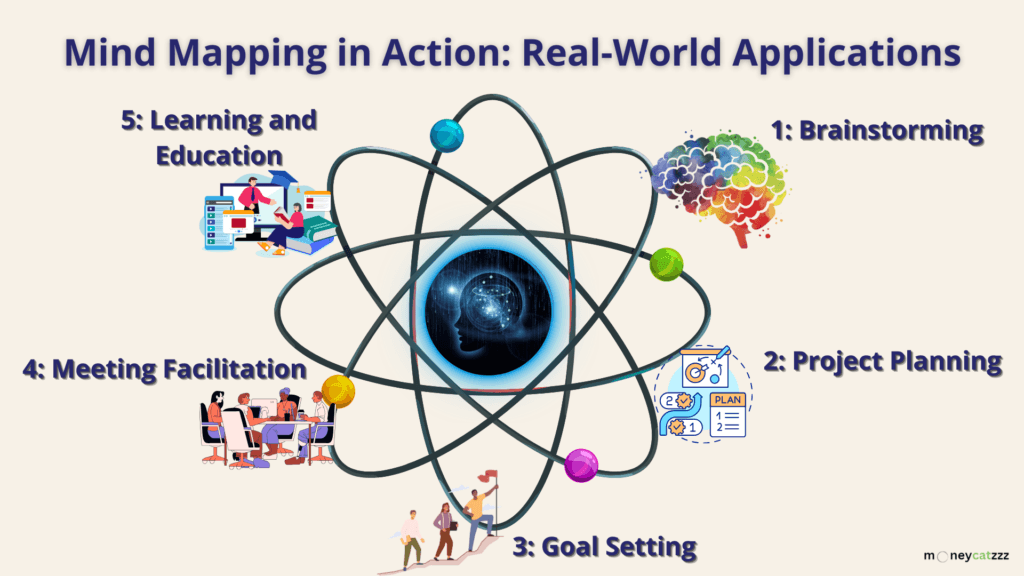
Mind Mapping in Action: Real-World Applications
1. Brainstorming: Fuel Creative Momentum
Mind maps are powerful tools for breaking through creative blocks and generating fresh ideas—instead of forcing linear thinking; they allow your mind to explore freely, visually connecting seemingly unrelated concepts.
For instance, a marketing team planning a fitness app launch might start with a central idea and branch out into influencer partnerships, in-app features, user personas—pricing strategies—creating a vivid visual landscape of possibilities.
A study published by ScienceDirect found that visual brainstorming techniques like mind mapping significantly improve idea fluency and originality compared to traditional note-taking. By externalizing thought visually, teams are better equipped to tap into divergent thinking and fuel innovation from the start.
2. Project Management: Clarify and Execute
Mind maps create a visual roadmap of your project lifecycle. With branches for milestones, resources, deadlines, and dependencies, you gain real-time clarity on priorities—and who owns what.
Research from the Project Management Institute (PMI) highlights that projects with clearly defined scopes and visual planning tools are 28% more likely to meet their original goals. Mind mapping supports this clarity by turning abstract workflows into structured, shareable visuals.
For example, a tech startup mapped its MVP development with a central node labeled “Product Launch,” branching into design, engineering, testing, and marketing—all updated in real-time and shared across teams. The result? Fewer bottlenecks, better alignment—and faster execution.
3. Goal Setting: Where Vision Becomes Action
Mind mapping turns abstract ambitions into tangible, trackable plans. When paired with the SMART framework, it transforms intention into execution. Take this example:
Goal: Increase website traffic by 20% in Q4
- Specific: Publish one blog post per week
- Measurable: Monitor traffic via Google Analytics
- Achievable: Backed by a clear content strategy
- Relevant: Aligned with lead generation goals
- Time-bound: Target set for end of Q4
Visually mapping out each component sharpens your focus, fuels follow-through, and keeps your momentum strong.
4. Productive Meetings: Structure in Real Time
Transform meetings from chaos to clarity. Build your agenda as a mind map and update it during the session. Assign tasks, capture ideas—and visually track action items in real time.
5. Learning & Training: Personalized Learning Maps
Mind mapping supports all learning styles—visual, auditory, and kinesthetic. Incorporate:
- Visuals for concepts
- Audio notes for playback
- Interactive elements (in digital tools) for engagement
Educators and coaches use this to increase learner retention and self-paced understanding.
[“Mind Mapping in Action: Real-World Applications” – moneycatzzz.com]
The Tech Stack: Mind Mapping Tools That Deliver
Here are the leading platforms to elevate your visual thinking:
- XMind: Robust desktop app with templates and style options
- MindMeister: Cloud-based with collaboration and mobile support
- Whimsical: AI-enhanced and design-focused, perfect for product teams
- Miro: Best for team-based mind mapping and integration with tools like Slack and Jira
Each offers unique features like drag-and-drop branching, cloud sync, and export options. They allow entrepreneurs and leaders to scale ideation—execution visually and collaboratively.

Learning from the Greats: The Roots of Visual Thinking
Tony Buzan, the father of modern mind mapping, emphasized the importance of radial structure, keywords, and images for unlocking creative cognition. His influence is still seen in today’s digital tools.
Books like How to Think Like Leonardo da Vinci by Michael Gelb explore historical precedents of mind mapping and offer mental exercises for connecting dots across disciplines.
Dan Roam’s The Back of the Napkin shows how simple visuals outperform complex language when solving problems and selling ideas—an essential mindset for leaders.
Visual Thinking as a Competitive Advantage
Mind mapping is more than a productivity hack—it’s a strategic asset.
For entrepreneurs and leaders navigating complexity—strategic mind mapping can deliver the following:
- Faster idea generation
- Deeper understanding
- Sharper decision-making
- Enhanced collaboration
- Long-term knowledge retention
By embracing visual thinking, you unlock the ability to connect ideas and see patterns—build clarity where others see chaos.
Ready to get started? Download a free mind map template from your tool of choice and commit to using it in your next brainstorming session, team meeting, or strategic plan. Share your progress using
#MindMappingChallenge and inspire others to join the movement.
Disclosure: This post may contain affiliate links. We only recommend products we believe in, and We may receive a commission at no cost to you! Thank you for your support!
Acknowledgement: Cover Image by moneycatzzz.com on Canva
Disclaimer: The information is provided for general information only. moneycatzzz.com makes no representations or warranties in relation to the information, including but not limited to any representation or warranty as to the fitness for any particular purpose of the information to the fullest extent permitted by law. While every effort has been made to ensure that the information provided in this article is accurate, reliable, and complete as of the time of writing, the information provided in this article should not be relied upon to make any financial, investment, real estate or legal decisions. Additionally, the information should not substitute advice from a trained professional who can take into account your personal facts and circumstances, and we accept no liability if you use the information to form decisions.