
 Reading Time: 8 mins #
 This post may contain affiliate links.
In a world that moves at lightning speed, clear and effective communication isn’t just important—it’s essential. A misunderstanding can unravel relationships, stall career momentum, and stifle personal growth. Whether in the boardroom or the living room, the ability to convey thoughts precisely can mean the difference between success and missed opportunities. A recent study revealed that 63% of employees have wasted time at work due to communication issues, highlighting the widespread impact of unclear interactions. Furthermore, research indicates that poor communication contributes to 70% of corporate errors, underscoring the critical need for clarity in professional settings.
Whether it’s a cryptic message from a friend, a vague email from your boss, or even conflicting thoughts within yourself, mixed signals can leave you frustrated, anxious, and uncertain about how to proceed. This guide serves as a beacon of clarity amidst the prevalence of mixed signals, transforming confusion into opportunities for understanding and growth. By delving into the psychology of communication, examining the repercussions of miscommunication, and implementing practical strategies for clearer interactions, you can strengthen your relationships, enhance your career prospects, and foster personal growth.
Understanding the causes of mixed signals can be both enlightening and reassuring. As George Bernard Shaw wisely observed:
“The single biggest problem in communication is the illusion that it has taken place.”
We often assume our message has been received as intended, only to realize that it was misinterpreted or, worse, completely misunderstood. This breakdown is precisely why clear and effective communication is not just a skill but a necessity in both personal and professional interactions.
Often, mixed signals arise from hidden assumptions. Others share our knowledge, perspectives, or emotions, leading us to communicate in a way that makes perfect sense but leaves others confused. Nonverbal cues—tone, facial expressions, body language—can further complicate matters, sometimes contradicting our words and sending unintended messages. Ambiguity, whether in a casual conversation or a business setting, opens the door for multiple interpretations, making active listening techniques essential in ensuring alignment.
The impact of miscommunication extends beyond minor misunderstandings. A recent study found that 86% of employees and executives cite poor communication as the root cause of workplace failures. This statistic highlights the tangible consequences of unclear messaging, reinforcing the importance of refining how we express ourselves and interpret others.
By embracing strategies to avoid mixed signals, such as mindful listening and seeking clarification, we create a space where messages are not just sent but truly understood. With a conscious effort to enhance clear and effective communication, we transform our interactions, reducing frustration and strengthening personal and professional connections.

[“Mixed Signals” – moneycatzzz.com]
The Consequences of Miscommunication
The impact of miscommunication reaches beyond simple misunderstandings, affecting personal and professional relationships. When messages lack clarity, confusion sets in, leading to frustration, missed opportunities, and weakened connections. Studies indicate that 86% of employees and executives blame workplace failures on poor communication, underscoring its critical role in success.
Some common consequences of mixed signals include:
- Strained relationships – Misinterpretations can erode trust and create unnecessary conflict.
- Missed opportunities – Unclear instructions or vague commitments may result in lost chances for growth.
- Decreased productivity – Team members struggling to understand expectations waste time and resources.
- Heightened stress and anxiety – Constant uncertainty in communication increases mental fatigue.
- Stalled personal and professional growth – A lack of clarity can prevent progress and hinder decision-making.
Consider a real-life scenario: A project manager tells their team, “Let’s revisit this next week,“ but fails to specify whether they expect updates or a complete proposal. Some team members assume they should proceed, while others await further instructions. The result? Missed deadlines, confusion, and unnecessary frustration.
To avoid mixed signals, it’s crucial to prioritize clear and effective communication in every interaction. Active listening techniques, clarifying questions, and confirming understanding can bridge communication gaps and ensure messages are received as intended.
Real-world examples of Miscommunication
Case Study 1: The Misinterpreted AI Assistant
Maria relied on a chatbot’s restaurant recommendation, only to arrive and find it closed for renovations. The chatbot’s outdated information led to wasted time and frustration—highlighting the risks of miscommunication in digital interactions and the need for clear and effective communication in AI-driven recommendations.
Case Study 2: The Misinterpreted Social Media Post
An influencer’s post featuring a controversial product sparked backlash due to an ambiguous caption. Although later clarified as a personal opinion rather than an endorsement, the damage was done—leading to negative comments and lost followers. This underscores the importance of avoiding mixed signals on social media by providing a clear context to prevent misunderstandings.

The Hidden Language of Communication: Understanding Nonverbal Cues
Effective communication goes beyond words—tone, body language, and facial expressions often convey more than what is spoken. Dr. Albert Mehrabian’s research reveals that only 7% of meaning comes from words, while 38% is derived from tone and 55% from body language. This explains why mixed signals occur even when we think we are being clear.
Our brains, wired to recognize patterns, sometimes misinterpret cues, leading to confusion. This phenomenon, known as apophenia, causes us to find meaning where none exists. A hesitant pause crossed arms, or an ambiguous facial expression can send unintended messages, influencing how others perceive our words.
By becoming more aware of nonverbal communication, we gain greater control over conveying and interpreting messages. Active listening techniques, such as observing body language and tone, help bridge gaps, ensuring messages align with intent. The key to clear and effective communication is recognizing these subtle signals and responding clearly.
Mastering Clarity: Strategies for Clearer Communication
Now that we’ve uncovered the root causes of mixed signals, it’s time to explore strategies that foster clear and effective communication. Strengthening these skills reduces misunderstandings and boosts confidence, ensuring that your message is received as intended.
The Power of Active Listening
Active listening techniques are one of the most effective ways to avoid mixed signals. This means fully engaging with the speaker—maintaining eye contact, nodding in acknowledgment, and asking clarifying questions. Focusing on both words and nonverbal cues confirms understanding and eliminates ambiguity, making conversations more meaningful and productive.
Enhancing Emotional Intelligence for Clearer Communication
Emotional intelligence (EI) is the ability to recognize, understand, and manage your emotions and those of others. Strong EI is essential for avoiding mixed signals and fostering clear and effective communication.
Daniel Goleman, in Emotional Intelligence, identifies five key components that shape our ability to connect and communicate:
- Self-awareness – Recognizing your emotions and their impact on interactions.
- Self-regulation – Managing impulses and responding thoughtfully rather than reactively.
- Motivation – Maintaining a positive mindset that drives constructive communication.
- Empathy – Understanding others’ emotions and perspectives to reduce misinterpretations.
- Social skills – Navigating conversations effectively to build strong relationships.
By developing these skills, you become more attuned to subtle cues, allowing you to interpret messages accurately and communicate with greater clarity and intent.
The STATE Method: A Framework for Difficult Conversations
Navigating difficult conversations requires structure and clarity. The STATE method, introduced in Crucial Conversations, offers a powerful approach to ensuring clear and effective communication while minimizing misunderstandings.
- Share your facts – Start with objective, verifiable information to establish a common ground.
- Tell your story – Explain your perspective while acknowledging personal biases.
- Ask for others’ paths – Invite different viewpoints to foster mutual understanding.
- Talk tentatively – Express ideas with openness rather than certainty to encourage dialogue.
- Encourage testing – Create a safe space for discussion, allowing all parties to explore solutions collaboratively.
Applying the STATE method makes conversations more productive, respectful, and solution-driven, reducing the risk of mixed signals and ensuring all voices are heard.
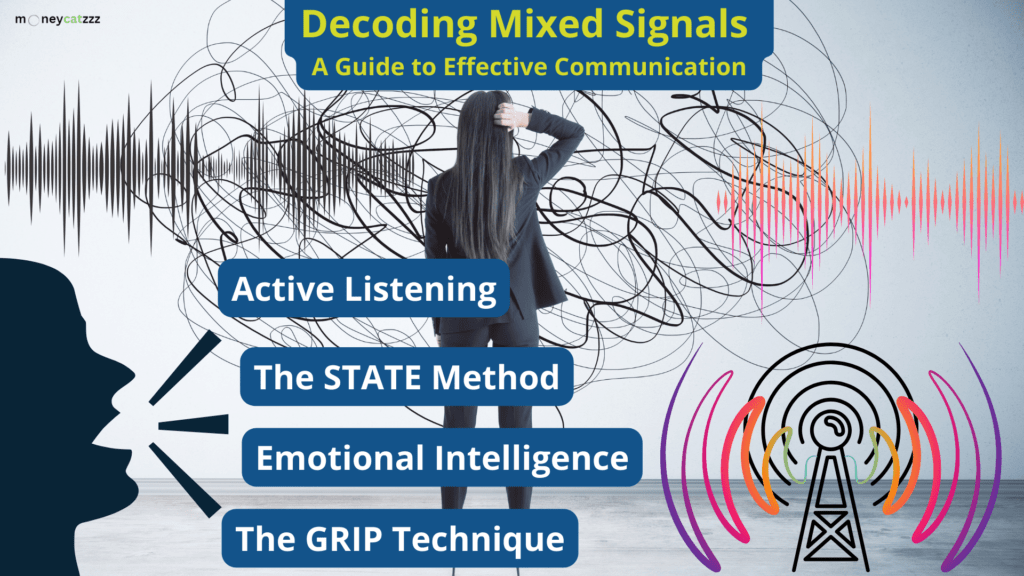
[“Guide to Effective Communication” – moneycatzzz.com]
The GRIP Technique: Structuring Conversations for Clarity
The GRIP technique provides a structured approach to navigating difficult conversations to ensure clear and effective communication. Introduced in Difficult Conversations, this method helps align expectations and prevent mixed signals by focusing on four key elements:
- Goal – Define the purpose of the conversation to ensure mutual understanding.
- Roles – Clarify each person’s responsibilities and expectations.
- Interests – Identify underlying needs and concerns to address the root issue.
- Process – Establish how the conversation will unfold and lead to resolution.
Like a safety net in a high-wire act, the GRIP technique offers a framework that fosters clarity, reduces misunderstandings, and creates a collaborative path to resolution.

Airbnb’s Breakthrough: The Power of Clear Communication
When Brian Chesky and Joe Gebbia faced financial struggles in San Francisco, they devised a creative solution—renting out air mattresses to conference attendees. What started as a necessity soon evolved into the foundation of Airbnb.
However, their early investor pitches were riddled with mixed signals. The focus on “air mattresses“ overshadowed the broader vision, leading many to dismiss the idea. Only when they refined their message—shifting the narrative from temporary sleeping arrangements to a unique travel experience—did investors begin to see the potential.
This event underscores the power of clear and effective communication. A well-articulated message can transform skepticism into opportunity, proving that clarity is key to success in both business and personal interactions.
Technology’s Double-Edged Role in Communication
Technology is pivotal in shaping how we connect in today’s digital landscape. While it offers convenience, it can also introduce mixed signals that disrupt understanding.
- How Technology Creates Miscommunication: Texts and emails strip away nonverbal cues, making tone and intent easy to misinterpret. Delayed responses in asynchronous communication can also create uncertainty and anxiety.
- How Technology Enhances Clarity: Video calls restore nonverbal communication, adding facial expressions and tone to conversations. Meanwhile, AI-powered tools are emerging to refine messaging, detect ambiguities, and facilitate clear and effective communication.
By leveraging technology mindfully, we can minimize confusion, avoid mixed signals, and foster stronger connections in both personal and professional settings.

[“Clarity” – Image on Canva/moneycatzzz.com]
The Power of Clarity: A Path to Stronger Connections
If there’s one takeaway, it’s this: clear and effective communication is the foundation of successful relationships, career advancement, and personal growth. By working to avoid mixed signals, you create opportunities for deeper understanding and stronger connections.
Essential Strategies for Avoiding Mixed Signals
- Be explicit – Don’t expect others to read between the lines. Say precisely what you mean.
- Check for understanding – Ask others to summarize key points to confirm alignment.
- Follow up in writing – A summary after verbal discussions ensures clarity.
- Stay consistent – Align your words, tone, and actions to prevent confusion.
- Practice metacommunication – Talk about how you communicate to improve interactions.
- Seek regular feedback – Stay open to suggestions that refine your communication style.
Turning Miscommunication into Growth
While mixed signals can be frustrating, they also offer powerful growth opportunities. Carol Dweck’s research on growth mindset teaches us that challenges—like misunderstandings—are stepping stones to improvement. Instead of seeing them as setbacks, we can use them to sharpen our skills and build stronger relationships.
By embracing a growth mindset, you can:
- Develop empathy – Seeing from another’s perspective minimizes misinterpretation.
- Master active listening techniques – Engaged listening ensures clarity and reduces miscommunication.
- Strengthen emotional intelligence – Recognizing and managing emotions leads to more meaningful connections.
- Seek continuous improvement – Regular feedback refines your approach and enhances your impact.
With these strategies, communication becomes a tool for transformation—unlocking deeper relationships, professional success, and personal fulfillment.
Disclosure: This post may contain affiliate links. We only recommend products we believe in, and We may receive a commission at no cost to you! Thank you for your support!
Acknowledgement: Cover Image by Unsplash.com
Disclaimer: The information is provided for general information only – moneycatzzz.com makes no representations or warranties in relation to the information, including but not limited to any representation or warranty as to the fitness for any particular purpose of the information to the fullest extent permitted by law. While every effort has been made to ensure that the information provided in this article is accurate, reliable, and complete as of the time of writing, the information provided in this article should not be relied upon to make any financial, investment, real estate or legal decisions. Additionally, the information should not substitute advice from a trained professional who can take into account your personal facts and circumstances, and we accept no liability if you use the information to form decisions.