
 This post may contain affiliate links.
 Reading Time: 8 mins #
In an age where promotions, pay raises, and side hustles fuel our income, you’d expect financial freedom to be within closer reach. Yet, nearly 49% of Americans earning over $100,000 annually still live paycheck to paycheck, according to a 2023 LendingClub report. Even more telling: for every 10% increase in income, household spending rises 7%, as the Bureau of Labor Statistics noted.
What’s behind this seemingly backward equation? Lifestyle creep: the quiet but relentless habit of upgrading your life with every increase in income.
This isn’t about reckless overspending or living lavishly beyond your means. It’s about making small, incremental decisions that subtly inflate your expenses, slowly eroding the financial gains you’ve worked hard to achieve. And it’s affecting not just average earners but also high-income professionals, executives, and entrepreneurs.
What Is Lifestyle Creep?
Lifestyle creep, also known as spending inflation, occurs when an increase in income leads to higher discretionary spending. Instead of bolstering savings, investments, or retirement funds, people opt for marginal lifestyle upgrades, such as premium coffee, an upgraded car lease, and a downtown apartment with a view.
These may seem harmless. But cumulatively, they turn raises and bonuses into vanishing acts. Promotions no longer translate into prosperity; they buy a more expensive treadmill.

Why Lifestyle Inflation Hurts More Than You Think
According to the National Endowment for Financial Education, 70% of individuals who receive raises take on new debt within six months. Financial security becomes an illusion.
Your emergency fund stagnates, your retirement gets delayed, and your net worth doesn’t reflect your salary. Worse, many begin to conflate success with the appearance of wealth, not actual financial freedom.
“Conspicuous consumption of valuable goods is an attribute of great wealth.” – Thorstein Veblen.
But in truth, it’s often the greatest wealth illusion.

[“The Hidden Cost of Daily Indulgences” – Image by moneycatzzz.com on Canva]
The Psychology Behind Lifestyle Creep
Lifestyle creep is as psychological as it is financial. Our desire for more is deeply ingrained in us.
Over 2,000 years ago, the Stoic philosopher Seneca warned, “It is not the man who has too little, but the man who craves more, that is poor.” This ancient insight underscores a modern truth: lifestyle creep stems from comparison, discontent, and dopamine-driven decision-making.
In the 19th century, Thorstein Veblen‘s theory of conspicuous consumption described spending as a means of signaling social status. That urge hasn’t just survived, it’s been weaponized by algorithms. Social media platforms like Instagram amplify lifestyle envy. A 2022 study by the University of Pennsylvania linked Instagram use to increased spending on luxury goods.
The Hedonic Treadmill: Why You Never Feel “Richer”
Even as income grows, your expectations shift upward. This is the hedonic treadmill: your psychological baseline for happiness adjusts with each new comfort, making contentment an elusive goal.
A 2010 Princeton study showed that emotional well-being plateaus between $75,000 and $110,000 (adjusted for inflation). Beyond that, additional income doesn’t significantly boost happiness, but it does fund lifestyle upgrades that can trigger stress and discontent.
Real-Life Case Study: The Lawyer vs. The Engineer
John, a 38-year-old attorney earning $200,000 annually, upgraded his home, leased a luxury car, and enrolled his kids in private school. Yet he feels broke. “My success traps me,” he admits.
In contrast, Maria, a software engineer earning $150,000, opted for a modest apartment, cooked at home, and saved 40% of her income. She retired early at 42 to start a nonprofit.
Their divergent outcomes underscore this truth: income is not a measure of wealth. Discipline is.
How Lifestyle Creep Creeps In: Death by a Thousand Upgrades
- Subscription Overload: Americans spend an average of $273/month on unused subscriptions (West Monroe, 2023). From streaming to fitness apps, these recurring expenses go unnoticed but accumulate.
- Invisible Grocery Inflation: Choosing organic over generic or imported cheese instead of local may feel like a small win—over time, these choices bloat your food budget.
- Convenience Spending: Uber instead of the train. Daily coffee runs. Premium grocery delivery. These time-savers add up.
A 2021 Bankrate study revealed that 64% of millennials regret lifestyle upgrades post-raise, citing delayed milestones like homeownership and retirement.
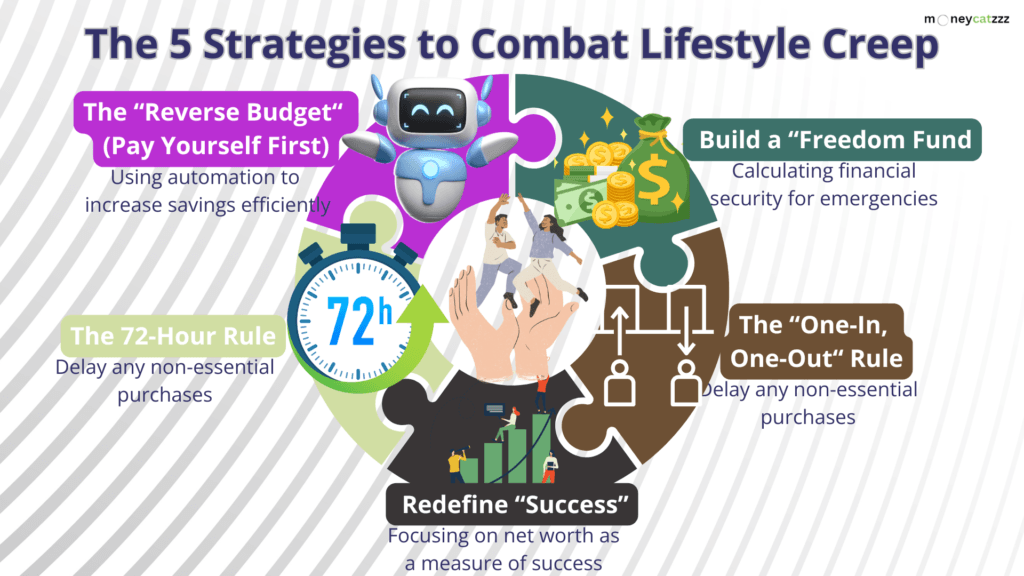
5 Strategies to Outsmart Lifestyle Creep
1. Automate First: The Reverse Budget
Pay yourself before lifestyle gets a say. Automate 10% of your income into savings and investments, and increase that by 1% each month. Tools like Rocket Money or YNAB can help cancel waste and track growth.
“You don’t need a budget. You need a system.” — David Bach, The Automatic Millionaire.
2. The 72-Hour Rule
Before spending over $100, wait three days. Research shows that impulse purchases lose their appeal after 72 hours. This technique can reduce impulse spending by up to 30%.
[“5 Ways to Fight Back” – Image by moneycatzzz.com on Canva]
3. Redefine Wealth and Success
In The Psychology of Money, Morgan Housel reminds us: “Wealth is what you don’t see.” It’s not in luxury handbags or upgraded tech; it’s in unspent potential. Focus on net worth, not income.
4. One-In, One-Out Rule
Every time you add an expense, eliminate another. New gym membership? Cancel a streaming service. It trains mindful trade-offs.
5. Build Your Freedom Fund
Calculate your “FU Number”— how much you need to cover 6–12 months of living expenses. This financial cushion reduces fear-based decisions and creates leverage.
The FIRE Movement: A Blueprint for Resistance
The Financial Independence, Retire Early (FIRE) movement rejects lifestyle creep in favor of freedom. Members save 50–70% of their income, live below their means, and often retire in their 30s or 40s.
Even billionaires get it right. Warren Buffett still lives in the same modest Omaha house he bought in 1958. With a net worth exceeding $120 billion, Buffett proves that discipline, not dollars, defines wealth.

Buy Back Your Life
Lifestyle creep is a choice. And every choice you make either buys you stuff or freedom.
As Vicki Robin wrote in Your Money or Your Life: “The price of anything is the amount of life you exchange for it.“
Trade today’s temptations for tomorrow’s liberty instead of trading your future for fleeting upgrades.
Your Action Plan
Today: Cancel one unused subscription.
This Week: Automate a 10% savings transfer.
This Month: Calculate your “FU Number“ and share it with a trusted accountability partner.
How do you fight lifestyle creep? Share your strategies in the comments, and let’s build a smarter, more financially free community.
Tools and Resources To Win The Rat Race
The Psychology of Money

Your Money or Your Life
The Automatic Millionaire
Disclosure: This post may contain affiliate links. We only recommend products we believe in, and we may receive a commission at no cost to you! Thank you for your support!
Acknowledgement: Cover Image by Unsplash.com
Disclaimer: The information is provided for general information only – moneycatzzz.com makes no representations or warranties in relation to the information, including but not limited to any representation or warranty as to the fitness for any particular purpose of the information to the fullest extent permitted by law. While every effort has been made to ensure that the information provided in this article is accurate, reliable, and complete as of the time of writing, the information provided in this article should not be relied upon to make any financial, investment, real estate or legal decisions. Additionally, the information should not substitute advice from a trained professional who can take into account your personal facts and circumstances, and we accept no liability if you use the information to form decisions.