
 Reading Time: 8 mins #
 This post may contain affiliate links.
“Change is hard at first, messy in the middle, and gorgeous at the end.” – Robin Sharma.
Imagine building your dream business for years: late nights, calculated risks, all-in sacrifices. Then, one day, it crumbles, not with a bang but with a slow, humiliating unraveling. Clients vanish. Revenue dries up. The thing that once gave your life meaning now feels like a ghost. What you’re experiencing isn’t just failure. It’s grief.
Most people associate “grief” with the loss of a loved one. But in the world of high achievers, professionals, and entrepreneurs, grief shows up in less obvious, but equally gutting ways: the death of a dream, the collapse of a business, the loss of identity after a career change, or the erosion of financial security.
The famous Five Stages of Grief, developed by psychiatrist Elisabeth Kübler-Ross, weren’t initially intended for these scenarios, but they offer a surprisingly profound roadmap for navigating any major life upheaval. When viewed through the lens of personal reinvention and financial resilience, these stages become more than a psychological theory. They become survival tools.
Let’s explore how this classic model can guide your next transformation.
1. Denial: “This Can’t Be Happening”
Typical mindset: “The numbers will bounce back next quarter.” “This role is just a rough patch.”
Reality: You’re stalling the inevitable.
In business and life, denial often masks itself as optimism. We rationalize warning signs and avoid the hard pivot. Denial isn’t laziness; it’s a coping mechanism. But staying there too long is costly.
Real-world example: In the early 2000s, Blockbuster refused to believe streaming was a real threat. Netflix offered to partner; they laughed. Blockbuster filed for bankruptcy in 2010. Denial isn’t just personal; it can bankrupt empires.
Actionable tip: Journaling or talking with a coach/therapist helps you name what’s being lost. Clarity breaks the spell of false hope.

2. Anger: “Why Me?”
Typical mindset: “I gave everything to this. This isn’t fair.”
Reality: Rage is grief’s armor; it deflects vulnerability.
Anger often kicks in when denial fades. It can manifest as bitterness toward clients, frustration with the system, or resentment of peers who “got lucky.“ But anger has energy. Channeled constructively, it becomes momentum.
Entrepreneurial insight: Many mission-driven founders start businesses after frustration with the status quo. The anger stage, when mined with intention, can spark vision.
Actionable tip: Redirect anger into action. Try a “rage list,” write down everything that went wrong, then highlight what’s in your control. That becomes your next step.
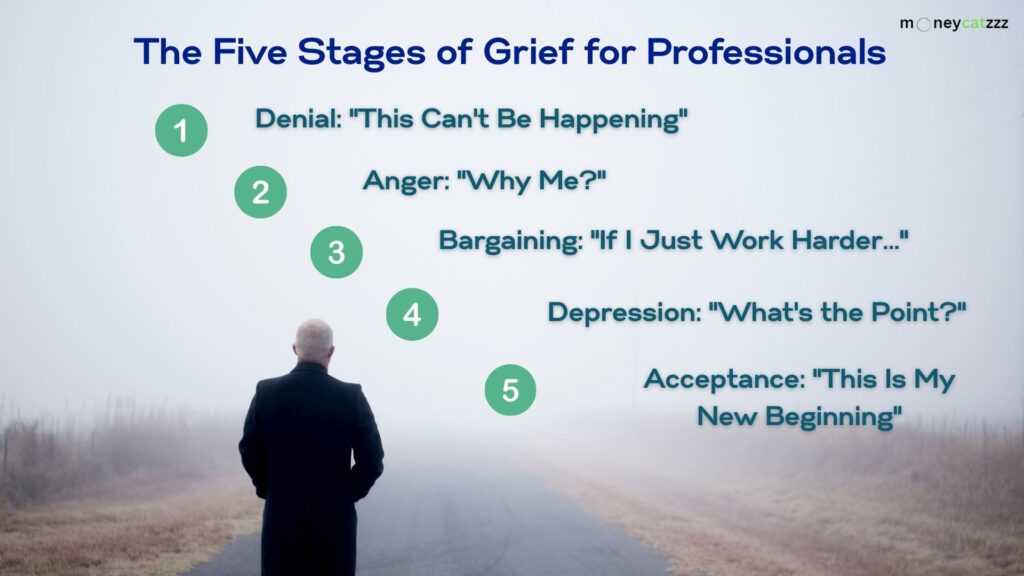
[“The Five Stages of Grief for Professionals: A Framework for Growth” – Image by moneycatzzz.com]
3. Bargaining: “If I Just Work Harder…”
Typical mindset: “Maybe if I launch a new product, things will fix themselves.”
Reality: You’re negotiating with a past that’s already gone.
Bargaining is seductive. It looks productive: new launches, late nights, LinkedIn updates, but it’s often a stall tactic. You’re not moving on; you’re clinging.
Financial context: After an income loss, people often overcompensate with risky investments or side hustles fueled by panic, not strategy. This phase can lead to burnout or deeper financial strain if unchecked.
Tool for moving forward: Get brutally honest about what’s no longer working. Use financial clarity tools like YNAB (You Need A Budget) or Ramsey’s Baby Steps to ground bargaining into practical recalibration.
You Might Also Like:

Expect the Unexpected: Taking out the Umbrellas on a Sunny Day
4. Depression: “What’s the Point?”
Typical mindset: “I’ve failed. Maybe I was never cut out for this.“
Reality: This is the valley before the climb.
This stage feels like freefall. Identity loss hits hard. Doubt creeps in. The temptation is to isolate, but this is when connection matters most.
Psychological insight: Dr. Brené Brown notes that depression often arises when “what we expected“ diverges drastically from “what happened.“ This stage isn’t failure, it’s emotional reckoning.
Tool for moving forward: Permit yourself to grieve the loss; not just the outcome, but the identity tied to it — practices like mindfulness, therapy, or simply talking with peers who’ve been through it can offer a lifeline.
The Power of Connection: Navigating Grief with a Strong Tribe
Isolation deepens grief. Resilience is amplified in the community. Peer masterminds, mentorship groups, and curated support circles provide the emotional scaffolding needed during reinvention.
Professional Insight: According to Harvard Business Review, high-performing professionals with strong support systems are significantly more likely to rebound quickly after failure. Surround yourself with people who remind you of your potential, not just your pain.
5. Acceptance: “This Is My New Beginning”
Typical mindset: “It’s time to rebuild smarter, not harder.”
Reality: Acceptance isn’t giving up. It’s taking back your power.
This is the breakthrough. You stop trying to get the old version of life back. Instead, you start building something more aligned. Acceptance is not apathy; it’s radical clarity.
Case Study: Barbara Corcoran (Shark Tank)
After being told she wasn’t smart enough to succeed in real estate, Corcoran turned heartbreak into horsepower. When her business partner left her, she didn’t collapse, she pivoted. Today, her net worth is estimated at over $100 million. Acceptance is where reinvention is born.
Tool for moving forward: Use reflection tools like the Self-Authoring Suite by Dr. Jordan Peterson to map your values and vision post-crisis. From here, resilience becomes strategy.

[“Denial: “This Can’t Be Happening” – Image by moneycatzzz.com]
Cultivating Resilience: Building Your Pre-Grief Armor
You don’t have to wait for collapse to strengthen your core. Anticipating and preparing for volatility is a hallmark of strategic leadership.
Proactive Practices:
- Build multiple income streams.
- Keep your professional network diverse and active.
- Develop psychological flexibility with tools like meditation or cognitive reframing.
- Create contingency plans for high-risk ventures.
Resilience isn’t just recovery — it’s readiness.
Practical Strategies for Moving Through the Stages
| Stage | Strategy | Resource |
|---|---|---|
| Denial | Journal the hard truths | “The Artist’s Way” by Julia Cameron |
| Anger | Channel into action | “The War of Art” by Steven Pressfield |
| Bargaining | Rebuild structure | YNAB, or financial planners |
| Depression | Build emotional support | “Lost Connections” by Johann Hari |
| Acceptance | Redefine your story | Self-Authoring Suite, Vision Boards |

Beyond Acceptance: Sustaining Your New Chapter and Redefining Success
Breakthrough doesn’t mean you’re done. The post-grief phase is fertile ground, but it requires tending.
Sustain Your Growth By:
- Setting iterative goals.
- Engaging in continuous learning.
- Celebrating small wins.
- Redefining success on your terms, not by metrics alone, but by meaning.
Evolution isn’t linear — it spirals upward with each turn.
Final Reflection: Grief as the Gateway to Growth
You don’t need to wait for a funeral to experience grief. Grief is the quiet undercurrent in high-stakes lives: entrepreneurship, reinvention, and major career shifts.
But here’s the good news: You’re not broken. You’re evolving.
Grief is not the end of the road. It’s a necessary passage. And on the other side lies something more substantial: clarity, courage, and the foundation for something even better.
Because what’s buried in grief… can become the seed of your next chapter.
Disclosure: This post may contain affiliate links. We only recommend products we believe in, and We may receive a commission at no cost to you! Thank you for your support!
Acknowledgement: Photo by moneycatzzz.com
Disclaimer: The information is provided for general information only – moneycatzzz.com makes no representations or warranties in relation to the information, including but not limited to any representation or warranty as to the fitness for any particular purpose of the information to the fullest extent permitted by law. While every effort has been made to ensure that the information provided in this article is accurate, reliable, and complete as of the time of writing, the information provided in this article should not be relied upon to make any financial, investment, real estate or legal decisions. Additionally, the information should not substitute advice from a trained professional who can take into account your personal facts and circumstances, and we accept no liability if you use the information to form decisions.