 Reading Time: 8 mins #
 This post may contain affiliate links.
Have you ever opened your closet and felt a wave of shame or stress—not because of what’s missing, but because of everything stuffed inside? Clothes that no longer fit. Gifts you didn’t ask for. Forgotten purchases with tags still on. That quiet chaos becomes the background noise of your day. You close the door and try to ignore it, but something lingers. It’s not just clutter—it’s weight.
We’ve mastered the art of accumulation in a world that equates more with better. But in doing so, many of us have lost touch with what truly matters. We don’t just own our stuff—our stuff starts to own us. We need to redress this problem, and the KonMari Method is a fitting solution, not as a trendy fix but as a philosophy for living with clarity, intention, and joy.
“Less is more.” – Robert Browning.
Let’s explore what this method truly offers—and why its impact reaches far beyond neatly folded shirts or organized drawers.
From Overwhelm to Intention: Why Clutter Matters More Than We Think
The average American home contains over 300,000 items. Let that number settle. That’s not just excess—it’s a daily drain on your attention, energy, and peace of mind.
Research from UCLA’s Center on Everyday Lives of Families found a direct correlation between high levels of clutter and increased cortisol—the body’s primary stress hormone. For many, especially women, clutter creates not just visual mess but emotional weight.
Clutter chips away at your focus hijack your time, and can even damage relationships. You’re not lazy or disorganized—living in a system that hasn’t taught you how to reset. That’s what Marie Kondo’s method addresses: the emotional root, not just the external symptoms.

[“Marie Kondo” – Konmari Media]
What Is the KonMari Method?
At its surface, the KonMari Method is a system for tidying up. But beneath that surface, a mindset is a conscious return to what sparks joy.
Popularized by Marie Kondo’s bestselling book The Life-Changing Magic of Tidying Up, the method revolves around six core principles:
- Commit to Tidying Up – This isn’t something you “try.” It requires intention and follow-through.
- Imagine Your Ideal Lifestyle – What do you want your space (and, by extension, your life) to feel like?
- Discard First – Before organizing, release what no longer serves you.
- Tidy by Category, Not Location – Work through categories (clothes, books, papers, etc.) one at a time.
- Follow the Correct Order – Begin with easier items like clothes and progress to sentimental ones.
- Ask: Does It Spark Joy? – This is your compass. Not logic. Not guilt. No obligation.
When you hold something in your hands and ask that question, you’re not evaluating its utility—you’re tuning into your emotional truth. That’s what makes it radical.
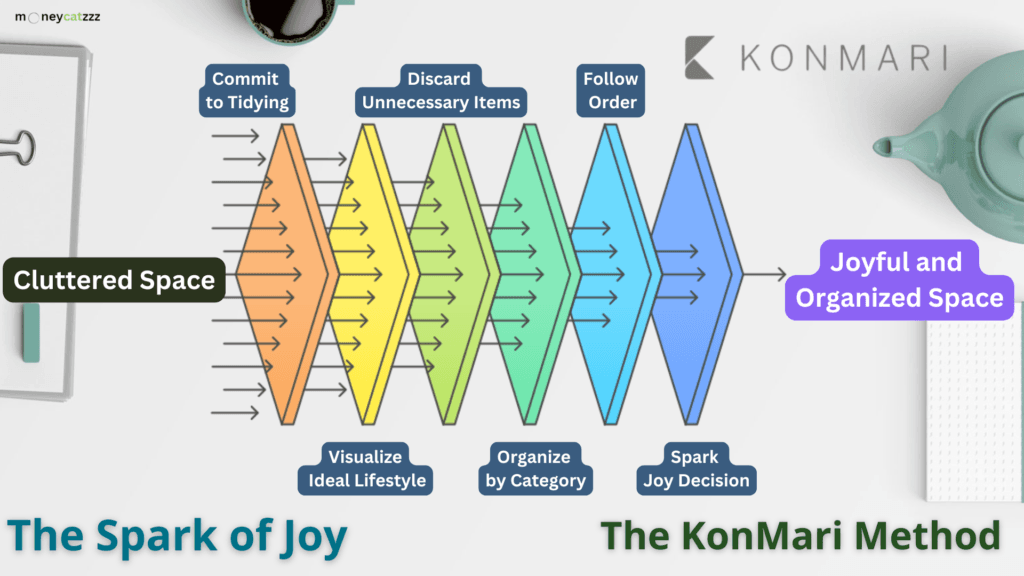
[“The Six Steps of The KonMari Method” – moneycatzzz.com]
More Than Clean Counters: The Psychology of Letting Go
The reason this method works isn’t because it’s trendy—it’s because it taps into some of the most fundamental psychological needs: autonomy, emotional clarity, and a sense of control in an unpredictable world.
- Emotional Processing: Letting go of items is rarely just about space. It’s about saying goodbye to old identities, unfinished versions of ourselves, or expectations we never signed up for.
- Decision Fatigue: We make thousands of micro-decisions daily. The KonMari sequence reduces cognitive overload by giving you a focused, step-by-step order.
- Gratitude as Closure: We practice mindfulness and emotional closure by thanking items before releasing them. It’s not about guilt—it’s about grace.

Real-Life Impact: Cassie’s Story
Cassie is a 35-year-old teacher and mother of two from Portland. Her days were packed: lesson plans, school runs, endless laundry. But the actual stressor wasn’t her schedule—it was her home. Every surface was a catch-all. Every room is a battle between intention and accumulation.
After watching Tidying Up with Marie Kondo on Netflix, Cassie started small—her closet. It took a whole weekend. She held every piece of clothing, asking herself honestly: “Do I feel joy when I wear this?” By Sunday night, she’d removed 60% of her wardrobe.
“I didn’t realize how much emotional baggage was hidden in my clothes,” she said. “Old jobs. Pre-kids. Versions of myself I was still clinging to.”
That ripple of clarity spread. She moved on to her children’s toys, kitchen tools, and sentimental items. By the end, she’d donated 15 bags to local charities and felt—more than organized—free.
Why It’s Not Just About the Stuff
Cassie’s story isn’t unique. And the transformation she experienced wasn’t really about minimalism. It was about alignment. Because when your environment reflects who you are today—not who you were or who someone else expected you to be—you move differently through the world.
This is what makes KonMari so powerful. It’s not about rules. It’s about resonance.
The results speak for themselves:
- Focus and Productivity: A Princeton University study showed that clutter competes for your attention, reducing performance and increasing cognitive overload.
- Emotional Relief: Decluttering has been linked to lower levels of anxiety and improved mood.
- Financial Awareness: When you understand what you truly value, impulse shopping and spending drop.
- Sustainability: KonMari promotes mindful consumption. Fewer, better things mean less waste and more intentional living.

“Marie Kondo – Tidy Mind, Tidy Life”- Image by D.K Waye
A Greener Approach to Letting Go
One critique of mass-decluttering trends is the waste they can generate. But KonMari is deeply aligned with sustainability—if you approach it consciously:
- Donate gently used items to local shelters, charities, or Buy Nothing groups.
- Sell valuable pieces online or via consignment.
- Recycle electronics, textiles, and paper properly.
- Reflect before you buy again. Ask: Will this bring lasting joy or temporary satisfaction?
Decluttering isn’t an excuse to purge thoughtlessly—it’s an invitation to participate in a healthier, more sustainable consumption cycle.
KonMari Beyond the Closet: Life Applications
What’s beautiful about this method is that its philosophy applies far beyond physical spaces. Once you learn how to filter for joy, you can apply the same lens to:
- Digital Life: Unsubscribe from emails that clutter your inbox. Organize your desktop. Delete apps you never use.
- Relationships: Who in your life sparks joy? Who drains you? Boundaries are a form of tidying.
- Work Commitments: Evaluate projects not just by ROI but by meaning. Does this work align with who you’re becoming?
Getting Started: A Practical KonMari Kickstart
If you’re ready to start, keep it simple. No pressure. No perfection. Just curiosity and commitment.
- Schedule a Joy Session: Block off a few hours with no distractions.
- Set the Mood: Light a candle. Play music. Make it intentional.
- Start with Clothes: The simplest category to build momentum.
- Create a Vision Board: Visual cues help remind you what you’re working toward.
- Honor Progress: Every item you release creates space for something better.
And if you hit resistance? That’s normal. Letting go is an emotional act. Feel it. Breathe through it. Move forward.
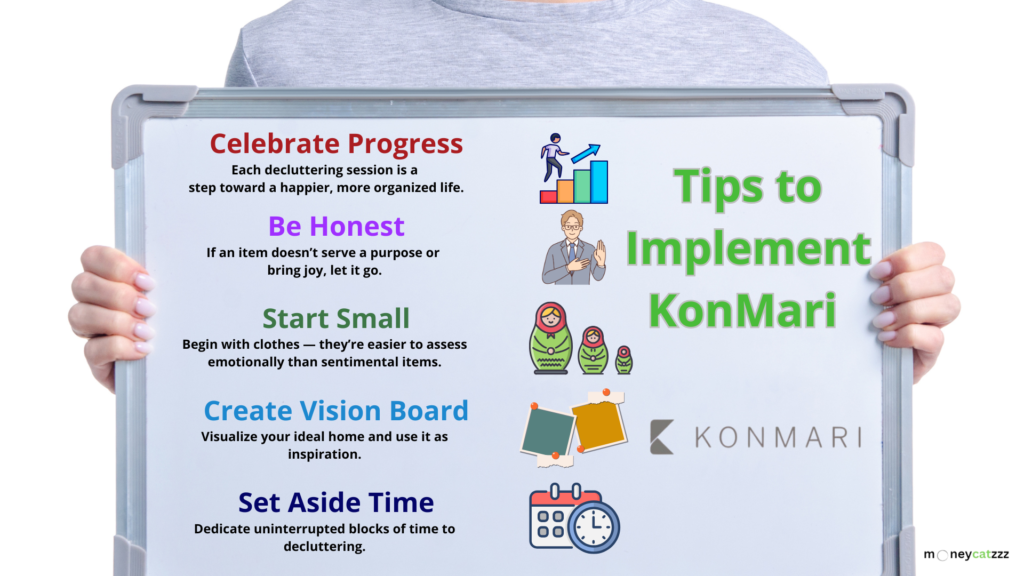
[“Practical Tips to Implement The KonMari Method” – moneycatzzz.com]
Why Joy Is a Strategy, Not a Luxury
Some people dismiss “sparking joy” as naive or unrealistic. But joy is a radical act of discernment in a noisy, overstuffed world. It’s a declaration that your time, energy, and space matter.
You don’t need a bigger house, more storage bins, or a minimalist aesthetic. You need one small shift in perspective: You deserve to live in a space—and a life—that reflects what you value most.

Final Thought: The Courage to Let Go
At its core, the KonMari Method isn’t about perfection or aesthetics. It’s about emotional honesty. It asks you to stop and listen—not to trends, advertisements, or yourself.
As Marie Kondo puts it:
“The question of what you want to own is how you want to live your life.”
So—how do you want to live?
Your home is the backdrop to your life. Make it one that supports your growth, reflects your joy, and empowers you to move through the world with less noise and more clarity.
Start small. Start today. Start with what no longer serves you.
Because on the other side of that drawer, that closet, that clutter—is freedom.
Disclosure: This post may contain affiliate links. We only recommend products we believe in, and We may receive a commission at no cost to you! Thank you for your support!
Acknowledgement: Cover Image by Michael Schwarzenberger from Pixabay
Disclaimer: The information is provided for general information only – moneycatzzz.com makes no representations or warranties in relation to the information, including but not limited to any representation or warranty as to the fitness for any particular purpose of the information to the fullest extent permitted by law. While every effort has been made to ensure that the information provided in this article is accurate, reliable, and complete as of the time of writing, the information provided in this article should not be relied upon to make any financial, investment, real estate or legal decisions. Additionally, the information should not substitute advice from a trained professional who can take into account your personal facts and circumstances, and we accept no liability if you use the information to form decisions.