
 Reading Time: 8 mins #
 This post may contain affiliate links.
The Mirage of the Clean Boardroom
Cash flow is optimized. Margins are secure. On the wall, the automated reporting dashboards flash nothing but clean, reassuring green numbers. On paper, the enterprise has arrived at the exact coordinates the partners sketched onto a napkin five years ago. Yet, when you sit across from the CEO in a room that smells of high-end millwork and expensive espresso, you do not see an operator in command of a triumph. You see an arsonist looking for a match.
They call me in to audit operations when the numbers don’t make sense. The financials scream growth, but the underlying cultural floorboards are completely warped. Look closely, and you notice the leadership team executing tasks with a flat, mechanical precision. Corporate momentum? Long gone AWOL. It is a clinical manifestation of dull motivation operating as a slow march toward an open grave.
External breakdowns are never structural novelties. They are simply the physical projection of a compromised internal blueprint. The partners stare at the flashing monitor, ignore the record profit margins, and whisper a quiet, terrified question: Why does everything feel so entirely dead?
The response won’t be found in your quarterly marketing spend or a sudden shift in consumer sentiment. The rot runs much deeper. It lives in how you have systematically dressed your motivation to protect yourself from the terrifying vulnerability of a quiet room.
The Expiration of the Novelty Subsidy
In the early stages of an enterprise, every operator runs on a psychological grant called the novelty subsidy. This is a period where chaos behaves as a natural stimulant. The threat of immediate bankruptcy, the erratic behavior of early clients, and the desperate scramble to achieve product-market fit all conspire to keep your central nervous system completely flooded with adrenaline.
During this frantic launch phase, you do not need an internal blueprint because the external environment handles the acceleration for you. The house is on fire, so you run. It is simple, visceral, and highly efficient survival.
The crisis occurs when the fire actually goes out.

Once the systems stabilize, the novelty subsidy expires. The wild, high-friction current of the early days transforms into a quiet, predictable infrastructure. This transition is where the sharpest founders collapse into a state of deep, unexplainable operational stagnation.
Certain systems break down entirely when they are deprived of stressors. In Antifragile, Nassim Nicholas Taleb maps this exact systemic decay: strip away the daily emergencies, and the operational ecosystem goes completely silent.
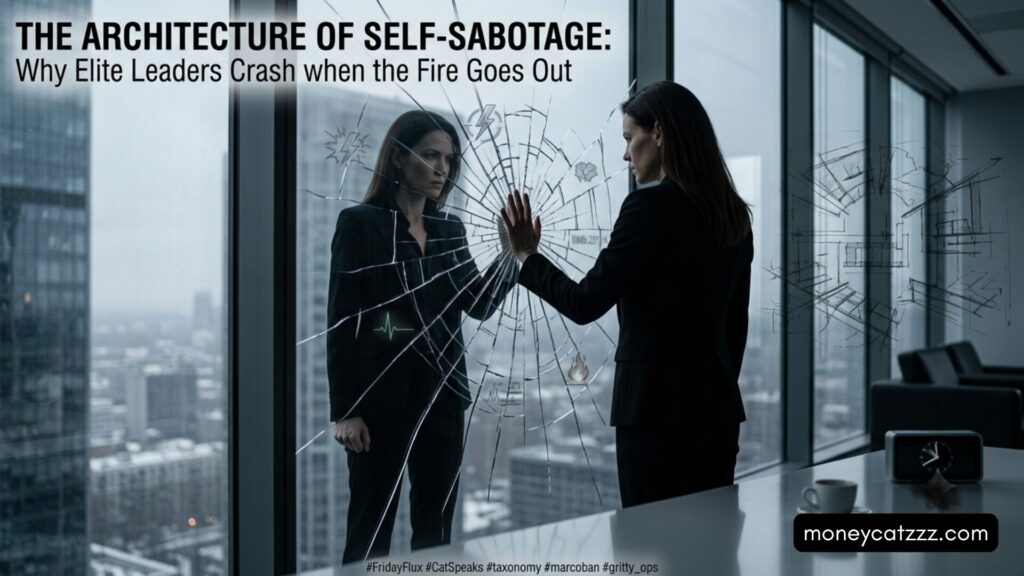
For an elite operator hooked on the chemical highs of early-stage crisis management, that hard-won peace feels terrifyingly unnatural. They look at a stable horizon and misdiagnose structural health as absolute paralysis. Trapped behind a dirty mirror, they mistake the mere absence of immediate trauma for a complete loss of personal trajectory.
[The Self-Sabotage Fallacy Trap| moneycatzzz.com]
The Taxonomy of Dressed Motivation
To fix a machine, you must call out the component failures without relying on the soft, hollow language of corporate human resources departments. When elite operators feel their internal drive begin to fracture, they immediately dress the word “motivation” with various clinical modifiers. They use these linguistic screens to mask a deeper architectural rot.
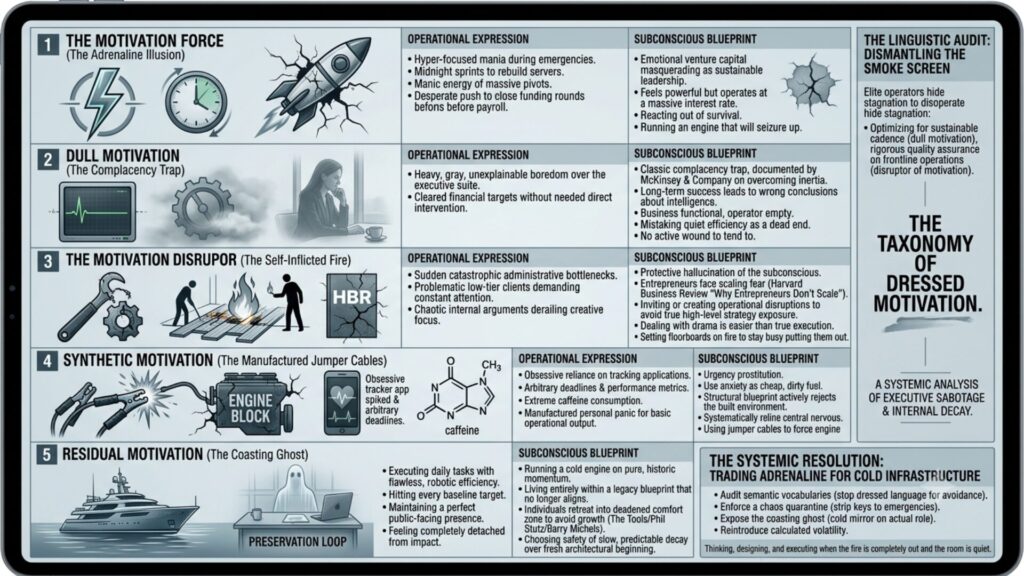
Through the lens of behavioral patterns, we can map this decay across five distinct structural states.
1. The Motivation Force (The Adrenaline Illusion)
- The Operational Expression: This is the hyper-focused, high-velocity mania that takes over during an emergency. It is the midnight sprint to rebuild a broken server, the manic energy of a massive pivot, or the desperate push to close a funding round before the payroll account dries up.
- The Subconscious Blueprint: This is emotional venture capital masquerading as a sustainable leadership strategy. It feels incredibly powerful because it mimics the raw speed of genuine vision, but it operates at a massive psychological interest rate. You are not building a sustainable asset; you are simply reacting out of survival. If your primary leadership tool is the sheer kinetic output of your own exhaustion, you are running a high-friction engine that will eventually seize up.
2. Dull Motivation (The Complacency Trap)
- The Operational Expression: A heavy, gray, unexplainable boredom that settles directly over the executive suite the moment the business begins to clear its financial targets without needing the founder’s direct intervention.
- The Subconscious Blueprint: This is the classic complacency trap that quietly dismantles successful operations. As documented in comprehensive organizational studies by McKinsey & Company on overcoming inertia, long-term success often leads organizations to draw the wrong conclusions about their own intelligence, causing them to fall off a performance cliff. When the daily fires stop, the operator must face the reality that they used the chaos of the startup to run away from their own identity. The business is functional, but the operator is empty. They misdiagnose the quiet efficiency of a stable machine as a personal dead end because they do not know how to exist without an active wound to tend to.
3. The Motivation Disruptor (The Self-Inflicted Fire)
- The Operational Expression: The sudden appearance of endless, catastrophic administrative bottlenecks, problematic low-tier clients who demand constant attention, or chaotic internal arguments that completely derail your high-stakes creative focus.
- The Subconscious Blueprint: a protective hallucination manufactured entirely by the subconscious mind. When an entrepreneur faces the terrifying reality of scaling a business, their narrow, intense focus can easily transform from an asset into a direct hindrance, a phenomenon analyzed in depth in the classic Harvard Business Review study “Why Entrepreneurs Don’t Scale.” Rather than doing the difficult, high-leverage work of transitioning from working on things to managing systems, the founder purposefully invites or creates operational disruptions. Dealing with a messy, dramatic crisis is vastly easier than sitting with the intense exposure of executing a true high-level strategy. You set your own floorboards on fire to stay busy putting them out.
4. Synthetic Motivation (The Manufactured Jumper Cables)
- The Operational Expression: An obsessive reliance on external tracking applications, arbitrary deadlines, performance metrics, extreme caffeine consumption, and manufactured personal panic to force basic operational output.
- The Subconscious Blueprint: This is urgency prostitution. When your baseline alignment with the enterprise is completely hollow, you are forced to use anxiety as a cheap, dirty fuel source. If you have to systematically reline your central nervous system to sit down and review your quarterly tax obligations or answer your executive communications, your structural blueprint is actively rejecting the environment you built. You are using the jumper cables of anxiety to force an engine to turn over, even though the block itself is completely cracked.
5. Residual Motivation (The Coasting Ghost)
- The Operational Expression: Executing daily tasks with flawless, robotic efficiency, hitting every baseline performance target, and maintaining a perfect public-facing presence while feeling completely detached from the actual impact of the work.
- The Subconscious Blueprint: This is running a cold engine on pure, historic momentum. You are living entirely within a legacy blueprint that no longer aligns with your current intelligence, capacity, or personal evolution. In their transformative psychological text The Tools, Phil Stutz and Barry Michels discuss how individuals frequently retreat into a deadened comfort zone to avoid the pain of true personal expansion. The operator remains inside the preservation loop because exiting the established entity requires an honest, messy ending. They choose the safety of a slow, predictable decay over the disruptive reality of a fresh architectural beginning.
[The 5 Taxonomy of Motivation | moneycatzzz.com]
Dismantling the Smoke Screen
Elite operators are incredibly intelligent creatures, which makes them uniquely dangerous to themselves. When their internal engine stalls, they do not simply sit on their hands. Instead, they perform a linguistic audit in reverse, dressing their stagnation in highly sophisticated, modern terminology to avoid the painful scrutiny of a clean mirror.
They do not admit to experiencing dull motivation. Instead, they tell their board that they are optimizing for sustainable cadence or entering a season of strategic consolidation. They do not acknowledge that they have become a walking disruptor of motivation. They claim they are conducting rigorous quality assurance on frontline operations.
This linguistic dressing allows the operator to protect their ego while their machine slowly rots from the inside out. They create complex operational definitions for what is ultimately a very simple problem: they are terrified of the space that opens up when a business actually succeeds. They have built an incredibly efficient cage, and because they do not know how to step outside of it—they spend their days re-polishing the brass bars.

Trading Adrenaline for Cold Infrastructure
If you are operating within these compromised blueprints, a wellness retreat or another superficial book on executive performance won’t fix the damage. You must systematically dismantle the old engine and rebuild your operational infrastructure from the floorboards up.
- Audit the semantic vocabularies: Stop using soft, dressed language to mask your operational avoidance. If you are deliberately dragging your feet on a critical executive hire because you secretly love being the indispensable hero of your tech stack, stop calling it a “deliberate talent acquisition strategy.” Call it what it is: an intentional bottleneck engineered to make you feel relevant.
- Enforce a chaos quarantine: If you are hooked on the manic rush of the motivation force, strip yourself of the keys to live emergencies. Hand tactical control to an operations director whose central nervous system isn’t addicted to crisis. Force yourself to sit in the quiet room until you learn how to pilot a stable ship without setting your own sails on fire.
- Expose the coasting ghost: Hold a cold mirror up to your actual role. If you are coasting on residual motivation, either design an explicit exit strategy or inject genuine, calculated volatility back into your growth models. Get out of the comfort zone. Step back into the space where failure is a real, visceral threat.
The ultimate measure of an elite leader is not how fast they run when the building is burning. It is how clearly they think, design, and execute when the fire is dead out and the room is perfectly quiet.
The smoke has cleared. Now step out of the cage, or admit you just like polishing the bars.
_______________________________________________
Reading List: Core Blueprints to Transform Dull Motivation for the Elite Operator
Turning Pro

The Tools

Antifragile



Disclosure: This post may contain affiliate links. We only recommend products we believe in, and we may receive a commission at no cost to you! Thank you for your support!
Acknowledgment: Cover Image by moneycatzzz.com
Disclaimer: The information is provided for general information only – moneycatzzz.com makes no representations or warranties in relation to the information, including but not limited to any representation or warranty as to the fitness for any particular purpose of the information to the fullest extent permitted by law. While every effort has been made to ensure that the information provided in this article is accurate, reliable, and complete as of the time of writing, the information provided in this article should not be relied upon to make any financial, investment, real estate or legal decisions. Additionally, the information should not substitute advice from a trained professional who can take into account your personal facts and circumstances, and we accept no liability if you use the information to form decisions.