 Reading Time: 8 mins #
 This post may contain affiliate links.
The air outside the trattoria on Greenwich Village’s Carmine Street was sharp with late-autumn frost. Inside, the room was a dense fog of roasted garlic. Loud voices competed with the heavy scent of spilled house red wine. It was a cramped basement Italian joint. The tables were placed close enough to make private conversation a public performance, exposing the quiet irony of our heavily guarded urban lives.
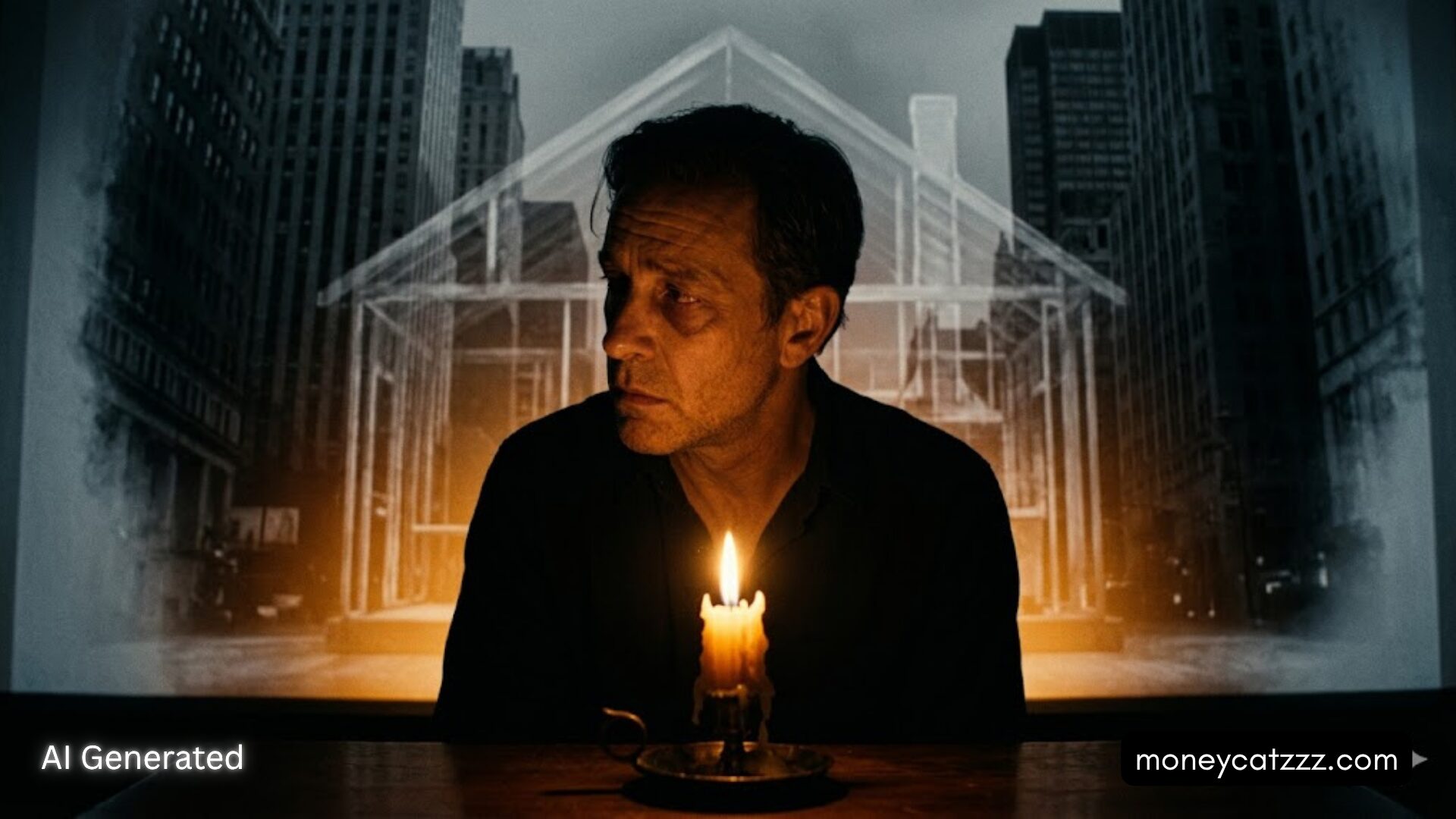
David sat across from me. His fingers nervously traced the chip on the rim of his heavy ceramic water glass. He looked forty-one going on fifty. The harsh incandescent amber glow of the low-burning candle between us caught the deep, permanent bracket lines around his mouth. It illuminated the dark shadows under his eyes. He had just finished a grueling matinee.
David is a journeyman stage actor. His face is a familiar landmark to anyone who watches off-Broadway theater. He is a reliable craftsman who routinely memorizes the entire script to understand his own spacing on the floorboards.
Tonight, he looked completely depleted. He spoke with the desperate, ragged cadence of a man who was physically running out of air.
The Fifth Curtain Call
“We had five curtain calls this afternoon,” David said. His voice dropped into a low, gravelly register that barely cut through the restaurant’s din. He took a slow, deliberate sip from a carafe of cheap Chianti. “Five.”
Most people look at a five-curtain-call ovation as the absolute peak of artistic validation. To David, it felt identical to an administrative detention.
He explained the mechanics of the trap. After a brutal, three-hour performance of an emotional demolition derby, the curtain falls. The lights snap up. The audience erupts. You walk out. You bow.
Then you step backward into the wings. You expect the house lights to come on so you can wash the greasepaint off your face. Instead, the applause intensifies.
The stage manager waves you back out. You step into the blinding heat of the spotlights for a second time. Your costume is soaked with sweat. Your throat feels like sandpaper.

By the fifth time the curtain rises, the applause transforms into a hostage situation. The gift becomes a demand.
You cannot leave the theater. Walking off while a crowd is clapping looks professionally suicidal. So you stand there frozen. Your mouth is stretched into a rigid, artificial mask of humble gratitude.
“The funny thing about it,” David said, leaning over his plate of rigatoni, “is that you keep bowing because it’s the easiest way to make them stop. You smile, and you take the applause, because as long as you’re playing the part, nobody asks you how you’re actually doing.”
The Shadow in Astoria
I listened to him in silence. My mind drifted to the profound contradiction running through his life offstage.
David lives in a tiny, rent-stabilized apartment in Astoria, Queens. The radiator clanks all night. The shelves are stacked with yellowing scripts he will never perform again. The economic reality of his existence is an ongoing exercise in hyper-vigilance. He survives on a volatile diet of regional stage gigs and low-budget commercial voice-overs.
Every single month is a desperate calculation. He watches his bank account to see if his residuals will clear in time to maintain his union health insurance. It is a suffocating contradiction to spend your afternoon speaking the high poetry of Arthur Miller, only to spend your evening dodging calls from a collections agency over a past-due electric bill. He is a man constantly treading water, knowing that a single slow week will pull him under.
Yet, a completely different script takes over when he calls his aging parents back in Ohio. His family operates on a comforting delusion. They believe their son is on the verge of breaking big in New York City. They treat his three-second television clips as Hollywood premieres.

[The Mask on the Wire | moneycatzzz.com]
David has spent the last fifteen years perfecting a secondary character to protect their pride. Offstage, he plays the role of the Prospering New York Artist.
He speaks with casual bravado about callbacks that led nowhere. He exaggerates his creative intimacy with directors. He spins his exhausting, low-wage hustle into a romantic narrative of bohemian dedication.
His family has absolute, uncritical trust in this manufactured persona. They believe the front. The alternative reality is too painful for either side to bear. David’s entire personal life has become a highly managed production. It is a piece of public relations designed to simulate a stability he has never actually possessed.
The Anatomy of the Irony
This is where the true, devastating irony of David’s life snaps completely shut.
The play he was performing that afternoon in the Village was Arthur Miller’s Death of a Salesman. David was playing Biff, the eldest son.
For three hours every day, David steps under the hot lights to inhabit a character whose entire psychological existence is an agonizing battle against a false family narrative. Biff Loman is a man suffocating under the weight of his father’s delusional expectations. He has been forced to perform the role of the magnificent, golden boy destined to conquer the corporate world.
In reality, Biff is a lost soul. He is a drifter who steals fountain pens from job interviews because he cannot face his own limitations. The entire climax of Miller’s tragedy hinges on Biff screaming at his father to stop the performance. He begs the family to face the terrifying simplicity of the truth.
Every night, David stands on that stage and delivers Biff’s desperate, weeping plea: Pop, I’m nothing! I’m a dime a dozen, absolute, unconditionally nothing!
He pours his actual, lived desperation into that line. He channels the real panic of his Astoria apartment into Biff’s agonizing confession. The audience watches this exposure of human fragility and responds with a standing ovation.
Then, David steps out to the edge of the stage for the fifth time. He drops Biff’s hard-won honesty. He resets his face into a pristine, confident smile. He uses the crowd’s applause to reinforce the exact lie he is living in his real life.
David has to maintain total, unyielding control over his public image to survive the expectations waiting for him back home. The absolute irony is staggering. He earns his weekly rent by brilliantly executing a masterpiece about the destructive violence of maintaining a false front. Then, he steps out of the stage door and uses the validation of that applause to sustain his own false front off the stage. The irony grows heavier with every single ticket sold. The play demands that he expose the lie of performance, yet his actual life demands that he keep performing.
The Illusion of Visibility
This isn’t just a personal quirk of David’s mind. It is simply how the world works now for so many of us. We have created a culture that pays very little attention to who a person actually is inside, while lavishing love and rewards on how bright they can shine on the outside.
The real heartbreak of it is that this constant hustle to look okay completely ruins our ability to rest.
When the people you love care more about the milestones than the actual person living through them, you feel like you don’t have a choice anymore. You become an actor in your own life to protect them. You learn to smile on cue, and you learn to look like you’re thriving even when you are completely hollow inside.
To satisfy his parents’ constant, anxious scrutiny, David’s energy has shifted completely away from the pure craft of acting. He is trapped in a second loop of performance, where his daily efforts are no longer measured by his growth as an artist, but by how cleanly he maintains the illusion of success for the audience back home.
The devastating irony of David’s situation is that the applause he craves is the very thing trapping him. We perform the irony of our public roles while hiding the decay beneath.
After a while, you lose your footing entirely. It is impossible to trust your own worth when you feel like your whole life is just a test you are about to fail.

[The Domestic Theater | moneycatzzz.com]
You stop moving forward because you care about where you are going. You keep moving because you are terrified of what happens if the people watching notice you have stopped. This endless pressure replaces a real sense of purpose with a desperate, quiet routine of just keeping up appearances.
When looking successful becomes the only thing that matters, a human life is treated as nothing more than a theatrical prop.
The Escape and the Silence
The dinner was winding down. With the carafe of Chianti long empty, the leftover pasta had begun to congeal into cold streaks of red sauce on our plates. Around us, the restaurant had thinned out to almost nothing, leaving only the murmur of the kitchen staff preparing to close up for the night.
“I don’t know how much longer I can keep the show running,” David said. He stared down at his hands. “The script is getting too heavy to carry outside the stage door.”

It takes immense courage to trust that the messy reality of your life is safer than a beautiful illusion. It means accepting that the best parts of being human can never be measured, tracked, or put on display for someone else’s approval. That realization is what finally breaks the cycle of external control. To liberate yourself from that surveillance, close the gap between the performer and the person.
David needs to let the applause stop. He needs to step off the platform and allow the hot lights to go dark. The ensuing silence will feel incredibly strange, an absolute void after fifteen years of chasing the roar of the crowd. Yet, that cold, unscripted quiet is the only honest sound left in the city. The final irony is that his actual life begins right there.
We paid the check and stepped out onto Carmine Street. The cold air hit us like a physical blow.
“Hey, David,” I called out before he reached the subway stairs. He stopped, turning his collar up against the wind, and looked back at me. “You don’t have to keep the house lights up for everyone else anymore. Just leave the ghost light on for yourself. That’s enough.”
A small, genuine smile finally broke through the tired lines of his face. He didn’t say anything, but he gave me a brief, tight nod.
I watched his silhouette disappear into the subterranean steps. He adjusted his shoulders, resetting his posture for the New York sidewalk, and stepped right back into the next scene of his unwritten play.
______________________
The Arthur Miller Collection


Death Of A Salesman
The Arthur Miller Tapes
Disclosure: This post may contain affiliate links. We only recommend products we believe in, and we may receive a commission at no cost to you! Thank you for your support!
Acknowledgment: Cover Image by moneycatzzz.com
Disclaimer: The information is provided for general information only – moneycatzzz.com makes no representations or warranties in relation to the information, including but not limited to any representation or warranty as to the fitness for any particular purpose of the information to the fullest extent permitted by law. While every effort has been made to ensure that the information provided in this article is accurate, reliable, and complete as of the time of writing, the information provided in this article should not be relied upon to make any financial, investment, real estate or legal decisions. Additionally, the information should not substitute advice from a trained professional who can take into account your personal facts and circumstances, and we accept no liability if you use the information to form decisions.