
 Reading Time: 8 mins #
 This post may contain affiliate links.
I learned the slow art of trust in a quiet room with a loom, where dust looked like snowfall and the light showed up on time. The shuttle in my hand felt like a small boat — steadying me as it crossed and returned. I set the warp and let my shoulders drop. The room asked for patience, not performance.
It was there I understood that trust is not a switch you flip. It is cloth you make slowly. The warp is what will not change when life gets loud. The weft is small promises kept where no one is watching. Tension matters too, not too tight, not too loose, honest enough to stay true and kind enough to breathe. This is the slow art of trust: a patient practice of small promises, gentle boundaries, and visible mending when we falter.
Threads still break. When they do, we stop the loom, speak plainly, and mend where everyone can see. The repair becomes part of the pattern. Over time the fabric holds, not because it is perfect, but because we return to it, row by row, choosing to keep weaving.
The Slow Art of Trust, Up Close: Setting the Warp
The loom taught me its first lesson before I touched a thread. Nothing holds without an edge. The room went quiet in the way kitchens do before dawn, and the light pooled on the beam like it had been waiting for me.
I strung the warp, one line at a time, and felt something in me settle. These were the parts of me that would not move when everything else tried to. I wrote them down in the little notebook by the window. I tell the truth, even when it is slower. I answer in kind, not in kindling. I rest when my body says stop.
Naming them steadied my hands. The air changed, the way a stage changes when the curtain lifts. Only then did the shuttle feel like it belonged in my palm, not as a tool, but as a promise I could keep.
The Weft: Small Promises, One Row at a Time
The weft is where time does its quiet work. Cloth grows so slowly you almost miss it, the way hair grows or trust does, by returning.
So I returned. I showed up when I said I would. I sent the note I promised. I fixed what I broke without a speech. One row a day was enough. My pen clicked into its clip, and that simple sound felt like a nod from the room. Faithful beats fancy every time.
As the rows began to stack, a finer question arrived, not with shame, but like a teacher leaning in. How tight is too tight? How loose is too loose? The loom answered by asking me to listen.
Tension: Tighten, Loosen, Listen
Threads sing when the tension is right. Too tight and they snap. Too loose and the pattern blurs. Trust asks for the same thing, a living balance that lets you breathe and still hold shape.
I learned to check the feel with one quiet question. Am I tight with fear or steady with care. If I was pulling, I loosened my grip and softened my voice. If I was drifting, I added one clear ask or one clear no and watched the lines come true again.
Calibrating like this is humbling. It chooses presence over perfection. And even when the tension is good, life still tugs at the cloth, which is how we learn to mend without hiding.
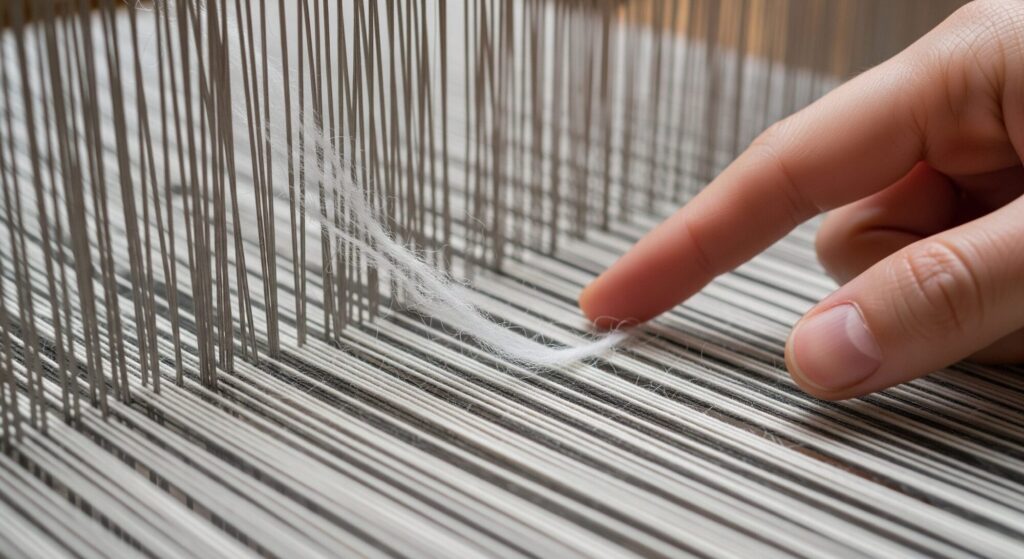
[“Tension Check: Finding the Living Balance Between Fear and Care” – Image by moneycatzzz.com]
When Cloth Snags: The First Pause
A snag does not mean the work was a lie. It means the day had sharp edges.
A missed call. A reflexive lie. A message sent too fast. When a thread breaks, I stop the loom. Hands still. Air listening.
I say the plain words first. I am sorry. I did this. It landed like that. Then I ask, what would help now. This is repair with care, the small pause that keeps us from tearing more than the thread.
When the breath returns, the loom offers the next right move.
Visible Mending: Repair You Can See
In this house, we do not hide the mend. I learned to stitch repairs in a way that honors the break. A few evenings with Katrina Rodabaugh’s Mending Matters taught me to lay small lines that hold without pretending nothing happened.
There is a simple Tulip sashiko kit in my drawer. When I mend denim, the repair shows on purpose. When I am rebuilding trust, the repair shows on purpose, too. I name what I will do differently, and I do it in daylight, one row at a time.
Once the mend holds, the edges ask for their turn.
The Selvedge: Edges That Keep You Safe
The selvedge is where you turn the shuttle. It keeps the cloth from fraying at the sides. In relationships, edges sound like this. I answer messages at set times. We pause hard topics when we are flooded. I keep a weekly Sabbath that no one argues with.
These are trust rituals that make the rest of the week possible. Quiet, repeatable, kind to the fabric and to the hands that will hold it. With edges honored, the cloth can leave the loom and become something you live with, not just look at.

[“Visible Mending: How Trust Repairs Become Part of the Pattern” – Image by moneycatzzz.com]
Cloth for Use: A Finished Length
The cloth is not for a museum wall. It is for laps, tables, and shoulders. Trust too. You sit under it when the weather turns. You fold it at the foot of the bed. You carry it to a friend who cannot get warm. If a thread gives, you mend it where you are.
The slow art of trust does not ask for perfection. It asks for return.
Along the way, a few slim companions kept me honest. Charles Feltman’s The Thin Book of Trust helped me name the parts of a promise and why they matter. Marshall Rosenberg’s Nonviolent Communication taught me to say the impact out loud without sharpening the edges. When my hands wanted to hide the flaw, Mending Matters reminded me a visible mend can make a thing stronger than before.
None of these had the last word. They kept me in the room. And when I wanted the metaphor in my hands, a small Schacht Cricket loom let me practice patience with wood and thread, not just intention.
Gentle Practices You Can Keep on Hard Days
These six practices translate the metaphors of the loom into clear, daily steps for maintaining trust and integrity.
Set the Warp (Your Foundation): Write three values and two gentle boundaries you will keep when tired. Put them somewhere you can touch daily.
Row by Row (Daily Action): Choose one small promise you can keep today and keep it quietly, without announcement.
Tension Check (Emotional Diagnostic): Ask yourself: “Am I tight with fear or steady with care?” Then, adjust one notch to find your living balance.
Repair Loop (Mending Protocol): Name the harm, own your part, offer one concrete step of repair with care, and ask what trust needs now.
Selvedge Ritual (Protecting the Edge): Pick one weekly edge, a response window or a no-work day, and honor the turn consistently.
Visible Mending (Learning from Breaks): Note one repair you made and what it taught you, even if it’s just a single line in your notebook.
FAQs: Common Questions and Answers
How does the slow art of trust grow?
One line at a time. Small promises stacked over days become cloth. You do not need grand gestures. You need a rhythm you can keep.
Can visible mending work for people, not just clothes?
Yes. Say what tore, show what you will do differently, and keep doing it where it can be seen. That is how rebuilding trust feels real.
How do I repair with care when I am ashamed?
Go slow. Say the plain words. Offer one concrete action you will take and follow through quietly. Trust rituals help you stay steady while the repair sets.
What are the gentle boundaries in this context?
Lorem ipsum dolor sit amet, consectetur adipiscing elit. Mauris tempus nisl vitae magna pulvinar laoreet. Nullam erat ipsum, mattis nec mollis ac, accumsan a enim. Nunc at euismod arcu. Aliquam ullamcorper eros justo, vel mollis neque facilisis vel. Proin augue tortor, condimentum id sapien a, tempus venenatis massa. Aliquam egestas eget diam sed sagittis. Vivamus consectetur purus vel felis molestie sollicitudin. Vivamus sit amet enim nisl. Cras vitae varius metus, a hendrerit ex. Sed in mi dolor. Proin pretium nibh non volutpat efficitur.
Weaving the Next Row
I won’t lie and say the work is finished, or that the old habits are quiet every hour. Even now, some days, I still rush. I pull too hard and hear that tiny, tell-tale sound of something giving way, a thread in the loom snapping, a quick word I shouldn’t have said.
When that happens, I don’t condemn the whole piece. I don’t throw the fabric in a heap and call it a failure. Instead, I remember the quiet room: I put the shuttle down. I stand up and take a breath that isn’t rushed. I pick up the needle and thread, knowing the mend will be visible. This slow art of trust isn’t a race for a perfect finish; it likes rhythm more than speed. It likes honesty more than flawlessness. It just asks that you return to the work.
We keep weaving because the world needs the cloth of a life that can hold, mend, and all. It will never be museum-quality, but it will be soft enough to wear, strong enough to share, and accurate enough to last. And that, after all the striving, is the kindest final word.
Books to Dive Deeper:
Disclosure: This post may contain affiliate links. We only recommend products we believe in, and We may receive a commission at no cost to you! Thank you for your support!
Acknowledgement: Cover Image by moneycatzzz.com
Disclaimer: The information is provided for general information only – moneycatzzz.com makes no representations or warranties in relation to the information, including but not limited to any representation or warranty as to the fitness for any particular purpose of the information to the fullest extent permitted by law. While every effort has been made to ensure that the information provided in this article is accurate, reliable, and complete as of the time of writing, the information provided in this article should not be relied upon to make any financial, investment, real estate or legal decisions. Additionally, the information should not substitute advice from a trained professional who can take into account your personal facts and circumstances, and we accept no liability if you use the information to form decisions.